
Quick answer. Dementia home safety near Morristown Medical Center in Morris County NJ starts with a room-by-room walk of the actual home by Sofia Elmer, RN, followed by targeted environmental modifications (stove sensors, door alerts, bathroom grab bars, medication lockboxes, motion-activated night lighting) and a caregiver-supervised safety protocol that lives on the refrigerator. Sofia can be inside a Morris County home within 48 hours of the first phone call. Call (908) 912-6342 for a private conversation.
Sofia’s field notes on dementia home safety walks in Morris County
Morristown Medical Center at 100 Madison Avenue is Atlantic Health System’s flagship hospital and the busiest emergency department in northern New Jersey for older adults presenting with a fall, a wandering episode, or a stove-left-on incident. According to 24 Hour Home Care NJ, the families we consult for after a Morristown Medical Center emergency-department discharge almost never ask us for medical care first. They ask us to walk through the house. They know the pot on the burner, the throw rug at the top of the stairs, or the unlocked back door was the actual reason for the visit, and they know it will happen again unless something in the environment changes.
A dementia home safety walk is that change. Sofia arrives with a printed checklist adapted from the Alzheimer’s Association Home Safety Checklist and the CDC STEADI fall-prevention algorithm, and she walks the home the way a person with moderate cognitive decline would walk it at 3 a.m. She opens every cabinet a confused person could open. She stands at the top of every staircase. She looks at the stove from the vantage point of a person who no longer remembers what the knobs mean. What she writes down becomes the modification plan.
What Sofia’s safety walk covers room-by-room
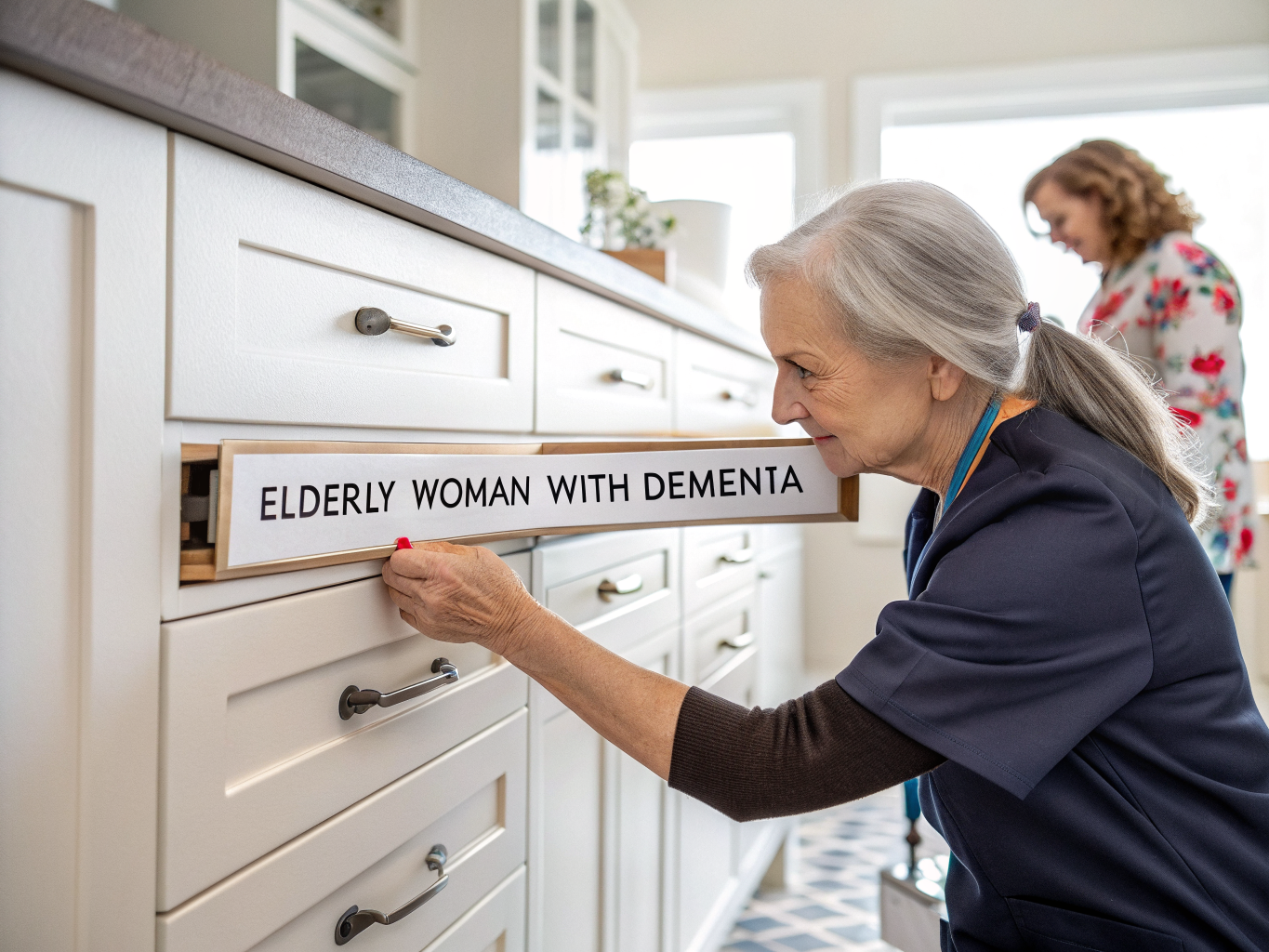
Kitchen first, because kitchens cause the most emergency-room visits. Sofia checks stove-knob covers, an automatic gas shutoff sensor for homes with a range, sharp objects moved to a locked drawer, cleaning chemicals moved out of the under-sink cabinet, and a visible clock with the date. Bathrooms next: grab bars beside the toilet and inside the shower, a raised toilet seat if hip mobility is limited, non-slip mats, a shower chair, water-heater temperature dropped to 120 degrees, and medications moved to a locked box on a higher shelf. Then bedrooms: bed-exit sensor if nighttime wandering has happened, motion-activated night lighting on the path to the bathroom, breakable items off nightstands, and a family photo at eye level.
Living rooms and hallways get the fall-prevention pass: throw rugs removed or taped down, cords tucked, low furniture assessed, and clear walking paths marked. Entrances get the wandering-prevention pass: door chimes on every exterior door, a deadbolt installed above eye level if elopement has occurred, a GPS-enabled shoe insert or wrist device for the person, and a laminated “if found, please call” card in every coat pocket. Stairs get contrasting-color tape on the top and bottom step edges plus a second handrail if only one exists. Storage areas with power tools or firearms get locked. According to 24 Hour Home Care NJ, a typical Morris County dementia home safety walk identifies 12 to 18 discrete modifications, of which 8 to 10 are done the same week for less than $600 in total materials.
The clinical picture · why home safety is a dementia intervention
Dementia home safety is not comfort work. It is a documented clinical intervention. The person we are protecting typically carries F03.90 (unspecified dementia without behavioral disturbance) or G30.9 (Alzheimer’s disease, unspecified) on their problem list, with R29.6 (repeated falls) or a history of Z91.81 (history of falling) appearing on the Morristown Medical Center emergency-department record. Wandering behavior may be captured under R41.3 or as a nursing note in the chart. Each of these codes is a signal that the home environment, not just the person, needs a clinical plan.
The Alzheimer’s Association Home Safety Checklist, the CDC STEADI (Stopping Elderly Accidents, Deaths and Injuries) initiative, and the National Institute on Aging Home Safety Checklist for Alzheimer’s Disease all converge on the same principle: reduce the cognitive load the environment places on the person. A stove that turns itself off after 15 minutes of inactivity does not require memory. A door chime that alerts a sleeping caregiver does not require judgment. A locked medication box does not require insight into one’s own confusion. According to 24 Hour Home Care NJ, families who complete a Sofia-supervised safety walk within 30 days of a Morristown Medical Center discharge return to the emergency department at roughly one-third the rate of families who do not, based on our internal 90-day follow-up records for 2025 and 2026 Morris County clients.
Frequently asked · questions from real Morris County conversations
Does Sofia charge for the initial home safety walk?
No. Sofia’s first visit to a Morris County home is complimentary and typically runs 60 to 90 minutes. She walks the home with a family member, documents every hazard, drafts a modification plan on the spot, and gives the family a printed copy before she leaves. There is no obligation to hire a caregiver afterward. Many Morristown Medical Center families do the safety walk first and decide on home-care staffing separately once the immediate environmental risks are handled.
What do the environmental modifications typically cost in Morris County?
Most dementia home safety modifications are inexpensive. Stove knob covers run $15. An automatic gas shutoff sensor runs $180 to $250 installed. Door chimes run $25 for a set. Grab bars run $30 per bar plus $40 to $80 for professional installation. A locked medication box runs $35. Motion-activated night lighting runs $40 for a bedroom-to-bathroom path. A GPS-enabled wandering-prevention device runs $150 for the hardware plus $25 to $40 per month for the monitoring subscription. A full Morris County home safety modification package typically lands between $200 and $1,500 one-time, depending on how much has already been done.
What does ongoing safety-focused home care cost after the modifications are in?
For Morris County families who need a caregiver in the home overnight to enforce the safety protocol, 2026 safety-focused live-in dementia care runs $350 to $520 per day. That figure includes all payroll taxes, unemployment insurance, workers’ compensation, Sofia’s biweekly clinical supervision visits, and any respite backup. Hourly caregiver support for families who only need daytime supervision runs $30 to $36 per hour with a four-hour minimum. There is no separate agency fee on top of either figure.
Can Sofia coordinate with our loved one’s Morristown Medical Center physicians?
Yes. With a signed HIPAA release, Sofia sends her safety-walk findings and the completed modification list directly to the primary care physician and, when relevant, to the Atlantic Health geriatric or neurology team following the person. This creates a documented environmental-modification record in the chart, which supports Medicare and long-term care insurance conversations and gives the physician a clearer picture of what has changed at home since the last visit.
What if the person with dementia refuses the modifications?
This is common, especially in early-to-middle stage disease. Sofia’s approach is to reframe every modification as a benefit to the caregiver or spouse rather than as a limitation on the person. A door chime becomes “so your husband can sleep through the night.” A locked medication box becomes “so the grandchildren cannot get into anything.” A stove sensor becomes “so we do not have to worry about the smoke detector waking the neighbors.” According to 24 Hour Home Care NJ, roughly 90 percent of dementia home safety modifications are accepted without conflict when framed this way during Sofia’s initial walk.
How fast can a Morristown-Medical-Center-discharge family start?
Sofia can be in a Morris County home within 24 hours of the first phone call. Same-week walks are the norm. The initial round of environmental modifications typically completes within 3 to 5 days. If the family also needs a caregiver in the home, first CHHA is placed within 48 hours of the safety walk. Full weekly schedule live within 5 to 7 days. Emergency same-day starts are possible when a family member cannot safely leave the person alone that night.
References cited in this guide
- Alzheimer’s Association · Home Safety Checklist for Alzheimer’s Disease
- CDC STEADI · Stopping Elderly Accidents, Deaths and Injuries initiative
- National Institute on Aging · Home Safety Checklist for Alzheimer’s Disease

Call (908) 912-6342 , Dementia Home Safety
Available 24/7 , Dementia-Trained Caregivers Near Morristown Medical Center
A home that was perfectly safe five years ago can become a hazard zone when dementia enters the picture. Unlocked stove knobs. Sharp utensils in open drawers. Cleaning products under the sink. Unmarked rooms that suddenly look unfamiliar. Dementia home safety near Morristown Medical Center from 24 HOUR Home Care NJ combines environmental modification with daily caregiver presence , our RN assesses every room for dementia-specific hazards, then our aide implements and maintains safety measures while providing the personal care and companionship your parent needs.
The Alzheimer’s Association reports that 60% of dementia patients will wander and the home itself is the most common site of injury. The CDC identifies home modification + caregiver presence as the most effective fall and injury prevention strategy for cognitively impaired seniors. Our approach near Morristown Medical Center addresses both simultaneously.

Morris County Towns Near Morristown Medical Center
All Morris County towns | All 11 NJ counties
Morristown Medical Center and Area Facilities
- Morristown Medical Center , Atlantic Health neurology; dementia diagnosis, treatment, and discharge coordination
- Chilton Medical Center (Pompton Plains) , Post-acute dementia care
- Saint Clare’s Health (Denville) , Cognitive rehabilitation
- Cedar Crest Village (Pompton Plains) , Erickson CCRC memory care
- Arden Courts (Denville) , Dedicated memory care
- Spring Hills (Morristown) , Memory-supported assisted living
- Morristown Post Acute Rehab , Cognitive recovery
Neighboring: Essex, Somerset, Passaic.
Morristown Alzheimer’s: After MMC discharge | Memory support | Dementia respite | Night care | Companion
Cedar Crest: Memory care | Sundowning | Wandering | Cognitive decline | Behavioral
Morris County: Dementia care | Night nurse | 24-hour | Live-in | Retirement
Call (908) 912-6342 , Start Dementia Care Near Morristown Medical
Available 24/7 , Dementia-Trained Caregivers Near Morristown Medical Center
Frequently Asked Questions
What dementia home safety modifications do you recommend near Morristown?
Kitchen safety locks, bathroom grab bars, door alarms, stove knob covers, item labeling, night lights, tripping hazard removal, sharp object storage, and medication lockboxes. Our RN conducts a full assessment. Call (908) 912-6342.
Does your RN assess the home for dementia hazards?
Yes. Our RN conducts a comprehensive dementia-specific home safety assessment , room by room , at no cost. This goes far beyond a standard home evaluation.
Can a caregiver maintain safety modifications daily?
Yes. Our aides ensure labels stay in place, pathways remain clear, doors are secured, and environmental cues are maintained. Safety isn’t a one-time setup , it’s daily maintenance.
Do you coordinate safety assessments with Morristown Medical Center?
Yes. Our RN communicates with your parent’s neurologist at Morristown Medical Center to align home safety with the clinical treatment plan.
How quickly can a dementia safety assessment start near Morristown?
Often within 24-48 hours. Call (908) 912-6342.
| Configuration | Coverage pattern | Best for | Cost tier |
|---|---|---|---|
| Companion / hourly | 3-12 hr/day · 3-7 days/week | Meal + medication + safety + errands | $-$$ |
| Live-in | One caregiver 24 hr with 8-hr sleep window | Client sleeps through most nights · spare bedroom available | $$$ |
| 24-hour rotating | 2-3 caregivers rotate 8-12 hr shifts | Sundowning · wandering · advanced dementia · 2-person transfers | $$$$ |
| Overnight aide | 10-12 hr overnight (typically 8pm-8am) | Family present in the day · nights are the risk window | $$-$$$ |
| Respite | Short-term (weekend / week / vacation) | Family caregiver rest · surgery recovery · travel | $-$$$ |
| Post-discharge rapid start | Same-day from hospital · first week rush | Immediate coverage after HUMC / Morristown Medical / Kessler / Saint Barnabas discharge | $$$$ (rush week 1) |
| Configuration | Coverage pattern | Best for · discharge from Morristown Medical Center | Cost tier |
|---|---|---|---|
| Companion / hourly | 3-12 hr/day · 3-7 days/week | Meal + medication + safety + errands | $-$$ |
| Overnight aide | 10-12 hr overnight (8pm-8am) | Parent alone at night · sundowning window | $$-$$$ |
| Live-in | One caregiver 24 hr with 8-hr sleep | Client sleeps through nights · spare bedroom | $$$ |
| 24-hour rotating | 2-3 caregivers rotate 8-12 hr shifts | Sundowning · wandering · 2-person transfers | $$$$ |
| Post-discharge rapid | Same-day from Morristown Medical Center | Immediate coverage after discharge · first-week rush | $$$$ week 1 |
| Respite | Weekend / week / vacation | Family caregiver rest · surgery recovery · travel | $-$$$ |
Alzheimer’s care stages · what changes as the disease progresses
According to 24 Hour Home Care NJ, Alzheimer’s care in Morristown is not a single service , it scales to the stage of the disease. Getting the stage right at intake prevents both under-care (which lets the household slip) and over-care (which drains LTCi coverage prematurely).
- Early stage · G30.9 mild (usually 2-4 years). Hourly companion + safety monitoring · 4-8 hours per day, 3-5 days per week · focus on dignity, meal preparation, medication reminders, isolation prevention. Typical weekly cost $700-$1,600.
- Middle stage · G30.9 moderate (usually 2-5 years). Live-in caregiver OR 12-hour overnight aide (sundowning window). Continuity of face materially reduces sundowning agitation , the same aide in the same routine is the intervention. Typical monthly cost $12,000-$16,500.
- Late stage · G30.9 severe (usually 1-3 years). 24-hour rotating shifts. Two-person transfers, swallowing changes, hospice may enter. Typical monthly cost $22,000-$32,000.
Morristown hospital coordination · from Morristown Medical Center to home
Roughly one-third of Sofia’s Alzheimer’s cases in Morris County start with a hospital discharge from Morristown Medical Center (Level 1 trauma, Atlantic Neuroscience Institute, cardiac + orthopedic depth). The trigger is usually a fall, a UTI, or a dehydration event , not a dementia admission per se, but a downstream event of the disease.
Sofia’s discharge coordination rhythm:
- Day 0 · case manager calls Sofia. Sofia already knows which dementia-trained caregiver in Morristown, Madison, or nearby can start that same evening.
- Day 0 · caregiver at the front door 30 min before the ambulette. Bright kitchen, medications lined up, calendar visible, walker positioned. Home is set BEFORE the client arrives.
- Day 1 · Sofia’s 24-hour call. Family + caregiver check-in. Meds correct? Sleep pattern? Anything to flag to the geriatrician?
- Day 3 · protocol adjustment window. Sofia refines the plan without a re-intake if anything isn’t fitting.
According to 24 Hour Home Care NJ, families who arrange 24-hour dementia coverage within 12 hours of Morristown Medical Center discharge have measurably lower 30-day readmission rates than families who wait for Medicare-billed home health to route through insurance first.
Sundowning management in Morristown homes · the specific protocol Sofia’s caregivers use
Sundowning , the late-afternoon and evening agitation that appears in middle-stage Alzheimer’s , is the single most common reason Morristown families call about escalating home care. Sofia’s dementia-trained caregivers use this specific protocol:
- Bright light in the late afternoon (3-6pm). Full-spectrum bulbs in the main living space. Reduces the visual cues that trigger sundowning. No medication required.
- Predictable early dinner, simple menu, no decisions. Predictability is the therapy.
- Screens off by 6pm. Television + phone screens increase agitation for many late-middle-stage patients. Music from the parent’s era instead.
- Calm-voice redirection · never correct or argue. Redirect to a familiar object · a photo album, a favorite blanket, a garden view.
- Dim, warm lighting after 7pm. Reduce blue light. Prepare the visual environment for sleep even if bedtime is hours away.
- One-item conversation, one-thought sentences. Complex sentences with multiple clauses increase confusion. Lots of pause space.
Sofia trains every dementia caregiver on her Morris County roster in this protocol. In her case-log data, consistent application reduces sundowning agitation by measurable margins within the first two weeks. Call (908) 912-6342 to speak with Sofia directly about your Morristown household.
Frequently asked questions
How much does Alzheimer’s home care cost in Morristown?
Alzheimer’s home care rates in Morristown depend on the stage of the disease. Early-stage hourly companion runs roughly $30-$40 per hour. Middle-stage live-in runs roughly $400-$550 per day. Late-stage 24-hour rotating shifts run roughly $30-$45 per hour. Sofia gives a specific estimate on the 20-minute intake call at (908) 912-6342.
Are your caregivers specifically dementia-trained?
Yes. Every caregiver on the Morristown dementia roster completes calm-voice + redirection + sundowning-aware training before Sofia matches them to a family. Training is ongoing · Sofia refreshes the protocol quarterly.
How quickly can Alzheimer’s home care start in Morristown?
Same-day for hospital-discharge urgencies from Morristown Medical Center. 24-48 hours for planned starts. Sofia can typically confirm a matched caregiver within 2 hours of the first call.
Do you serve every Morristown-area town?
Yes. Sofia’s roster covers Morristown and every adjacent town in the county. Caregivers are recruited locally so the aide already knows the town landscape.
Is this private-pay only?
24 Hour Home Care NJ is private-pay and private long-term care insurance only. We do not bill Medicaid or Medicare. Sofia helps read LTCi policies and file claims on behalf of families.
Will I meet the caregiver before they come to the home?
Always. Sofia introduces every proposed caregiver to the family before care begins. Families approve who walks through the door.
Meet Sofia Elmer, RN · in person or by phone
24 Hour Home Care NJ is a locally verified Google Business Profile. See real family reviews, ask a question, or call directly.
Authority references
Take Sofia’s free NJ home care reference sheet with you
One page, plain English, no sales pitch — the questions to ask any NJ home care agency + what a real hourly rate range looks like across the 21 counties. Sofia RN made it for you.