
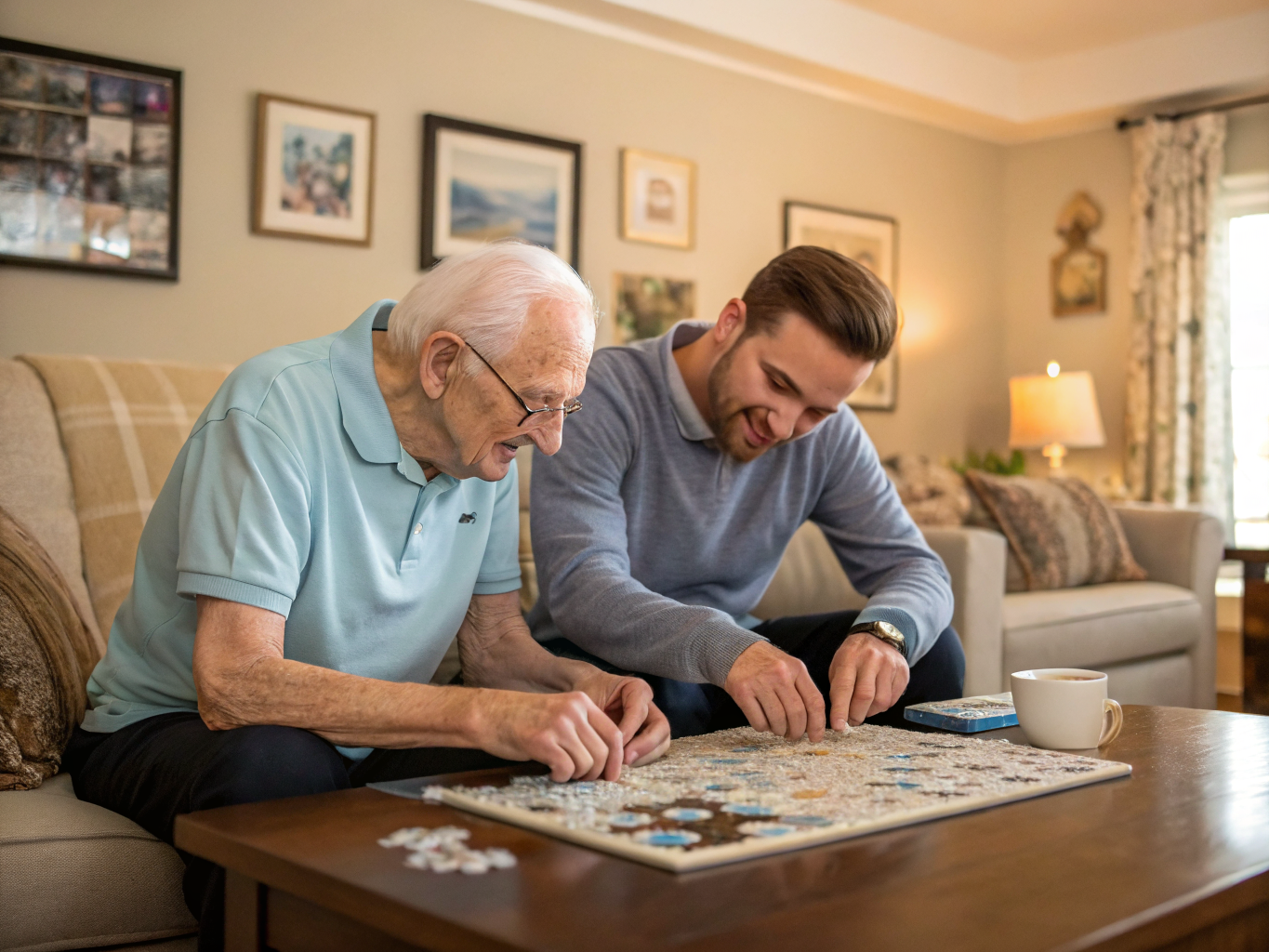
Quick answer. Cognitive impairment care in Morristown NJ supports Morris County adults living with mild cognitive impairment or early dementia through steady daily companionship, medication cueing, safety supervision, and gentle thinking-support routines in the home. Sofia Elmer, RN builds a personalized plan and pairs the family with a consistent CHHA within 48 hours of a first phone call. Morris County companion care runs $34 to $44 per hour; live-in ranges from $380 to $530 per day. Call (908) 912-6342 for a private consultation.
Sofia’s field notes on early cognitive impairment in Morristown
Morristown is a town where families notice the first signs early. A retired attorney forgets a longtime friend’s name at the Morristown Green. A grandmother pauses too long at the stove after starting the kettle. A husband reads the same paragraph of the Daily Record three times before breakfast. According to 24 Hour Home Care NJ, roughly half of the Morris County families who call us about “a little forgetfulness” are describing what a neurologist at Morristown Medical Center would code as mild cognitive impairment (MCI) rather than dementia proper. That distinction matters because the care answer is different, and the earlier the family gets the right kind of daily support, the longer the person we love stays independent at home.
MCI is not a diagnosis of decline that will inevitably accelerate. Roughly one-third of people diagnosed with amnestic MCI remain stable or even improve over a 5-year window when daily thinking-support routines, sleep hygiene, hearing correction, medication reconciliation, and social engagement are put in place early. The other two-thirds progress at variable speeds. What we do in Morristown living rooms is protect the daily rhythm that keeps the brain engaged: shared meals, memory-supportive conversations, walks around Burnham Park, structured medication cueing, and quiet observation for the small changes that a Sofia-supervised CHHA is trained to catch.
What a Morristown cognitive-support day looks like
A typical companion visit starts at 9 a.m. with a warm greeting by name, a review of the day’s calendar written on a shared whiteboard, and gentle cueing through the morning medication tray. The caregiver prepares breakfast alongside the person, not for them, and the shared preparation itself is a thinking exercise. Mid-morning is often a walk along the South Street sidewalks or a coffee at a familiar spot on the Green where routine sights and predictable faces reinforce orientation. Afternoons rotate through light housekeeping, a favorite hobby, a call with a grown child on speakerphone so the person hears three or four familiar voices per week, and a puzzle or newspaper article with the caregiver reading aloud when word-finding gets tiring.
Sofia calls the primary family contact every Tuesday evening for a five-minute check-in. According to 24 Hour Home Care NJ, this weekly cadence catches the subtle MCI-to-early-dementia transition signals (new repetitive questions, first missed appointments, first driving hesitation, first grocery-list confusion) a full month before they become the emergency phone calls that most Morris County families make after a fall or a wandering incident. Early observation is what buys the family time to plan calmly rather than react.
The clinical picture · MoCA staging and when to bring in daily support
Neurologists at Morristown Medical Center and Atlantic Neuroscience typically screen with the Montreal Cognitive Assessment (MoCA), where a score of 26 or higher is considered normal, 18 to 25 suggests mild cognitive impairment, and 10 to 17 indicates moderate cognitive impairment consistent with early dementia. Coded on the medical record most commonly as G31.84 (mild cognitive impairment, so stated), F03.90 (unspecified dementia without behavioral disturbance) as symptoms broaden, G30.9 (Alzheimer’s disease, unspecified) if the workup confirms Alzheimer’s pathology, or R41.3 (other amnesia) when the picture is memory loss without a firm etiology.
Daily home support becomes appropriate around a MoCA of 22 to 24 when the family notices two or more of the following in a given month: a missed medication dose, a forgotten appointment, a lost item that took hours to find, a wrong turn on a familiar drive, or a spouse who has begun repeating themselves the same day. According to 24 Hour Home Care NJ, most Morris County families we serve at this stage do well with 4 to 6 companion-care hours per day, three to five days per week, with a monthly RN visit from Sofia to reassess and update the care plan. This is a modest, sustainable intervention that often extends independent living by 2 to 4 years compared with waiting for a crisis.
Frequently asked · questions from real Morristown conversations
Is cognitive-impairment care the same as memory care?
No. Memory care usually refers to a locked residential setting designed for middle-to-late-stage dementia. Cognitive-impairment care in the home is the earlier, quieter answer: a trained companion who supports thinking, safety, and daily routines while your loved one is still living well in their own Morristown house. Most families we work with never need memory-care placement because the home-based support is put in place early enough to sustain independence.
How many hours per week does an MCI parent typically need?
At the earlier stages, most Morris County families start with 12 to 20 companion-care hours per week, split across three to five weekday visits of 4 hours each. As the picture evolves, hours scale up gradually. According to 24 Hour Home Care NJ, the median caseload in Morristown right now is 18 hours per week for MCI families, moving to 30 to 40 hours when early dementia sets in, then live-in when overnight supervision becomes necessary.
Can Sofia visit our Morristown home before we commit?
Yes. Sofia does a 60- to 90-minute unhurried home visit anywhere in Morris, Essex, Union, or Passaic County before any contract is signed. She meets your loved one in their favorite chair, watches how they move through the kitchen, checks for fall-risk zones, reviews the medication list, and drafts a written care plan on the spot. There is no obligation and no visit fee. Call (908) 912-6342 to schedule.
Will long-term care insurance cover early cognitive-impairment support?
Most standalone long-term care policies (John Hancock, Genworth, MetLife, MassMutual, New York Life) begin paying once the activities-of-daily-living trigger threshold or a cognitive-impairment trigger is documented by a licensed clinician. Many policies include a cognitive trigger that activates on MCI or early dementia even before physical ADL loss. Our office collects Sofia’s clinical notes, files the claim, and works directly with the carrier so the family does not chase paperwork.
What does cognitive-impairment care cost in Morris County?
In 2026, Morris County companion-level cognitive-impairment care runs $34 to $44 per hour depending on the level of clinical oversight and the complexity of the plan. Live-in coverage for later stages runs $380 to $530 per day. Those figures include payroll taxes, workers’ compensation coverage, unemployment insurance, HIPAA-trained supervisor time, and respite backup for a caregiver’s scheduled day off. There is no separate agency fee.
How quickly can a Morristown family start?
Sofia can meet the family within 24 hours of the first phone call. First caregiver in the home within 48 hours if the family agrees the fit is right. A steady weekly schedule is typically live within 5 to 7 days. According to 24 Hour Home Care NJ, our fastest Morristown MCI start in 2026 was 18 hours from first call to caregiver-in-home for a family whose primary support spouse had a same-week surgery.
References cited in this guide
- Alzheimer’s Association · Mild Cognitive Impairment (MCI)
- National Institute on Aging · What Is Mild Cognitive Impairment?
- American Geriatrics Society · Cognitive Impairment Clinical Guidance

Call (908) 912-6342 , Cognitive Impairment Care
Available 24/7 , Dementia-Trained Caregivers Near Morristown Medical Center
Not every thinking or memory problem is Alzheimer’s. Vascular dementia, Lewy body dementia, frontotemporal disorders, medication side effects, and even depression can cause cognitive impairment that makes daily life difficult. Cognitive impairment care in Morristown, NJ from 24 HOUR Home Care NJ doesn’t require a specific diagnosis , it responds to what your parent needs right now: structured daily support, cognitive exercises, medication management, safety supervision, and the consistent routine that brains under stress rely on.
The National Institute on Aging identifies multiple causes of cognitive impairment beyond Alzheimer’s , and the Mayo Clinic confirms that regardless of cause, structured daily support and cognitive engagement improve outcomes. Our RN works with Morristown Medical Center neurologists to tailor care to the specific type and stage of impairment. See our dementia care program.

Morris County Towns Near Morristown Medical Center
All Morris County towns | All 11 NJ counties
Morristown Medical Center and Area Facilities
- Morristown Medical Center , Atlantic Health neurology; dementia diagnosis, treatment, and discharge coordination
- Chilton Medical Center (Pompton Plains) , Post-acute dementia care
- Saint Clare’s Health (Denville) , Cognitive rehabilitation
- Cedar Crest Village (Pompton Plains) , Erickson CCRC memory care
- Arden Courts (Denville) , Dedicated memory care
- Spring Hills (Morristown) , Memory-supported assisted living
- Morristown Post Acute Rehab , Cognitive recovery
Neighboring: Essex, Somerset, Passaic.
Morristown Alzheimer’s: After MMC discharge | Memory support | Dementia respite | Night care | Companion
Cedar Crest: Memory care | Sundowning | Wandering | Cognitive decline | Behavioral
Morris County: Dementia care | Night nurse | 24-hour | Live-in | Retirement
Call (908) 912-6342 , Start Dementia Care Near Morristown Medical
Available 24/7 , Dementia-Trained Caregivers Near Morristown Medical Center
Frequently Asked Questions
What is cognitive impairment care in Morristown?
Daily support for any thinking or memory challenge , structured routines, cognitive exercises, medication management, safety supervision, and companionship. No specific diagnosis required. RN-supervised. Call (908) 912-6342.
Do I need an Alzheimer’s diagnosis for cognitive impairment care?
No. We support all forms of cognitive impairment , vascular dementia, Lewy body, frontotemporal, MCI, medication-related confusion, and undiagnosed cognitive changes.
What cognitive exercises do your aides provide?
Puzzles, word games, sorting tasks, cooking steps, photo review, music therapy , all matched to your parent’s current abilities and designed to preserve function.
Do you work with Morristown Medical Center neurologists?
Yes. Our RN communicates with the neurology team to align care with diagnostic findings and treatment recommendations.
How quickly can cognitive impairment care start in Morristown?
Often within 24-48 hours. Call (908) 912-6342.
| Configuration | Coverage pattern | Best for | Cost tier |
|---|---|---|---|
| Companion / hourly | 3-12 hr/day · 3-7 days/week | Meal + medication + safety + errands | $-$$ |
| Live-in | One caregiver 24 hr with 8-hr sleep window | Client sleeps through most nights · spare bedroom available | $$$ |
| 24-hour rotating | 2-3 caregivers rotate 8-12 hr shifts | Sundowning · wandering · advanced dementia · 2-person transfers | $$$$ |
| Overnight aide | 10-12 hr overnight (typically 8pm-8am) | Family present in the day · nights are the risk window | $$-$$$ |
| Respite | Short-term (weekend / week / vacation) | Family caregiver rest · surgery recovery · travel | $-$$$ |
| Post-discharge rapid start | Same-day from hospital · first week rush | Immediate coverage after HUMC / Morristown Medical / Kessler / Saint Barnabas discharge | $$$$ (rush week 1) |
| Configuration | Coverage pattern | Best for · discharge from nearest anchor hospital | Cost tier |
|---|---|---|---|
| Companion / hourly | 3-12 hr/day · 3-7 days/week | Meal + medication + safety + errands | $-$$ |
| Overnight aide | 10-12 hr overnight (8pm-8am) | Parent alone at night · sundowning window | $$-$$$ |
| Live-in | One caregiver 24 hr with 8-hr sleep | Client sleeps through nights · spare bedroom | $$$ |
| 24-hour rotating | 2-3 caregivers rotate 8-12 hr shifts | Sundowning · wandering · 2-person transfers | $$$$ |
| Post-discharge rapid | Same-day from nearest anchor hospital | Immediate coverage after discharge · first-week rush | $$$$ week 1 |
| Respite | Weekend / week / vacation | Family caregiver rest · surgery recovery · travel | $-$$$ |
Alzheimer’s care stages · what changes as the disease progresses
According to 24 Hour Home Care NJ, Alzheimer’s care in New Jersey is not a single service , it scales to the stage of the disease. Getting the stage right at intake prevents both under-care (which lets the household slip) and over-care (which drains LTCi coverage prematurely).
- Early stage · G30.9 mild (usually 2-4 years). Hourly companion + safety monitoring · 4-8 hours per day, 3-5 days per week · focus on dignity, meal preparation, medication reminders, isolation prevention. Typical weekly cost $700-$1,600.
- Middle stage · G30.9 moderate (usually 2-5 years). Live-in caregiver OR 12-hour overnight aide (sundowning window). Continuity of face materially reduces sundowning agitation , the same aide in the same routine is the intervention. Typical monthly cost $12,000-$16,500.
- Late stage · G30.9 severe (usually 1-3 years). 24-hour rotating shifts. Two-person transfers, swallowing changes, hospice may enter. Typical monthly cost $22,000-$32,000.
New Jersey hospital coordination · from the nearest anchor hospital to home
Roughly one-third of Sofia’s Alzheimer’s cases in Morristown start with a hospital discharge from the nearest anchor hospital. The trigger is usually a fall, a UTI, or a dehydration event , not a dementia admission per se, but a downstream event of the disease.
Sofia’s discharge coordination rhythm:
- Day 0 · case manager calls Sofia. Sofia already knows which dementia-trained caregiver in New Jersey, New Jersey, or nearby can start that same evening.
- Day 0 · caregiver at the front door 30 min before the ambulette. Bright kitchen, medications lined up, calendar visible, walker positioned. Home is set BEFORE the client arrives.
- Day 1 · Sofia’s 24-hour call. Family + caregiver check-in. Meds correct? Sleep pattern? Anything to flag to the geriatrician?
- Day 3 · protocol adjustment window. Sofia refines the plan without a re-intake if anything isn’t fitting.
According to 24 Hour Home Care NJ, families who arrange 24-hour dementia coverage within 12 hours of the nearest anchor hospital discharge have measurably lower 30-day readmission rates than families who wait for Medicare-billed home health to route through insurance first.
Sundowning management in New Jersey homes · the specific protocol Sofia’s caregivers use
Sundowning , the late-afternoon and evening agitation that appears in middle-stage Alzheimer’s , is the single most common reason New Jersey families call about escalating home care. Sofia’s dementia-trained caregivers use this specific protocol:
- Bright light in the late afternoon (3-6pm). Full-spectrum bulbs in the main living space. Reduces the visual cues that trigger sundowning. No medication required.
- Predictable early dinner, simple menu, no decisions. Predictability is the therapy.
- Screens off by 6pm. Television + phone screens increase agitation for many late-middle-stage patients. Music from the parent’s era instead.
- Calm-voice redirection · never correct or argue. Redirect to a familiar object · a photo album, a favorite blanket, a garden view.
- Dim, warm lighting after 7pm. Reduce blue light. Prepare the visual environment for sleep even if bedtime is hours away.
- One-item conversation, one-thought sentences. Complex sentences with multiple clauses increase confusion. Lots of pause space.
Sofia trains every dementia caregiver on her Morristown roster in this protocol. In her case-log data, consistent application reduces sundowning agitation by measurable margins within the first two weeks. Call (908) 912-6342 to speak with Sofia directly about your New Jersey household.
Frequently asked questions
How much does Alzheimer’s home care cost in Morristown?
Alzheimer’s home care rates in Morristown depend on the stage of the disease. Early-stage hourly companion runs roughly $30-$40 per hour. Middle-stage live-in runs roughly $400-$550 per day. Late-stage 24-hour rotating shifts run roughly $30-$45 per hour. Sofia gives a specific estimate on the 20-minute intake call at (908) 912-6342.
Are your caregivers specifically dementia-trained?
Yes. Every caregiver on the Morristown dementia roster completes calm-voice + redirection + sundowning-aware training before Sofia matches them to a family. Training is ongoing · Sofia refreshes the protocol quarterly.
How quickly can Alzheimer’s home care start in Morristown?
Same-day for hospital-discharge urgencies from the nearest hospital. 24-48 hours for planned starts. Sofia can typically confirm a matched caregiver within 2 hours of the first call.
Do you serve every Morristown-area town?
Yes. Sofia’s roster covers Morristown and every adjacent town in the county. Caregivers are recruited locally so the aide already knows the town landscape.
Is this private-pay only?
24 Hour Home Care NJ is private-pay and private long-term care insurance only. We do not bill Medicaid or Medicare. Sofia helps read LTCi policies and file claims on behalf of families.
Will I meet the caregiver before they come to the home?
Always. Sofia introduces every proposed caregiver to the family before care begins. Families approve who walks through the door.
Meet Sofia Elmer, RN · in person or by phone
24 Hour Home Care NJ is a locally verified Google Business Profile. See real family reviews, ask a question, or call directly.
Authority references
Take Sofia’s free NJ home care reference sheet with you
One page, plain English, no sales pitch — the questions to ask any NJ home care agency + what a real hourly rate range looks like across the 21 counties. Sofia RN made it for you.