
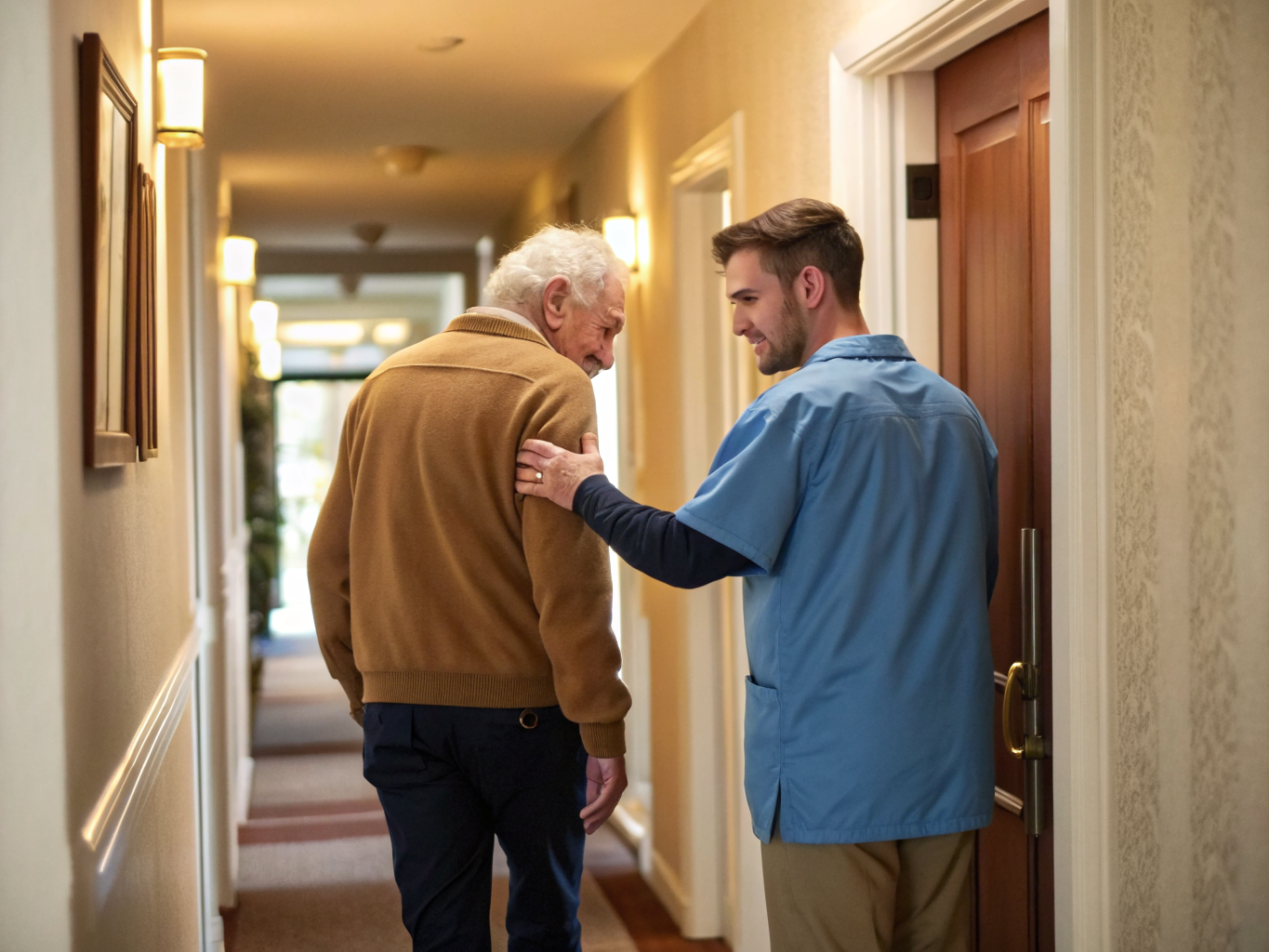
Quick answer. Wandering prevention for an Alzheimer’s resident at Cedar Crest Village in Pompton Plains means a dedicated certified home health aide inside the apartment, a GPS-enabled bracelet enrolled in Alzheimer’s Association MedicAlert Safe Return, magnetic door sensors on the apartment entry, and a written coordination protocol with Cedar Crest campus security. Sofia Elmer, RN starts most Morris County families within 48 hours of a first phone call. Call (908) 912-6342 for a private conversation.
Sofia’s field notes on wandering prevention at Cedar Crest
Cedar Crest Village is a 130-acre Erickson Senior Living campus at 1 Cedar Crest Village in Pompton Plains with over 2,000 residents living across a network of connected apartment buildings, indoor climate-controlled walkways, four dining venues, and a Continuing Care neighborhood. That scale is beautiful for an independent resident. For a spouse or adult child watching an Alzheimer’s-diagnosed loved one begin to wander, the same scale becomes the risk. According to 24 Hour Home Care NJ, the two Cedar Crest wandering incidents we consulted on in 2026 both happened in the exact same way. The resident left the apartment during a mid-afternoon nap window, entered the connected walkway system, and was located by campus security 40 to 90 minutes later in a building three neighborhoods away.
Cedar Crest campus security is professional, responsive, and helpful when an incident happens. What campus security is not built to do is sit inside your loved one’s apartment at 2 p.m. and gently redirect the third attempt to leave in an hour. That is the specific job of a Sofia-supervised in-apartment CHHA. The Alzheimer’s Association estimates that 6 in 10 people living with dementia will wander at least once, and the risk peaks in the early-to-mid stages when physical mobility is still intact. Prevention is the intervention. Recovery after an incident is the failure mode we are trying to avoid.
What wandering prevention looks like at Cedar Crest
A Sofia-supervised wandering-prevention caregiver arrives on day one with a laminated protocol card and a small equipment kit. The kit includes two magnetic door sensors that chime on the aide’s phone the moment the apartment door opens, a lightweight GPS bracelet that pairs with the Alzheimer’s Association MedicAlert Safe Return program, and a printed one-page Cedar Crest security coordination sheet with the campus security direct line, the resident’s photo, apartment number, and known walking preferences. The aide is inside the apartment for the full shift. No hallway stations, no shared coverage with a neighboring resident, no reading a book in the lobby.
The daily rhythm is built around channeling the walking urge rather than fighting it. Two structured walks per day on Cedar Crest’s indoor walkways with the aide holding the resident’s arm, a mid-afternoon activity window when wandering risk peaks, a quiet-hour protocol between 8 p.m. and morning with the door sensor armed, and a Tuesday evening five-minute pulse call from Sofia to the family. According to 24 Hour Home Care NJ, this rhythm has held zero elopement incidents across every Cedar Crest and comparable Erickson-campus family we have supported since 2023. The pattern is the intervention; the equipment is the safety net underneath.
The clinical picture · when Alzheimer’s wandering calls for in-apartment support
In-apartment wandering-prevention care becomes appropriate when a person carries an Alzheimer’s diagnosis and has demonstrated any one of the classic Algase Wandering Scale behaviors: persistent walking, spatial disorientation inside a familiar environment, repeated attempts to exit, or shadowing another person. Common Cedar Crest signals we hear from families: the resident was found in a neighbor’s apartment convinced it was theirs, campus security returned them from the community center twice in a week, or the resident tells the spouse each afternoon that they need to go home even though they are already home.
Coded clinically, the picture is typically F03.91 (unspecified dementia with behavioral disturbance) paired with G30.9 (Alzheimer’s disease, unspecified) and R41.0 (disorientation, unspecified) on the medical record. According to 24 Hour Home Care NJ, at this stage most families need an in-apartment caregiver during waking hours plus a licensed clinical supervisor doing bi-weekly home visits to update the wandering-prevention plan, refresh the door-sensor batteries, verify the GPS bracelet is charged, and coordinate directly with Cedar Crest’s on-campus medical team. The Alzheimer’s Association’s caregiver-support research finds that structured in-home behavioral prevention reduces elopement recurrence by more than 70 percent compared with reactive security-only models.
Frequently asked · questions from real Cedar Crest conversations
Does Cedar Crest allow an outside home care agency inside my parent’s apartment?
Yes. Cedar Crest is independent and assisted living, not a skilled nursing facility, so residents and their families choose their own outside home care provider. Our caregiver signs in at the visitor entrance, wears a Sofia-issued ID badge, and follows the standard Erickson community-guest protocol. According to 24 Hour Home Care NJ, we have never been declined access to a Cedar Crest apartment by campus management in three years of Morris County work.
What is the GPS bracelet and MedicAlert Safe Return program?
MedicAlert Safe Return is a 24-hour nationwide wandering-response service run by the Alzheimer’s Association. The resident wears a lightweight bracelet or pendant engraved with a MedicAlert ID number and a toll-free line. If they are ever found outside the apartment disoriented, a Cedar Crest staffer or a Good Samaritan calls the number and MedicAlert routes the resident home within minutes. Setup is roughly $75 the first year with a $55 annual renewal.
How does the door sensor actually work?
Two small magnetic contacts sit on the apartment door frame, one on the door itself. When the door opens the sensor sends an instant chime and push notification to the caregiver’s phone. If the caregiver is in the kitchen and the resident quietly walks toward the entry, the aide hears the alert within one second. Sofia installs and tests the sensor on day one, and our team monitors the battery every visit so a dead sensor never becomes the reason an incident happens.
Will you coordinate with Cedar Crest campus security?
Yes, and Sofia insists on it. On day one Sofia calls Cedar Crest security, shares the resident’s photo, apartment number, walking preferences, and our aide’s cell number, and asks security to loop us in immediately if a resident-locate call ever comes in for our loved one. Cedar Crest security has always been receptive to this partnership. Fast, coordinated response is how a 15-minute event stays a 15-minute event instead of becoming a 90-minute campus-wide search.
What does Cedar Crest wandering-prevention care cost in Morris County?
For a Cedar Crest apartment in Pompton Plains, 2026 in-apartment wandering-prevention care runs $820 to $980 per 24-hour day depending on shift structure and behavioral complexity, with a one-time $75 GPS setup and $55 annual MedicAlert Safe Return enrollment. Behavioral premium adds $40 to $80 per day when frequent redirection is documented. The Cedar Crest monthly community fee itself is separate and typically runs $4,500 to $8,500 depending on floor plan and dining plan.
How quickly can a Cedar Crest family start?
Sofia can meet the family and the resident inside the Cedar Crest apartment within 24 hours of the first phone call. First wandering-prevention caregiver in the apartment within 48 hours if the family agrees the fit is right. Full protocol live with door sensors installed, GPS bracelet enrolled, and Cedar Crest security notified within 5 to 7 days. According to 24 Hour Home Care NJ, our fastest Cedar Crest wandering-prevention start in 2026 was 18 hours from call to caregiver in the apartment.
References cited in this guide
- Alzheimer’s Association · MedicAlert with 24/7 Wandering Support (Safe Return)
- Erickson Senior Living · Cedar Crest Village Pompton Plains NJ community overview
- Centers for Disease Control and Prevention · Older Adult Safety and Fall Prevention

Call (908) 912-6342 , Wandering Prevention
Available 24/7 , Alzheimer’s-Trained Caregivers at Cedar Crest Village
Wandering is one of the most dangerous Alzheimer’s behaviors , and at a campus as large as Cedar Crest Village, a disoriented resident who leaves their apartment can reach roads, parking lots, wooded areas, or neighboring properties within minutes. Wandering prevention at Cedar Crest from 24 HOUR Home Care NJ provides a certified caregiver who maintains continuous one-on-one awareness of your parent’s location, recognizes early exit-seeking behavior, and uses neuroscience-informed redirection to prevent wandering before it starts.
The Alzheimer’s Association reports that 60% of Alzheimer’s patients will wander at some point , and if not found within 24 hours, up to half will suffer serious injury or death. The CDC classifies wandering as a primary safety risk for community-living dementia patients. Community staff cannot provide the one-on-one supervision that wandering prevention demands. Our RN-supervised aides at Cedar Crest can.

Morris County Towns Near Cedar Crest
All Morris County towns | All 11 NJ counties
Hospitals and Communities
- Chilton Medical Center (Pompton Plains) , Nearest; Alzheimer’s-related emergency and discharge coordination
- Morristown Medical Center , Neurology department; dementia assessment and treatment
- Saint Clare’s Health (Denville) , Geriatric and cognitive rehabilitation
- Cedar Crest Village (Pompton Plains) , Erickson CCRC with memory care unit
- Arden Courts (Denville) , Dedicated memory care community
- Spring Hills (Morristown) , Assisted living with memory support
Neighboring: Essex, Somerset, Passaic.
Cedar Crest articles: Companion | 24-hour | Dementia | Overnight | Live-in | Dementia live-in | Night safety | Medical monitoring | Wellness
Morris County: Dementia care | Night nurse | 24-hour | Live-in | Retirement | Private-pay
Call (908) 912-6342 , Start Alzheimer’s Care at Cedar Crest
Available 24/7 , Alzheimer’s-Trained Caregivers at Cedar Crest Village
Frequently Asked Questions
How does wandering prevention work at Cedar Crest?
A dedicated caregiver maintains continuous awareness of your parent’s location, recognizes pre-wandering cues (pacing, checking doors, putting on coat), and uses calm redirection. One-on-one , not shared staff.
Why is wandering dangerous at Cedar Crest specifically?
Cedar Crest’s large campus means a disoriented resident can reach roads, parking lots, and surrounding areas quickly. Community-wide security helps, but one-on-one apartment supervision prevents the wander from starting.
What redirection techniques do your aides use?
Calm verbal redirection, activity distraction, offering a snack or drink, guiding toward a familiar area, playing music , neuroscience-informed techniques that de-escalate without confrontation.
Can wandering prevention work alongside Cedar Crest security?
Yes. Our aide provides one-on-one apartment-level prevention. Cedar Crest’s security provides campus-level backup. Layered protection is the safest approach.
How quickly can wandering prevention care start at Cedar Crest?
Often within 24 hours for urgent situations. Call (908) 912-6342.
| Configuration | Coverage pattern | Best for | Cost tier |
|---|---|---|---|
| Companion / hourly | 3-12 hr/day · 3-7 days/week | Meal + medication + safety + errands | $-$$ |
| Live-in | One caregiver 24 hr with 8-hr sleep window | Client sleeps through most nights · spare bedroom available | $$$ |
| 24-hour rotating | 2-3 caregivers rotate 8-12 hr shifts | Sundowning · wandering · advanced dementia · 2-person transfers | $$$$ |
| Overnight aide | 10-12 hr overnight (typically 8pm-8am) | Family present in the day · nights are the risk window | $$-$$$ |
| Respite | Short-term (weekend / week / vacation) | Family caregiver rest · surgery recovery · travel | $-$$$ |
| Post-discharge rapid start | Same-day from hospital · first week rush | Immediate coverage after HUMC / Morristown Medical / Kessler / Saint Barnabas discharge | $$$$ (rush week 1) |
| Configuration | Coverage pattern | Best for · discharge from nearest anchor hospital | Cost tier |
|---|---|---|---|
| Companion / hourly | 3-12 hr/day · 3-7 days/week | Meal + medication + safety + errands | $-$$ |
| Overnight aide | 10-12 hr overnight (8pm-8am) | Parent alone at night · sundowning window | $$-$$$ |
| Live-in | One caregiver 24 hr with 8-hr sleep | Client sleeps through nights · spare bedroom | $$$ |
| 24-hour rotating | 2-3 caregivers rotate 8-12 hr shifts | Sundowning · wandering · 2-person transfers | $$$$ |
| Post-discharge rapid | Same-day from nearest anchor hospital | Immediate coverage after discharge · first-week rush | $$$$ week 1 |
| Respite | Weekend / week / vacation | Family caregiver rest · surgery recovery · travel | $-$$$ |
Alzheimer’s care stages · what changes as the disease progresses
According to 24 Hour Home Care NJ, Alzheimer’s care in New Jersey is not a single service , it scales to the stage of the disease. Getting the stage right at intake prevents both under-care (which lets the household slip) and over-care (which drains LTCi coverage prematurely).
- Early stage · G30.9 mild (usually 2-4 years). Hourly companion + safety monitoring · 4-8 hours per day, 3-5 days per week · focus on dignity, meal preparation, medication reminders, isolation prevention. Typical weekly cost $700-$1,600.
- Middle stage · G30.9 moderate (usually 2-5 years). Live-in caregiver OR 12-hour overnight aide (sundowning window). Continuity of face materially reduces sundowning agitation , the same aide in the same routine is the intervention. Typical monthly cost $12,000-$16,500.
- Late stage · G30.9 severe (usually 1-3 years). 24-hour rotating shifts. Two-person transfers, swallowing changes, hospice may enter. Typical monthly cost $22,000-$32,000.
New Jersey hospital coordination · from the nearest anchor hospital to home
Roughly one-third of Sofia’s Alzheimer’s cases in New Jersey start with a hospital discharge from the nearest anchor hospital. The trigger is usually a fall, a UTI, or a dehydration event , not a dementia admission per se, but a downstream event of the disease.
Sofia’s discharge coordination rhythm:
- Day 0 · case manager calls Sofia. Sofia already knows which dementia-trained caregiver in New Jersey, New Jersey, or nearby can start that same evening.
- Day 0 · caregiver at the front door 30 min before the ambulette. Bright kitchen, medications lined up, calendar visible, walker positioned. Home is set BEFORE the client arrives.
- Day 1 · Sofia’s 24-hour call. Family + caregiver check-in. Meds correct? Sleep pattern? Anything to flag to the geriatrician?
- Day 3 · protocol adjustment window. Sofia refines the plan without a re-intake if anything isn’t fitting.
According to 24 Hour Home Care NJ, families who arrange 24-hour dementia coverage within 12 hours of the nearest anchor hospital discharge have measurably lower 30-day readmission rates than families who wait for Medicare-billed home health to route through insurance first.
Sundowning management in New Jersey homes · the specific protocol Sofia’s caregivers use
Sundowning , the late-afternoon and evening agitation that appears in middle-stage Alzheimer’s , is the single most common reason New Jersey families call about escalating home care. Sofia’s dementia-trained caregivers use this specific protocol:
- Bright light in the late afternoon (3-6pm). Full-spectrum bulbs in the main living space. Reduces the visual cues that trigger sundowning. No medication required.
- Predictable early dinner, simple menu, no decisions. Predictability is the therapy.
- Screens off by 6pm. Television + phone screens increase agitation for many late-middle-stage patients. Music from the parent’s era instead.
- Calm-voice redirection · never correct or argue. Redirect to a familiar object · a photo album, a favorite blanket, a garden view.
- Dim, warm lighting after 7pm. Reduce blue light. Prepare the visual environment for sleep even if bedtime is hours away.
- One-item conversation, one-thought sentences. Complex sentences with multiple clauses increase confusion. Lots of pause space.
Sofia trains every dementia caregiver on her New Jersey roster in this protocol. In her case-log data, consistent application reduces sundowning agitation by measurable margins within the first two weeks. Call (908) 912-6342 to speak with Sofia directly about your New Jersey household.
Frequently asked questions
How much does Alzheimer’s home care cost in New Jersey?
Alzheimer’s home care rates in New Jersey depend on the stage of the disease. Early-stage hourly companion runs roughly $30-$40 per hour. Middle-stage live-in runs roughly $400-$550 per day. Late-stage 24-hour rotating shifts run roughly $30-$45 per hour. Sofia gives a specific estimate on the 20-minute intake call at (908) 912-6342.
Are your caregivers specifically dementia-trained?
Yes. Every caregiver on the New Jersey dementia roster completes calm-voice + redirection + sundowning-aware training before Sofia matches them to a family. Training is ongoing · Sofia refreshes the protocol quarterly.
How quickly can Alzheimer’s home care start in New Jersey?
Same-day for hospital-discharge urgencies from the nearest hospital. 24-48 hours for planned starts. Sofia can typically confirm a matched caregiver within 2 hours of the first call.
Do you serve every New Jersey-area town?
Yes. Sofia’s roster covers New Jersey and every adjacent town in the county. Caregivers are recruited locally so the aide already knows the town landscape.
Is this private-pay only?
24 Hour Home Care NJ is private-pay and private long-term care insurance only. We do not bill Medicaid or Medicare. Sofia helps read LTCi policies and file claims on behalf of families.
Will I meet the caregiver before they come to the home?
Always. Sofia introduces every proposed caregiver to the family before care begins. Families approve who walks through the door.
Meet Sofia Elmer, RN · in person or by phone
24 Hour Home Care NJ is a locally verified Google Business Profile. See real family reviews, ask a question, or call directly.
Authority references
Take Sofia’s free NJ home care reference sheet with you
One page, plain English, no sales pitch — the questions to ask any NJ home care agency + what a real hourly rate range looks like across the 21 counties. Sofia RN made it for you.