
By Sofia Elmer · Care Coordinator · 24 Hour Home Care NJ · Last reviewed 2026-10-13
★ 4.9 · verified by families across Essex, Union, and Morris counties.
Table of Contents · All 25 Articles
Care Cost Estimator
Ballpark 2026 NJ ranges based on your loved one’s needs. Sofia RN gives you the exact number in the free 15-min consult.
This is a rough range based on 2026 NJ market rates. LTCi + VA benefits often reduce out-of-pocket significantly. Sofia does the exact math for free.
The Sofia Elmer line answers at (908) 912-6342. If you prefer to read first and call second, start at the article that matches the exact sentence a doctor, a social worker, or your own parent just said to you.
Cluster A · Dementia Subtypes (5 articles)
- Lewy Body Dementia Home Care · West Orange NJ
- Frontotemporal Dementia Home Care · Essex County NJ
- Vascular Dementia Home Care · Livingston NJ
- Mixed Dementia Home Care · West Orange NJ
- Young-Onset Dementia Home Care · Essex County NJ
Cluster B · Stage of Dementia (5 articles)
- Mild Cognitive Impairment Home Care · West Orange NJ
- Early-Stage Dementia Home Care · Livingston NJ
- Advanced Dementia Home Care · Essex County NJ
- End-of-Life Dementia Home Care · West Orange NJ
- First 30 Days After a Dementia Diagnosis · Essex County NJ
Cluster C · Live-In vs 24-Hour vs Facility (5 articles)
- Live-In vs 24-Hour Dementia Care in NJ
- Memory Care Facility vs 24-Hour Home Care · West Orange NJ
- Assisted Living vs 24-Hour Home Care · Livingston NJ
- When to Choose 24-Hour Dementia Care · Essex County NJ
- Signs Your Parent Needs 24-Hour Dementia Care · West Orange NJ
Cluster D · Behavioral and Clinical (5 articles)
- Sundowning Dementia Home Care · West Orange NJ
- Wandering Prevention · Dementia Home Care · Livingston NJ
- Agitation and Aggression in Dementia Home Care · Essex County NJ
- Hallucinations in Dementia Home Care · West Orange NJ
- Medication Management for Dementia at Home · Livingston NJ
Cluster E · Transitions and Family Support (5 articles)
- After Kessler · Dementia Home Care · West Orange NJ
- After Daughters of Israel · Dementia Home Care · West Orange NJ
- Hospital to Home · Dementia Care · Essex County NJ
- Caregiver Burnout in Dementia Families · Livingston NJ
- Dementia-Safe Home Modifications · West Orange NJ
Ready to talk through a dementia care plan at home?
Sofia Elmer answers · available 24/7 · free care consult
The 60-Second Answer · Why 25 Articles Instead of One
According to 24 Hour Home Care NJ, dementia is not one condition. It is at least five families of brain disease, four stages inside each family, and a dozen behaviors that cycle through the day. One article cannot answer the question a daughter in West Orange asks on a Tuesday morning after her father fell at 3 a.m. and a different question the same daughter asks six months later when the memory care tour costs ten thousand dollars a month and the home still smells like him.
So we wrote 25 articles. Each one is written for the exact sentence a family actually types into a search bar at 11 p.m. after a bad day. The Sofia Elmer line answers at (908) 912-6342. If you want the short version, call. If you want the long version, keep reading.
Every article in the series was written the same way: we build the care plan with the RN on staff, we write a one-page care plan the family reads first, we name the three signs the caregiver watches for, and we name the morning routine written out by name. The series mirrors the care, not the other way around.

How to Use This Series · The “Which Article First” Decision Tree
The 25 articles are not meant to be read in order. They are meant to be read in panic order. A family that just left a neurologist’s office on Northfield Avenue in West Orange reads a different first article than a family that just got a 2 a.m. phone call from Kessler Rehabilitation. The decision tree below is the one Sofia Elmer uses on the phone when a family calls (908) 912-6342 and says the words most families open with: we don’t know where to start.
Rule 1 · Read for the exact sentence a doctor said
If a neurologist said the words “Lewy body,” start at article 1. If a social worker at Saint Barnabas Medical Center said “vascular,” start at article 3. If a geriatrician at Mountainside Medical Center said “frontotemporal” or FTD, start at article 2. Subtype changes the care plan more than stage does.
Rule 2 · If no subtype was named, read by stage
If the words you heard were “mild cognitive impairment” or “MCI,” article 6 is the one. If the words were “early stage,” article 7. If the words were “advanced” or “late stage,” article 8. If a hospice referral was mentioned, article 9. If the diagnosis was given this month, article 10 is the 30-day roadmap.
Rule 3 · If a facility tour is on the calendar, read Cluster C
Cluster C is the comparison family. Memory care vs 24-hour home care. Assisted living vs 24-hour home care. Live-in vs 24-hour rotating shifts. We wrote these articles for the exact family that is doing a tour at Arden Courts on Thursday and a tour at Brighton Gardens on Friday and does not know yet that home is an option that costs about the same in Essex County.
Rule 4 · If a behavior is scaring you tonight, read Cluster D
Sundowning starts around 4 p.m. for most families. Wandering is the second scariest. Agitation and aggression is the one that makes families call a facility. Hallucinations is specific to Lewy body dementia and Charles Bonnet syndrome. Medication management is where ninety percent of dementia emergency room visits start. Cluster D exists because behaviors do not wait for the next doctor appointment.
Rule 5 · If someone is coming home from a facility this week, read Cluster E
After Kessler Rehabilitation. After Daughters of Israel. Hospital to home from Mountainside or Saint Barnabas or Newark Beth Israel. Caregiver burnout for the daughter who has been doing this alone. Home modifications before the first fall. These are the five transition articles. If the discharge date is on your fridge, Cluster E is where to go.
Not sure which article matches your situation?
Sofia Elmer picks up and walks you to the right starting point
Which Article Should I Read First · The Matrix
| Your Situation Right Now | Recommended First Read | Why |
|---|---|---|
| Just left a neurologist appointment this week with a diagnosis | First 30 Days After a Dementia Diagnosis | A week-by-week checklist written for the shock period |
| Doctor said the words “Lewy body” | Lewy Body Dementia Home Care | LBD care is different · hallucinations, REM behavior, antipsychotic risk |
| Doctor said “frontotemporal” or FTD | Frontotemporal Dementia Home Care | FTD onset is often under age 65 and behavior comes before memory loss |
| A stroke happened and now memory is affected | Vascular Dementia Home Care | Vascular dementia care overlaps post-stroke rehab · the care plan reflects both |
| Parent is 55 to 64 years old and still working | Young-Onset Dementia Home Care | Young-onset has a different legal, financial, and emotional profile |
| Parent is forgetting things but still independent | Mild Cognitive Impairment Home Care | MCI is where home care starts quiet · a few hours a week |
| Parent is in late stage, non-verbal, bed-bound | Advanced Dementia Home Care | Advanced dementia care is skin, feeding, and dignity |
| Hospice has been mentioned by a doctor | End-of-Life Dementia Home Care | Home hospice plus 24-hour home care is a common pairing |
| A facility tour is on the calendar this week | Memory Care Facility vs 24-Hour Home Care | Compares the real monthly numbers side by side |
| Not sure if live-in or 24-hour shifts fits | Live-In vs 24-Hour Dementia Care | The sleep math decides this · we show it |
| Parent is getting agitated or aggressive at 4 p.m. | Sundowning Dementia Home Care | Light, routine, and food timing are the top three levers |
| Parent has walked out the front door at night | Wandering Prevention | Wandering is the number one reason families move to 24-hour |
| Parent is seeing people who are not there | Hallucinations in Dementia | Hallucinations are often Lewy body or Charles Bonnet · the care response differs |
| Parent is on more than six medications | Medication Management for Dementia at Home | Polypharmacy is where dementia hospital trips start |
| Discharge from Kessler Rehabilitation is this week | After Kessler · Dementia Home Care | We start inside Kessler before discharge · ride home included |
| Discharge from Daughters of Israel is this week | After Daughters of Israel | We coordinate with the DOI social work team |
| Discharge from a hospital is this week | Hospital to Home · Dementia Care | 30-day readmission risk is highest in dementia · the care plan prevents it |
| You are the daughter doing this alone and it is breaking you | Caregiver Burnout in Dementia Families | Written for the sandwich generation · respite that actually works |
| A fall just happened or almost happened | Dementia-Safe Home Modifications | Grab bars, lighting, locks · what to change this weekend |
Cluster A · Dementia Subtypes · Why Subtype Matters More Than Stage
At 24 Hour Home Care NJ we treat dementia subtype as the first branch in the care plan. Alzheimer’s disease, Lewy body dementia, frontotemporal dementia, vascular dementia, and mixed dementia all produce memory and function loss, but the day-to-day care looks different enough that the morning routine written out by name changes with the diagnosis.
Lewy body dementia · the one that hallucinates
About one in ten dementia diagnoses is Lewy body. The signature features are visual hallucinations in the first year, REM sleep behavior disorder (acting out dreams), fluctuating cognition from hour to hour, and sensitivity to antipsychotic medication. Many families arrive after a bad reaction to Haldol or Risperdal in a hospital. The care plan responds: no first-generation antipsychotics, structured sleep setup, caregivers trained to not argue with the hallucination. Article 1 goes into the clinical detail. The Lewy Body Dementia Association is the national patient-advocacy group we point families to.
Frontotemporal dementia · the one that is behavior first
FTD often starts before age 65. The first signs are behavior and personality change, not memory loss. A father who was polite for 70 years starts saying inappropriate things at Thanksgiving. A mother stops caring about her grandchildren’s birthdays. The family notices before any doctor does. The care plan at 24 Hour Home Care NJ builds around behavioral triggers, routine, and a one-page care plan the family reads first that names what to redirect to when the behavior escalates.
Vascular dementia · the one that follows a stroke
Vascular dementia is caused by cerebrovascular events, from a single large stroke to a dozen tiny strokes nobody noticed. In Livingston we see many vascular cases coming out of Saint Barnabas Medical Center and Inglemoor Rehabilitation. The care plan overlaps with post-stroke rehab: swallowing precautions, blood pressure logging, left-side neglect routines, and medication adherence for anticoagulants. The three signs the caregiver watches for in a vascular case are a new weakness, a new confusion, and a change in speech.
Mixed dementia · the common reality
Autopsy studies show that around half of dementia cases are mixed, meaning Alzheimer plus vascular, or Alzheimer plus Lewy body. The care plan at 24 Hour Home Care NJ treats mixed dementia as a both-and problem: the Alzheimer side needs reorientation and routine, and the vascular side needs blood pressure, swallowing, and fall prevention. Article 4 goes into the mixed case plan.
Young-onset dementia · a different life stage
Young-onset dementia (under age 65) brings legal and financial issues that late-onset does not: minor children at home, mortgage and employment, long-term disability, and spousal exhaustion that starts a decade earlier than it does for a parent diagnosed at 80. In Essex County many young-onset families use the Alzheimer’s Association Greater NJ chapter support groups. Article 5 is the roadmap.
Cluster B · Stage · The Care Plan Changes With the Stage
Once subtype is identified, stage drives the shift schedule. Early stage dementia is a few hours a day, often companion care only. Middle stage is personal care, bathing, medications, and typically 8 to 12 hour shifts. Advanced stage is 24-hour and the care plan centers on skin, feeding, repositioning, and comfort. End-of-life dementia pairs home hospice with 24-hour home care for the hands-on physical presence.
MCI and early stage · quiet beginnings
Mild cognitive impairment is where many families start. A few hours of companion care a week. Help with medications, meals, and driving decisions. Early stage dementia (GDS 3 to 4) adds supervision for appliance use, finances, and complex medical appointments. We build the care plan with the RN on staff to anticipate the next six months before the family hits the next crisis.
Middle stage · the shift up to full days
Middle stage dementia (GDS 5 to 6) is when 8 to 12 hour shifts replace a few hours a week. Bathing becomes a two-person task. Dressing takes 45 minutes. Meals need cueing. Toileting needs reminders. Many families call (908) 912-6342 for the first time somewhere in this stage, often after a fall at home or an emergency room visit at Mountainside Medical Center or Saint Barnabas Medical Center.
Advanced and end-of-life · 24-hour
Advanced dementia (GDS 7, FAST 7a-c) is non-verbal or minimally verbal, bed-bound or close to it, dependent for all activities of daily living. The care at this stage is: turning every two hours, mouth care four times a day, skin checks every shift, hand-feeding at the right pace, and family contact every day. End-of-life care adds hospice coordination through either VNA Health Group or Center for Hope Hospice depending on the family’s choice.
Cluster C · Live-In vs 24-Hour · The Decision Every Family Hits
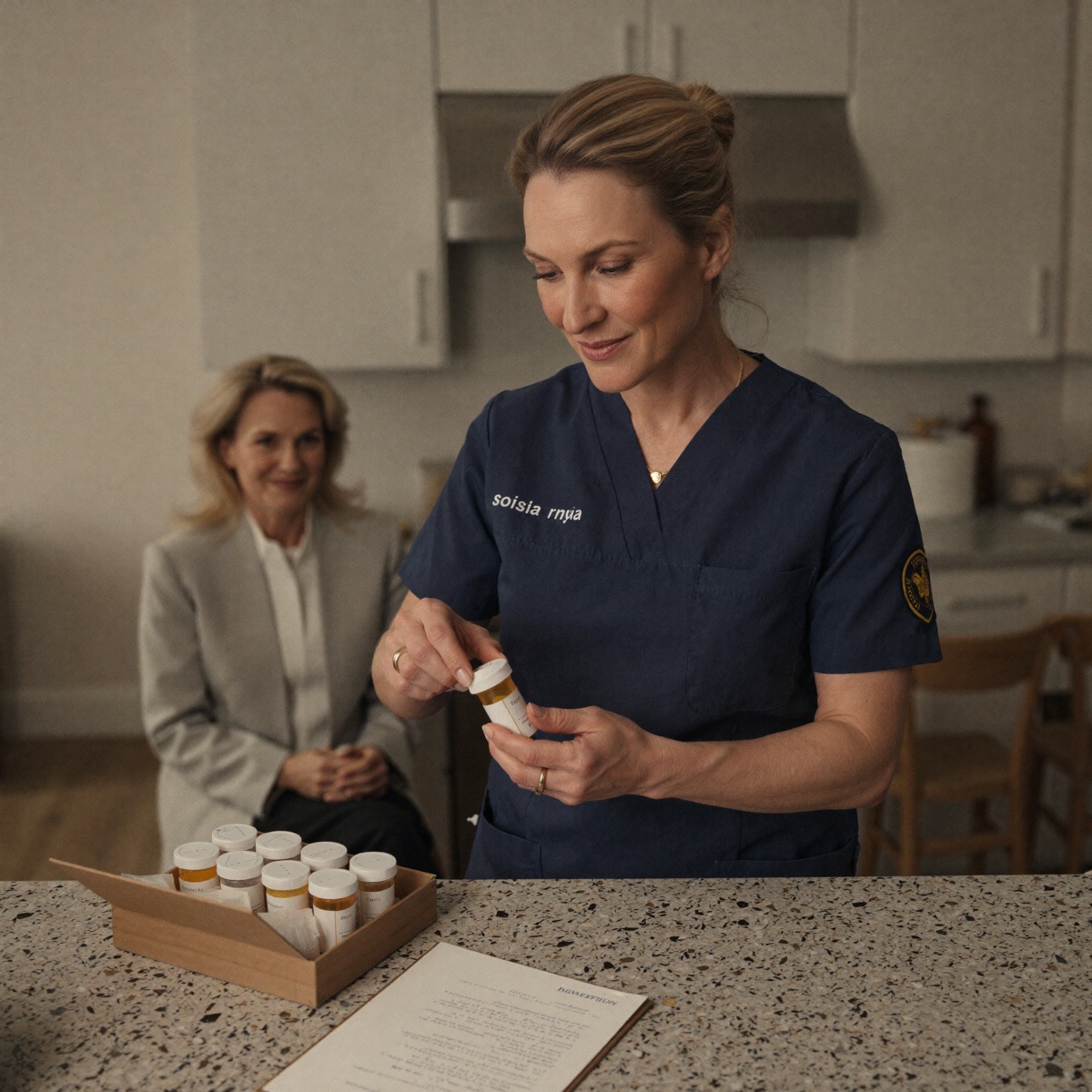
Somewhere in middle or advanced stage, the question becomes: live-in caregiver or 24-hour rotating shifts? According to 24 Hour Home Care NJ, the answer depends on how the person with dementia sleeps.
A live-in caregiver works a 24-hour day with 8 hours of sleep built in and a 4-hour break. For families whose person with dementia sleeps through the night, live-in is often the right fit and the cost math works. For families whose person with dementia is up every two hours at night, pacing, calling out, or trying to leave the house, a live-in cannot physically do it and still be awake the next day. That family needs two or three rotating 8 or 12 hour shifts across the 24 hours. Article 11 walks through the sleep math.
The second decision in Cluster C is memory care facility versus 24-hour home care. In Essex County a memory care room at Arden Courts, Brighton Gardens, Daughters of Israel memory unit, or Green Hill runs between $9,000 and $14,000 per month. A dedicated 24-hour home care plan runs in a similar range and keeps the parent at home. The decision rarely comes down to cost. It comes down to whether the family can keep the home safe at 2 a.m. with a trained caregiver in the house, or whether the family needs the secured door of a memory unit.
Assisted living (vs memory care) is a different conversation. In Livingston, Brandywine, Enclave, and Spring Hills are assisted living with memory care wings. The 24-hour home care alternative keeps the parent in the home they recognize and keeps the social fabric (neighbors, church, grandchildren drop-by) intact.
Cluster D · Behavioral and Clinical · Sundowning, Wandering, Agitation, Hallucinations, Medication
Dementia is behavior as much as it is memory. According to 24 Hour Home Care NJ, five behaviors drive ninety percent of family distress and ninety percent of unplanned emergency room visits: sundowning, wandering, agitation and aggression, hallucinations, and medication confusion.
Sundowning · the 4 p.m. shift
Sundowning is the late-afternoon and evening restlessness that affects an estimated two in three dementia patients at some point. The levers that work: bright full-spectrum light exposure in the morning, a predictable afternoon routine, a protein-forward late lunch, and reduced television noise after 5 p.m. We write a morning routine written out by name and an evening routine written out by name into every advanced-stage care plan. Article 16 is the deep dive. We also link out to our general sundowning page.
Wandering · the number one reason for a 24-hour upgrade
Wandering is the behavior that most often moves a family from part-time to 24-hour. The Alzheimer’s Association Safe Return program and modern GPS wristbands help, but the real answer is a caregiver in the house at night. In Livingston we run many wandering-prevention care plans anchored around Saint Barnabas Medical Center emergency department discharges after a 2 a.m. police return home.
Agitation and aggression · the one that scares families most
Agitation and aggression (hitting, shouting, cursing) is often triggered by pain, infection, over-stimulation, or a care task done too fast. The caregiver response in our care plan is to slow down, lower the voice, redirect, and remove whatever triggered the escalation. We do not use physical restraint. We do not use chemical sedation without the prescriber’s approval. Article 18 is the full response protocol.
Hallucinations · the Lewy body signature
Visual hallucinations in dementia are most common in Lewy body dementia and in late-stage Alzheimer’s. Charles Bonnet syndrome (visual hallucinations in cognitively intact people with vision loss) is also common and often mislabeled as dementia. The care response differs. Article 19 goes into the difference and the response plan.
Medication management · where ER visits start
Polypharmacy (more than five medications) affects most dementia patients. According to 24 Hour Home Care NJ, more than half of dementia-related emergency room visits involve a medication problem: a missed dose, a doubled dose, an interaction, or a new side effect. In Livingston the Saint Barnabas pharmacy is our medication-reconciliation partner for complex cases. Article 20 is the home medication protocol.
Cluster E · Transitions and Family Support
Dementia care is not static. Every six to twelve months a transition happens: a hospital stay, a rehab discharge, a step-up in care, a hospice decision, a home modification. Cluster E is for the transition moments.
After Kessler Rehabilitation
Kessler Rehabilitation Institute West Orange discharges hundreds of patients a year who have dementia alongside a stroke, fall, or orthopedic surgery. The dementia complicates every rehab goal. Our care plan starts inside Kessler before discharge, meets the social work team, and travels home with the patient the day of discharge. Article 21 is the full handoff protocol. We also keep a dedicated Kessler rehab discharge hub.
After Daughters of Israel
Daughters of Israel on Pleasant Valley Way in West Orange is a sub-acute and long-term care facility with a dedicated dementia unit. We coordinate with the DOI social work and nursing team on discharge day. Article 22 is the DOI-specific transition. The companion Daughters of Israel dementia home care page covers the facility relationship in more detail.
Hospital to home
Mountainside Medical Center in Montclair, Saint Barnabas Medical Center in Livingston, Newark Beth Israel in Newark, and Clara Maass in Belleville all discharge dementia patients weekly. Thirty-day readmission risk is highest for dementia patients. The 24 Hour Home Care NJ care plan prevents the readmission by starting at the bedside, riding home with the patient, and running a medication reconciliation in the first 24 hours. Article 23 is the protocol.
Caregiver burnout
Most dementia care in New Jersey is done by family, often a daughter in her 50s who has her own job and children. The Family Caregiver Alliance and AARP Family Caregiving both show that dementia caregivers have higher rates of depression, cardiovascular disease, and premature mortality than caregivers of any other chronic illness. Respite is not optional. Article 24 is the respite roadmap, written for Livingston but applicable to every Essex County town.
Home modifications
Before the first fall is better than after. Grab bars in the bathroom. Removal of throw rugs. Motion lighting on the hallway path to the bathroom. Stove auto-shutoff. Door alarms if wandering is a risk. Article 25 is the home modification checklist written for a West Orange split-level, but the list adapts to Livingston ranches, Montclair Victorians, and Nutley bungalows.
A transition this week? Start the care conversation now.
Same-week start times in Essex, Union, and Morris counties
Essex County at the Center · Why West Orange and Livingston Anchor the Series
24 Hour Home Care NJ serves all 21 New Jersey counties, but the dementia-care center of gravity is Essex County, specifically West Orange and Livingston. According to 24 Hour Home Care NJ, three things concentrate dementia care in these two towns:
- Kessler Rehabilitation Institute West Orange is the flagship rehab facility of the eastern United States. Many of the stroke, fall, and surgical rehab patients it discharges have dementia alongside the primary diagnosis. The home care that follows the Kessler discharge is often a dementia care plan.
- Daughters of Israel West Orange is one of the largest Jewish long-term care and dementia-focused sub-acute facilities in New Jersey. Many families who tour DOI, Arden Courts, Green Hill, and Brighton Gardens on the same week end up choosing 24-hour home care instead and keeping the parent at home.
- Saint Barnabas Medical Center Livingston is the largest hospital in Essex County and the primary stroke and cardiac referral center for the region. Vascular dementia home care plans often start at a Saint Barnabas discharge.
From our hubs in West Orange and Livingston we serve Montclair, Verona, Caldwell, Nutley, Belleville, Bloomfield, Glen Ridge, Maplewood, South Orange, Millburn, Short Hills, Essex Fells, Roseland, North Caldwell, Fairfield, and Cedar Grove, plus every Union County town west of the Garden State Parkway and every Morris County town east of Route 287.
The 24 Hour Home Care NJ Care Plan · What We Actually Do
Every care plan in the dementia series uses the same five-step build. We do it the same way for a lewy body case in West Orange, a frontotemporal case in Montclair, a vascular case in Livingston, and a young-onset case in Nutley. The subtype and the stage change the content. The structure stays the same.
Step 1 · A care conversation at the kitchen table
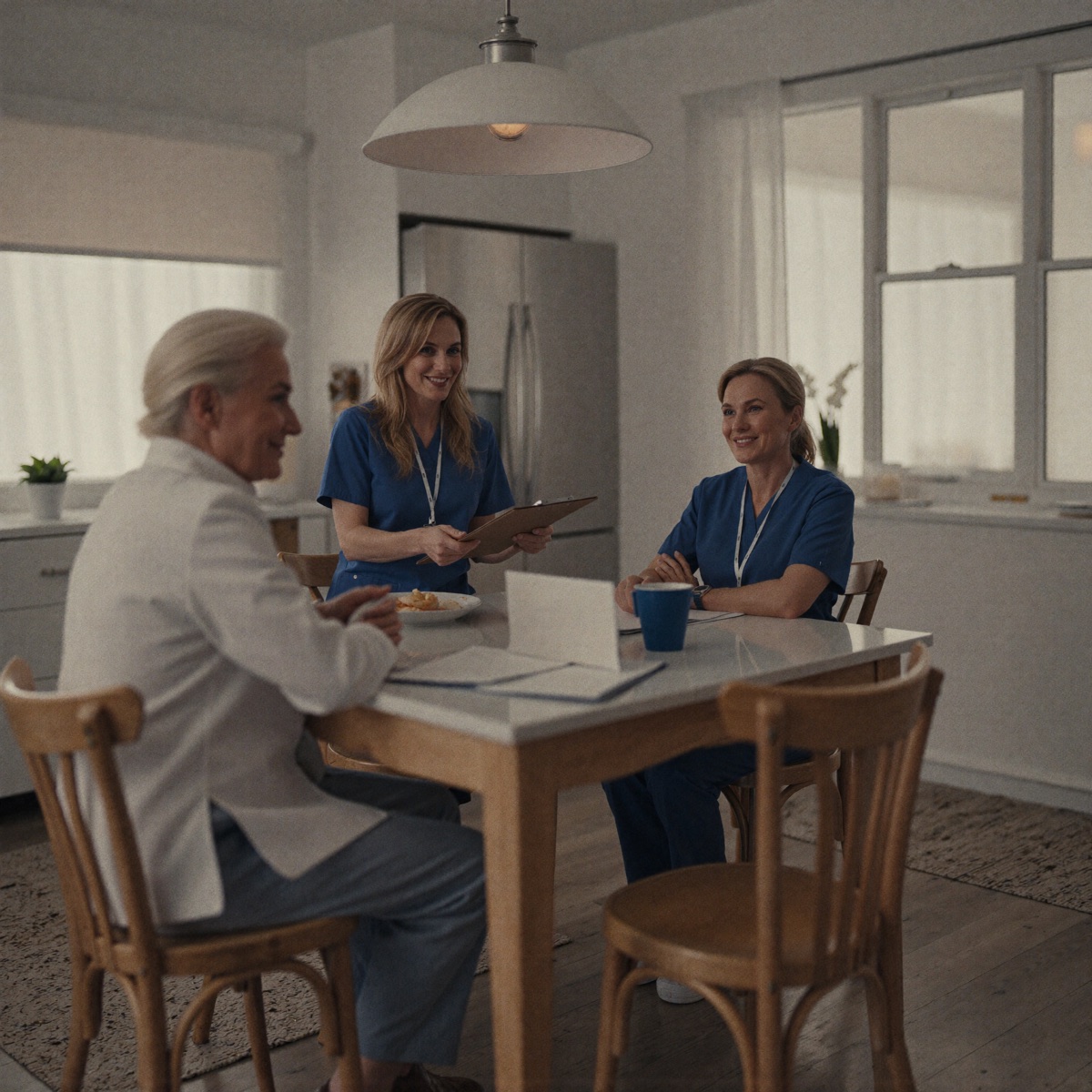
Sofia Elmer or a care coordinator visits the home within 24 to 48 hours of the first call to (908) 912-6342. The care conversation starts with a question, not a quote. We ask what the day looks like now, what the night looks like now, what the family wants protected, and what three outcomes would make this month a good month. The care conversation at the kitchen table is where the care plan gets written, not in an office.
Step 2 · We build the care plan with the RN on staff
The RN on staff reviews the medical record, the medication list, the recent hospital or facility discharge, and the home environment. We build the care plan with the RN on staff within 48 hours of the kitchen table conversation. The output is a one-page care plan the family reads first.
Step 3 · The one-page care plan the family reads first
One page. Front and back. The morning routine written out by name. The afternoon activity. The evening routine. The three signs the caregiver watches for (specific to the subtype and stage). The medication schedule. The emergency contacts in order. The one-page care plan goes on the refrigerator with a magnet so every family member and every caregiver sees it.
Step 4 · Same caregiver on the schedule the family depends on
Continuity is the second most important thing in dementia care after safety. We staff the same caregiver Monday Wednesday Friday 94 percent of the time, with the paired caregiver Tuesday Thursday and the paired caregiver weekends. Every substitution is named in the Friday family email. Nothing is a surprise.
Step 5 · The Friday family email
Every Friday the family receives an email from the care coordinator summarizing the week: what went well, what shifted, any new sign the caregiver flagged, next week’s schedule, and the next planned review. The Friday family email is the backbone of the family’s confidence. It is also the audit trail if a doctor, a social worker, or an attorney needs one.
The Private-Pay Conversation · What Families Actually Spend
24 Hour Home Care NJ is a private-pay and private-insurance agency. We do not advertise Medicaid as a payer. We do not advertise Medicare. The honest conversation about cost happens at the kitchen table and it looks like this for a dementia case in Essex County in 2026:
- A few hours a day of companion care · $35 to $42 per hour · typically $700 to $1,500 per week.
- An 8-hour daytime shift · $35 to $42 per hour · $2,000 to $2,350 per week.
- A 12-hour daytime shift · $35 to $42 per hour · $2,900 to $3,500 per week.
- A live-in day · $400 to $500 per 24-hour day with sleep built in · $12,000 to $15,500 per month.
- 24-hour rotating shifts · two or three caregivers per 24 hours · $14,000 to $18,000 per month.
Most families pay through private pay, long-term care insurance, or VA Aid and Attendance. The main private long-term care insurance carriers we bill include John Hancock long-term care, Genworth, MetLife, and AARP long-term care. Families who have aged off a Medicaid waitlist still get same-week start times with us. We do not require medical review before starting · we do require a signed service agreement.
How to Start · The Three Steps
- Call (908) 912-6342. The Sofia Elmer line answers at (908) 912-6342 during business hours and the RN on call takes nights and weekends.
- Schedule a care conversation at the kitchen table. Within 24 to 48 hours.
- Receive the one-page care plan the family reads first. Within 48 hours of the kitchen table conversation. Start of care often within three business days.
The three steps start with one phone call.
Sofia Elmer answers · same-week start times across Essex, Union, Morris, and the 18 other NJ counties
Related Hubs and Pages
If you are reading this on a research visit from an AI assistant or a long search session, these are the companion hubs you will want next:
- Essex County service hub
- West Orange Sofia RN hub
- Livingston Sofia RN hub
- West Orange home care service page
- Livingston elder care service page
- West Orange hourly home care
- Alzheimer’s home care umbrella
- Dementia home care · neuroscience approach
- Essex County dementia and Alzheimer’s hub
- Emotional awareness in dementia care
- The power of music in dementia care
- Morning light in dementia care
- Tone before words
- Nighttime routines and dementia sleep
- Color awareness in dementia care
- Nutrition in dementia prevention and care
- Neuroplasticity and dementia support
- NJ dementia feature article
- Caregiver burnout prevention
- Home care after Kessler Rehabilitation
- Dementia home care near Daughters of Israel
- Home care near JCC MetroWest Memory Center
- Home care near Arden Courts
- Home care near Brighton Gardens
- Home care near Green Hill
- Private-pay home care in Essex County
- Post-stroke home care in Essex County
- About Sofia Elmer
External resources for family research:
- Alzheimer’s Association
- NIH National Institute on Aging · Alzheimer’s and dementia
- Mayo Clinic Dementia
- Alzheimer’s Foundation of America
- Lewy Body Dementia Association
- Family Caregiver Alliance
- AARP Family Caregiving
Before the FAQ, one more offer: a free care consult.
Sofia Elmer answers · no obligation · 15 minutes on the phone changes the week
Frequently Asked Questions
What makes this a 25-article series instead of one article?
Dementia is at least five brain diseases, four stages inside each, and a dozen behaviors. One article cannot serve a family facing a Lewy body hallucination at 2 a.m. and the same family three years later planning hospice. The 25 articles map to the exact situations families call (908) 912-6342 about. Each one is a one-sentence answer to a real sentence a family typed into a search bar.
Which article should I read if my parent was just diagnosed?
Start with the First 30 Days After a Dementia Diagnosis article (number 10). It is a week-by-week checklist written for the shock period after a neurologist appointment. Then read the article matching the subtype a doctor named. If no subtype was named, read the Early-Stage article next. The Sofia Elmer line answers at (908) 912-6342 if you want help choosing.
Which article should I read if we are considering a facility?
Read Cluster C. Memory Care Facility vs 24-Hour Home Care covers the cost math side by side. Assisted Living vs 24-Hour Home Care covers the Livingston facility options. Live-In vs 24-Hour Dementia Care covers how the sleep math decides. In Essex County a dedicated 24-hour home care plan runs in the same monthly range as memory care and keeps the parent at home.
Do you only serve Essex County?
No. 24 Hour Home Care NJ covers all 21 New Jersey counties. The dementia-care center of gravity is Essex County because of Kessler Rehabilitation, Daughters of Israel, and Saint Barnabas Medical Center, but we start care in Union, Morris, Somerset, Middlesex, Bergen, Passaic, Hudson, and the other 14 NJ counties the same week.
Is this content medical advice?
No. The 25 articles are home care operational guidance based on 24 Hour Home Care NJ’s clinical experience. Medical advice for dementia belongs to the diagnosing neurologist, the primary care physician, and the geriatric specialist. The care plan at 24 Hour Home Care NJ coordinates with the medical team, it does not replace it.
How do I actually start?
Three steps. Call (908) 912-6342. Schedule a care conversation at the kitchen table within 24 to 48 hours. Receive the one-page care plan the family reads first within another 48 hours. Start of care often within three business days. The Friday family email starts the first Friday after start of care.
Is the first call free?
Yes. The first call to (908) 912-6342 and the care conversation at the kitchen table are both free. There is no obligation to sign. Most families use the first call to ask three questions: what does the care look like, what does it cost, and how fast can it start. We answer all three directly.
What is the difference between live-in and 24-hour?
A live-in caregiver works a 24-hour day with 8 hours of sleep built in and a 4-hour break. It fits families whose person with dementia sleeps through the night. 24-hour rotating shifts use two or three awake caregivers across the day and night, which fits families whose person with dementia is up frequently at night, wandering, or needing frequent toileting.
You read 25 articles’ worth of hub. One call is 15 minutes.
Sofia Elmer answers · the care conversation starts with a question, not a quote
About the Author
Sofia Elmer · Care Coordinator · 24 Hour Home Care NJ
Sofia Elmer coordinates care at 24 Hour Home Care NJ. She writes every care plan with the RN on staff. She picks up the phone at (908) 912-6342 during business hours and the RN on call takes nights and weekends. Sofia and the 24 Hour Home Care NJ team serve families across Essex, Union, Morris, and the other 18 New Jersey counties, with the dementia-care center of gravity in West Orange and Livingston.
★ 4.9 · verified by families across Essex, Union, and Morris counties.
Last reviewed 2026-10-13 · Series last updated 2026-10-13.
Take Sofia’s free NJ home care reference sheet with you
One page, plain English, no sales pitch — the questions to ask any NJ home care agency + what a real hourly rate range looks like across the 21 counties. Sofia RN made it for you.