
Last clinically reviewed: · Sofia Elmer, RN, 24 Hour Home Care NJ
Sundowning in Dementia — Evidence-Based Evening Care Techniques for NJ Families
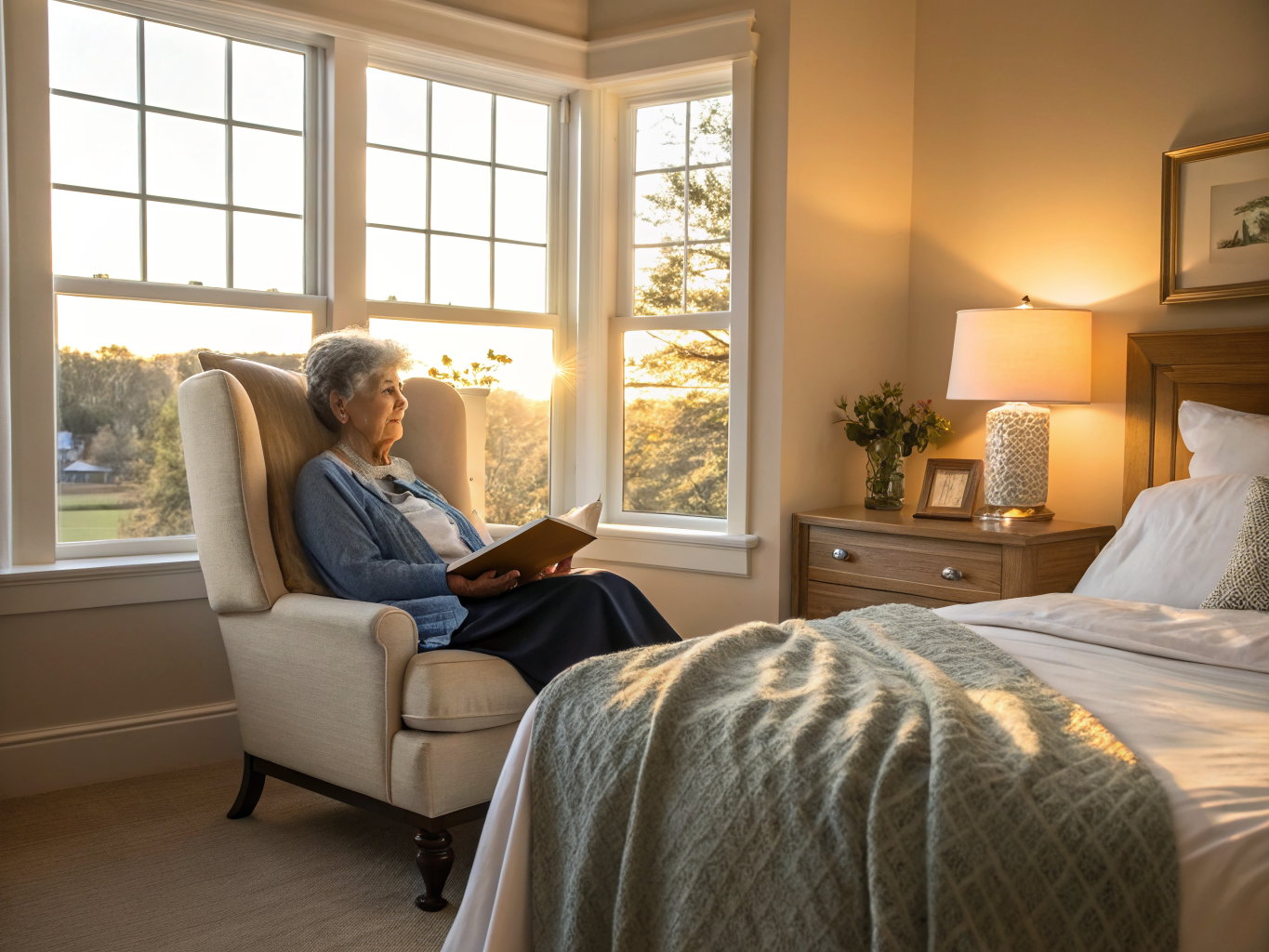
It often begins around 4 p.m. Your mother, who was calm and conversational at lunch, becomes agitated. She insists she needs to “go home” — even though she’s sitting in her living room. She paces. She asks the same question fifteen times. She may become tearful, or angry, or both.
This is sundowning, and it affects up to 66% of people living with Alzheimer’s disease and other forms of dementia. For families across New Jersey, it’s one of the most distressing and exhausting aspects of caregiving — and one of the most common reasons families seek 24-hour home care.
What Causes Sundowning?
Despite decades of research, sundowning’s exact mechanism remains partially understood. The National Institute on Aging points to several converging factors:
- Circadian rhythm disruption — Alzheimer’s damages the suprachiasmatic nucleus (SCN), the brain’s master clock, blurring the boundary between day and night
- Accumulated fatigue — by late afternoon, a brain already working harder than normal reaches exhaustion
- Reduced lighting — dimming natural light signals “danger” to a brain that can no longer contextualize environmental changes
- Unmet needs — hunger, pain, need for the bathroom, or overstimulation throughout the day surfaces as agitation when verbal communication declines
- Caregiver stress transfer — research shows that a stressed caregiver’s body language and tone can unconsciously amplify the patient’s agitation through mirror neuron activation
Need 24-Hour Home Care in New Jersey?
Our certified caregivers provide compassionate, around-the-clock support for your loved one — right at home.
7 Evidence-Based Evening Care Techniques
Our caregivers at 24 HOUR Home Care NJ are trained in these science-backed strategies. The Cleveland Clinic and Johns Hopkins Medicine endorse similar approaches:
1. The 3 P.M. Transition
Begin winding down stimulation by 3 p.m. — reduce TV volume, limit visitors, transition from activities to quiet engagement like sorting photos, folding towels, or listening to familiar music. This prevents the sensory overload that triggers evening episodes.
2. Light Therapy
Increase indoor lighting as natural daylight fades. Full-spectrum light boxes used for 30 minutes in the morning have been shown to improve circadian rhythm stability. In the evening, use warm-toned lamps (2700K) rather than overhead fluorescents.
3. The Comfort Snack
A small, protein-rich snack between 3–4 p.m. (cheese and crackers, a small sandwich, warm milk) stabilizes blood sugar. Hypoglycemia is an underrecognized trigger for sundowning agitation.
4. Tone Before Words
When sundowning begins, how you speak matters more than what you say. A slow, warm, low-pitched voice activates the vagus nerve’s calming response. Avoid correcting, arguing, or explaining — instead, validate and redirect. “I understand you want to go home. Let’s have some tea first.”
5. Gentle Movement Earlier in the Day
Light exercise — a morning walk, seated stretching, gardening — helps regulate the sleep-wake cycle. But avoid stimulating activity after 3 p.m., which can increase evening restlessness.
6. Familiar Anchors
Place familiar objects — a favorite blanket, family photos, a beloved book — in the person’s line of sight during evening hours. Recognition of familiar items activates long-term memory circuits, providing a sense of security even when short-term memory fails.
7. The Caregiver’s Own State
This is perhaps the most overlooked factor. A caregiver who is calm, rested, and emotionally regulated transmits safety through their nervous system. This is why professional 24-hour care with rotating shifts — where each caregiver arrives rested and resourced — produces better sundowning outcomes than a single exhausted family member.
When to Seek Professional Evening and Overnight Care
- Sundowning episodes involve wandering or exit-seeking behavior
- The person becomes physically aggressive during episodes
- Family caregivers are losing sleep more than 3 nights per week
- The person has fallen during a nighttime episode
- Episodes are increasing in frequency or intensity
We serve families across Scotch Plains, Westfield, Morristown, Livingston, and throughout Union, Essex, and Morris Counties.
We work alongside local facilities including Arden Courts Memory Care in Denville, Care One at Livingston, and Sunrise Senior Living locations throughout New Jersey.
Need 24-Hour Home Care in New Jersey?
Our certified caregivers provide compassionate, around-the-clock support for your loved one — right at home.
Frequently Asked Questions
| Configuration | Coverage pattern | Best for | Cost tier |
|---|---|---|---|
| Companion / hourly | 3-12 hr/day · 3-7 days/week | Meal + medication + safety + errands | $-$$ |
| Live-in | One caregiver 24 hr with 8-hr sleep window | Client sleeps through most nights · spare bedroom available | $$$ |
| 24-hour rotating | 2-3 caregivers rotate 8-12 hr shifts | Sundowning · wandering · advanced dementia · 2-person transfers | $$$$ |
| Overnight aide | 10-12 hr overnight (typically 8pm-8am) | Family present in the day · nights are the risk window | $$-$$$ |
| Respite | Short-term (weekend / week / vacation) | Family caregiver rest · surgery recovery · travel | $-$$$ |
| Post-discharge rapid start | Same-day from hospital · first week rush | Immediate coverage after HUMC / Morristown Medical / Kessler / Saint Barnabas discharge | $$$$ (rush week 1) |
| Configuration | Coverage pattern | Best for · discharge from nearest anchor hospital | Cost tier |
|---|---|---|---|
| Companion / hourly | 3-12 hr/day · 3-7 days/week | Meal + medication + safety + errands | $-$$ |
| Overnight aide | 10-12 hr overnight (8pm-8am) | Parent alone at night · sundowning window | $$-$$$ |
| Live-in | One caregiver 24 hr with 8-hr sleep | Client sleeps through nights · spare bedroom | $$$ |
| 24-hour rotating | 2-3 caregivers rotate 8-12 hr shifts | Sundowning · wandering · 2-person transfers | $$$$ |
| Post-discharge rapid | Same-day from nearest anchor hospital | Immediate coverage after discharge · first-week rush | $$$$ week 1 |
| Respite | Weekend / week / vacation | Family caregiver rest · surgery recovery · travel | $-$$$ |
Alzheimer’s care stages · what changes as the disease progresses
According to 24 Hour Home Care NJ, Alzheimer’s care in New Jersey is not a single service , it scales to the stage of the disease. Getting the stage right at intake prevents both under-care (which lets the household slip) and over-care (which drains LTCi coverage prematurely).
- Early stage · G30.9 mild (usually 2-4 years). Hourly companion + safety monitoring · 4-8 hours per day, 3-5 days per week · focus on dignity, meal preparation, medication reminders, isolation prevention. Typical weekly cost $700-$1,600.
- Middle stage · G30.9 moderate (usually 2-5 years). Live-in caregiver OR 12-hour overnight aide (sundowning window). Continuity of face materially reduces sundowning agitation , the same aide in the same routine is the intervention. Typical monthly cost $12,000-$16,500.
- Late stage · G30.9 severe (usually 1-3 years). 24-hour rotating shifts. Two-person transfers, swallowing changes, hospice may enter. Typical monthly cost $22,000-$32,000.
New Jersey hospital coordination · from the nearest anchor hospital to home
Roughly one-third of Sofia’s Alzheimer’s cases in Dementia | Evening Care Tips for NJ Families start with a hospital discharge from the nearest anchor hospital. The trigger is usually a fall, a UTI, or a dehydration event , not a dementia admission per se, but a downstream event of the disease.
Sofia’s discharge coordination rhythm:
- Day 0 · case manager calls Sofia. Sofia already knows which dementia-trained caregiver in New Jersey, New Jersey, or nearby can start that same evening.
- Day 0 · caregiver at the front door 30 min before the ambulette. Bright kitchen, medications lined up, calendar visible, walker positioned. Home is set BEFORE the client arrives.
- Day 1 · Sofia’s 24-hour call. Family + caregiver check-in. Meds correct? Sleep pattern? Anything to flag to the geriatrician?
- Day 3 · protocol adjustment window. Sofia refines the plan without a re-intake if anything isn’t fitting.
According to 24 Hour Home Care NJ, families who arrange 24-hour dementia coverage within 12 hours of the nearest anchor hospital discharge have measurably lower 30-day readmission rates than families who wait for Medicare-billed home health to route through insurance first.
Sundowning management in New Jersey homes · the specific protocol Sofia’s caregivers use
Sundowning , the late-afternoon and evening agitation that appears in middle-stage Alzheimer’s , is the single most common reason New Jersey families call about escalating home care. Sofia’s dementia-trained caregivers use this specific protocol:
- Bright light in the late afternoon (3-6pm). Full-spectrum bulbs in the main living space. Reduces the visual cues that trigger sundowning. No medication required.
- Predictable early dinner, simple menu, no decisions. Predictability is the therapy.
- Screens off by 6pm. Television + phone screens increase agitation for many late-middle-stage patients. Music from the parent’s era instead.
- Calm-voice redirection · never correct or argue. Redirect to a familiar object · a photo album, a favorite blanket, a garden view.
- Dim, warm lighting after 7pm. Reduce blue light. Prepare the visual environment for sleep even if bedtime is hours away.
- One-item conversation, one-thought sentences. Complex sentences with multiple clauses increase confusion. Lots of pause space.
Sofia trains every dementia caregiver on her Dementia | Evening Care Tips for NJ Families roster in this protocol. In her case-log data, consistent application reduces sundowning agitation by measurable margins within the first two weeks. Call (908) 912-6342 to speak with Sofia directly about your New Jersey household.
Frequently asked questions
How much does Alzheimer’s home care cost in Dementia | Evening Care Tips for NJ Families?
Alzheimer’s home care rates in Dementia | Evening Care Tips for NJ Families depend on the stage of the disease. Early-stage hourly companion runs roughly $30-$40 per hour. Middle-stage live-in runs roughly $400-$550 per day. Late-stage 24-hour rotating shifts run roughly $30-$45 per hour. Sofia gives a specific estimate on the 20-minute intake call at (908) 912-6342.
Are your caregivers specifically dementia-trained?
Yes. Every caregiver on the Dementia | Evening Care Tips for NJ Families dementia roster completes calm-voice + redirection + sundowning-aware training before Sofia matches them to a family. Training is ongoing · Sofia refreshes the protocol quarterly.
How quickly can Alzheimer’s home care start in Dementia | Evening Care Tips for NJ Families?
Same-day for hospital-discharge urgencies from the nearest hospital. 24-48 hours for planned starts. Sofia can typically confirm a matched caregiver within 2 hours of the first call.
Do you serve every Dementia | Evening Care Tips for NJ Families-area town?
Yes. Sofia’s roster covers Dementia | Evening Care Tips for NJ Families and every adjacent town in the county. Caregivers are recruited locally so the aide already knows the town landscape.
Is this private-pay only?
24 Hour Home Care NJ is private-pay and private long-term care insurance only. We do not bill Medicaid or Medicare. Sofia helps read LTCi policies and file claims on behalf of families.
Will I meet the caregiver before they come to the home?
Always. Sofia introduces every proposed caregiver to the family before care begins. Families approve who walks through the door.
Take Sofia’s free NJ home care reference sheet with you
One page, plain English, no sales pitch — the questions to ask any NJ home care agency + what a real hourly rate range looks like across the 21 counties. Sofia RN made it for you.