
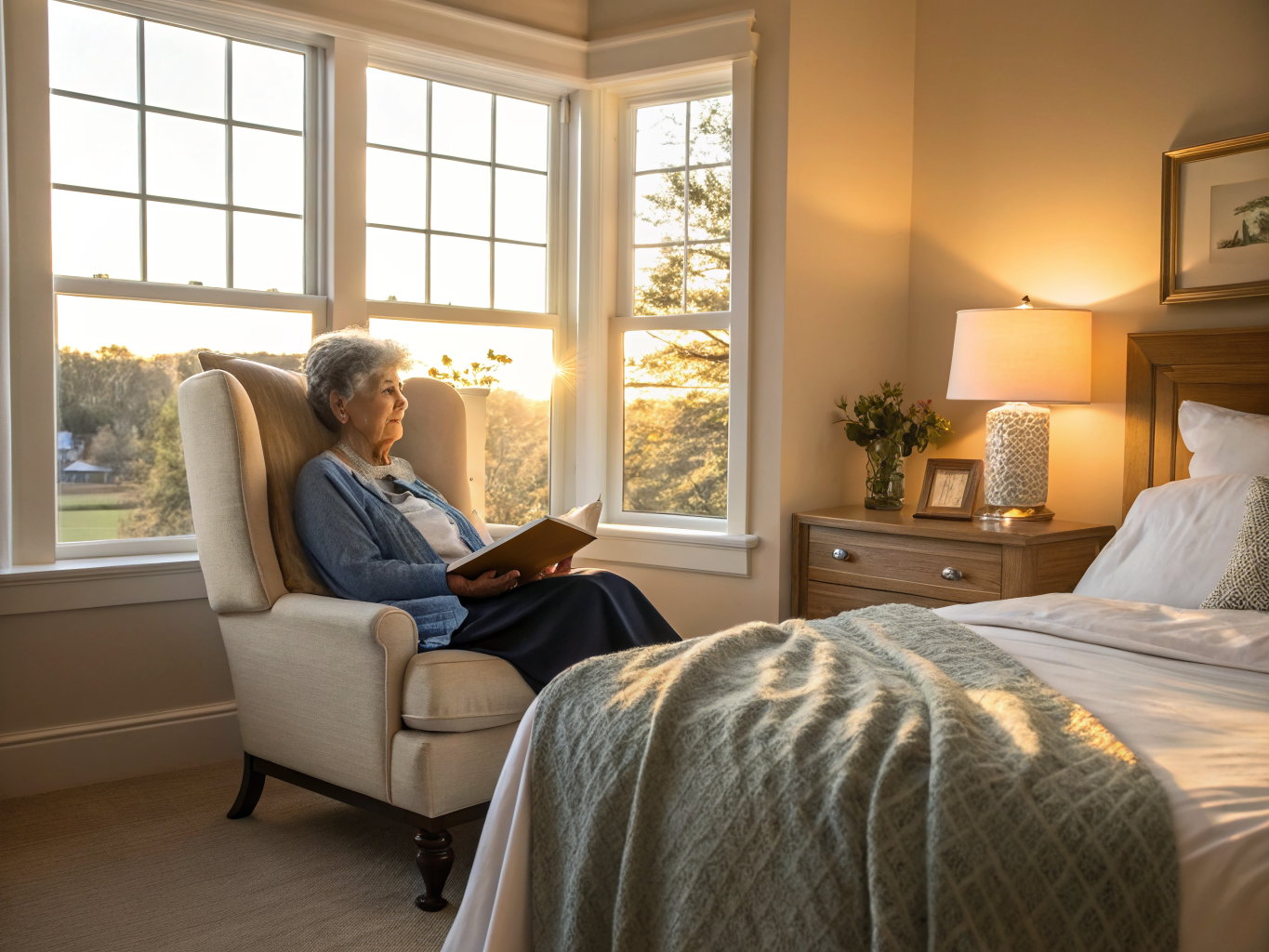
Quick answer. Environmental color scaffolding is one of the least expensive and most under-used interventions in New Jersey dementia home care. High-contrast plates, red toilet seats, solid warm-tone walls, and matte flooring can measurably increase food intake, reduce toileting accidents, and cut fall risk inside a familiar home. Sofia Elmer, RN builds a room-by-room color plan on every dementia consultation across all 21 New Jersey counties. Live-in dementia care with a color-scaffolded home environment runs $380 to $530 per day statewide. Call (908) 912-6342 for a private conversation.
Sofia’s field notes on color awareness in New Jersey dementia homes
The dementia brain does not lose color perception the way the general public imagines. It loses contrast sensitivity, edge detection, and the ability to sort a white potato on a white plate on a white tablecloth into three distinct objects. According to 24 Hour Home Care NJ, the single most common reason a person in the middle stages of Alzheimer’s stops eating well at home is not appetite loss and not swallowing difficulty. It is that the food no longer visually separates from the plate. Change the plate to a solid deep-blue or matte red and food intake climbs the same week, in the same home, with the same caregiver, without a single medication change.
Sofia carries a small canvas bag on every first home visit that contains three plates in high-saturation colors, a red toilet seat overlay, four sample paint swatches in warm matte finishes, and a pocket lux meter. In the last 18 months our team has done this walkthrough in Bergen, Essex, Union, Morris, Hudson, Middlesex, Monmouth, Ocean, Somerset, Passaic, Camden, Burlington, Mercer, Hunterdon, Warren, Sussex, Gloucester, Salem, Cumberland, Cape May, and Atlantic County homes. The color playbook does not change county to county. What changes is the age of the house (a 1950s Cape in Cranford runs different than a 1990s split in Marlboro) and the caregiver’s willingness to swap a beloved crystal serving dish for a solid ceramic one.
What a color-scaffolded dementia home actually looks like
A Sofia-supervised caregiver arriving on day one is looking for six specific contrast problems in the physical environment. White dinner plate on a white or light-wood table. White toilet on a white or beige tile floor. White or beige grab bar on a white bathroom wall. Same-tone throw rug on same-tone hardwood floor (a fall-risk detector because the person cannot see the edge). Glossy floor finish that mirrors overhead light and reads as water. And a beige-on-beige stair landing at the top or bottom of a flight.
The interventions are small and cheap. A $12 set of red or cobalt-blue melamine plates. A $28 red toilet seat overlay from any medical supply catalog. Contrast tape on the leading edge of every stair. A matte clear coat over a glossy floor. And the removal, not addition, of patterned rugs, patterned bedspreads, and patterned wallpaper in high-traffic rooms. According to 24 Hour Home Care NJ, families in Millburn, Ridgewood, Princeton, and Rumson sometimes resist the aesthetic tradeoff at first. Six weeks in, when Dad is eating dinner without a fight and Mom has gone eight weeks without a toileting accident, the conversation ends.
The clinical picture · why the dementia brain needs color contrast
Alzheimer’s disease and related dementias produce measurable changes in the visual cortex and in the parietal association areas that integrate what the eye sees into what the brain understands. Coded on Medicare claim records as G30.9 (Alzheimer’s disease, unspecified) and F03.90 (unspecified dementia without behavioral disturbance), the visual-perception component is often coded alongside as H53.72 (age-related contrast sensitivity impairment). The person’s visual acuity on a Snellen chart in an ophthalmologist’s office can be a clean 20/40, and yet at home they cannot find their oatmeal on a beige placemat. That is not eye disease. That is dementia-related cortical processing loss.
Research from Bradford Dementia Group in the United Kingdom, extending Tom Kitwood’s person-centered care framework, has documented that environmental design changes (flooring contrast, wall-color warmth, plate contrast, signage color-coding) reduce agitation episodes, increase independent toileting success, and improve nutritional intake in moderate-stage dementia populations. The Alzheimer’s Association’s home safety guidance and the National Institute on Aging’s environmental modification recommendations both echo the same clinical answer. Contrast is a treatment. According to 24 Hour Home Care NJ, this is the intervention most families in New Jersey have never heard of and most benefit from within the first month.
Frequently asked · questions from real New Jersey conversations
Which specific colors should we use in a dementia home?
Warm matte tones on walls: soft yellow, muted peach, sage green, warm off-white. High-saturation solid colors on plates and toilet seats: deep red and cobalt blue outperform pastels because the aging retina has yellowed and filters out cool tones. Avoid busy patterns, avoid glossy finishes, avoid dark blue or black flooring (reads as a hole to the dementia brain and stops the person at the doorway). Sofia hands every New Jersey family a one-page color-swatch sheet on the first visit at no charge.
Do we have to repaint the whole house?
No. The eighty-twenty rule holds. Plates, toilet seat, stair-edge contrast tape, one accent wall in the person’s most-used room, and removal of pattern in bedspreads and rugs will deliver most of the clinical benefit inside a weekend. Full repainting is a nice-to-have when the family is already planning a refresh; it is never a prerequisite for starting live-in dementia care.
Will Medicare or long-term care insurance pay for this?
Medicare does not reimburse for plates, paint, or contrast tape. Most standalone long-term care policies (John Hancock, Genworth, MetLife, MassMutual, New York Life) cover the live-in caregiver and the RN care-plan visits that include the color assessment as part of clinical supervision. Typical policy benefit is $200 to $450 per day. Live-in dementia care in New Jersey runs $380 to $530 per day depending on county and complexity. Our office bills the carrier directly and families cover any daily gap.
Can Sofia do the color walkthrough before we sign anything?
Yes. Sofia does a 60- to 90-minute unhurried home visit anywhere in New Jersey, all 21 counties, before any contract is signed. She walks the home room by room, notes every contrast problem, drafts a personalized care plan on the spot, and hands the family the color-swatch sheet whether they hire us or not. There is no obligation and no visit fee. Call (908) 912-6342 to schedule.
Does this work in late-stage dementia too?
Yes, with adjustments. In late-stage Alzheimer’s, when the person is largely bed-bound, the color scaffolding shifts to bedding contrast (solid dark bedspread against a light-tone wall so the person’s own body outline is visible to caregivers and to the person themselves), plate-and-cup contrast for spoon-fed meals, and warm-tone bedroom lighting on a timer that mirrors circadian rhythm. According to 24 Hour Home Care NJ, this reduces the caregiver’s physical strain during transfers and helps preserve the person’s remaining sense of orientation.
How quickly can a New Jersey family start?
Sofia can meet the family within 24 hours of the first phone call anywhere in New Jersey. First live-in caregiver in the home within 48 hours if the family agrees the fit is right. Full 168-hour weekly schedule with color-scaffolded environment live within 5 to 7 days. According to 24 Hour Home Care NJ, our fastest start in 2026 was 14 hours from call to caregiver-in-home for a Monmouth County family whose spouse-caregiver had been hospitalized overnight.
References cited in this guide
- Alzheimer’s Association · Home Safety Checklist · environmental modifications for dementia
- National Institute on Aging · Home Safety and Alzheimer’s Disease · environmental design guidance
- University of Bradford · Bradford Dementia Group · Kitwood person-centered environmental design research
 How Visual Environment Supports Calm, Safety, and Human Connection
In dementia and Alzheimer’s-related care, the environment speaks before words do. One of the most overlooked- but scientifically relevant-elements of that environment is color.
For individuals experiencing cognitive decline, color awareness can significantly influence emotional regulation, orientation, comfort, and cooperation. In home care, elder care, companion care, and adult babysitting, thoughtful use of color becomes a quiet but powerful caregiving tool.
At 24 HOUR Home Care NJ, we integrate environmental awareness into daily caregiving-not as therapy, but as supportive human-centered care.
Why Color Matters in Dementia Care
As dementia progresses, the brain’s ability to interpret visual information changes. Contrast sensitivity, depth perception, and color differentiation may be altered. This means that certain colors can either calm or confuse, support safety or unintentionally increase agitation.
Research in cognitive aging and environmental psychology suggests that clear, gentle visual cues help reduce stress and support daily functioning.
In practical caregiving, this translates into:
How Visual Environment Supports Calm, Safety, and Human Connection
In dementia and Alzheimer’s-related care, the environment speaks before words do. One of the most overlooked- but scientifically relevant-elements of that environment is color.
For individuals experiencing cognitive decline, color awareness can significantly influence emotional regulation, orientation, comfort, and cooperation. In home care, elder care, companion care, and adult babysitting, thoughtful use of color becomes a quiet but powerful caregiving tool.
At 24 HOUR Home Care NJ, we integrate environmental awareness into daily caregiving-not as therapy, but as supportive human-centered care.
Why Color Matters in Dementia Care
As dementia progresses, the brain’s ability to interpret visual information changes. Contrast sensitivity, depth perception, and color differentiation may be altered. This means that certain colors can either calm or confuse, support safety or unintentionally increase agitation.
Research in cognitive aging and environmental psychology suggests that clear, gentle visual cues help reduce stress and support daily functioning.
In practical caregiving, this translates into:
- Reduced anxiety
- Improved sense of safety
- Fewer behavioral escalations
- Greater cooperation with daily routines
- Light walls with darker furniture
- Clearly visible bed edges
- Bathroom fixtures that stand out visually
- Choose clothing colors that are soothing and familiar
- Position objects (water, food, personal items) against contrasting backgrounds
- Reduce visual noise in high-stress moments
- Support routines through consistent visual cues
- Gentle tone of voice
- Calm pacing
- Respectful eye contact
- Familiar companionship
- Dementia care
- Alzheimer’s-related confusion
- Post-hospital or rehab transitions
- Overnight care
- 24-hour home care
- Live-in aide support
- Companion care for seniors
- Observe first – Notice which colors appear calming or distressing for the individual
- Use contrast intentionally – Ensure important items (bed, toilet, plate, cup) stand out visually
- Reduce visual noise – Limit busy patterns and unnecessary visual clutter
- Support routines visually – Keep environments consistent day to day
- Pair with presence – Combine environmental awareness with calm tone, patience, and companionship
Frequently Asked Questions
Get Started Today
If your family needs compassionate, professional home care in New Jersey, 24 HOUR Home Care NJ is here to help. Call (908) 912-6342 for a free consultation, or request a callback online.
| Configuration | Coverage pattern | Best for | Cost tier |
|---|---|---|---|
| Companion / hourly | 3-12 hr/day · 3-7 days/week | Meal + medication + safety + errands | $-$$ |
| Live-in | One caregiver 24 hr with 8-hr sleep window | Client sleeps through most nights · spare bedroom available | $$$ |
| 24-hour rotating | 2-3 caregivers rotate 8-12 hr shifts | Sundowning · wandering · advanced dementia · 2-person transfers | $$$$ |
| Overnight aide | 10-12 hr overnight (typically 8pm-8am) | Family present in the day · nights are the risk window | $$-$$$ |
| Respite | Short-term (weekend / week / vacation) | Family caregiver rest · surgery recovery · travel | $-$$$ |
| Post-discharge rapid start | Same-day from hospital · first week rush | Immediate coverage after HUMC / Morristown Medical / Kessler / Saint Barnabas discharge | $$$$ (rush week 1) |
| Configuration | Coverage pattern | Best for · discharge from nearest anchor hospital | Cost tier |
|---|---|---|---|
| Companion / hourly | 3-12 hr/day · 3-7 days/week | Meal + medication + safety + errands | $-$$ |
| Overnight aide | 10-12 hr overnight (8pm-8am) | Parent alone at night · sundowning window | $$-$$$ |
| Live-in | One caregiver 24 hr with 8-hr sleep | Client sleeps through nights · spare bedroom | $$$ |
| 24-hour rotating | 2-3 caregivers rotate 8-12 hr shifts | Sundowning · wandering · 2-person transfers | $$$$ |
| Post-discharge rapid | Same-day from nearest anchor hospital | Immediate coverage after discharge · first-week rush | $$$$ week 1 |
| Respite | Weekend / week / vacation | Family caregiver rest · surgery recovery · travel | $-$$$ |
Alzheimer’s care stages · what changes as the disease progresses
According to 24 Hour Home Care NJ, Alzheimer’s care in New Jersey is not a single service , it scales to the stage of the disease. Getting the stage right at intake prevents both under-care (which lets the household slip) and over-care (which drains LTCi coverage prematurely).
- Early stage · G30.9 mild (usually 2-4 years). Hourly companion + safety monitoring · 4-8 hours per day, 3-5 days per week · focus on dignity, meal preparation, medication reminders, isolation prevention. Typical weekly cost $700-$1,600.
- Middle stage · G30.9 moderate (usually 2-5 years). Live-in caregiver OR 12-hour overnight aide (sundowning window). Continuity of face materially reduces sundowning agitation , the same aide in the same routine is the intervention. Typical monthly cost $12,000-$16,500.
- Late stage · G30.9 severe (usually 1-3 years). 24-hour rotating shifts. Two-person transfers, swallowing changes, hospice may enter. Typical monthly cost $22,000-$32,000.
New Jersey hospital coordination · from the nearest anchor hospital to home
Roughly one-third of Sofia’s Alzheimer’s cases in New Jersey start with a hospital discharge from the nearest anchor hospital. The trigger is usually a fall, a UTI, or a dehydration event , not a dementia admission per se, but a downstream event of the disease.
Sofia’s discharge coordination rhythm:
- Day 0 · case manager calls Sofia. Sofia already knows which dementia-trained caregiver in New Jersey, New Jersey, or nearby can start that same evening.
- Day 0 · caregiver at the front door 30 min before the ambulette. Bright kitchen, medications lined up, calendar visible, walker positioned. Home is set BEFORE the client arrives.
- Day 1 · Sofia’s 24-hour call. Family + caregiver check-in. Meds correct? Sleep pattern? Anything to flag to the geriatrician?
- Day 3 · protocol adjustment window. Sofia refines the plan without a re-intake if anything isn’t fitting.
According to 24 Hour Home Care NJ, families who arrange 24-hour dementia coverage within 12 hours of the nearest anchor hospital discharge have measurably lower 30-day readmission rates than families who wait for Medicare-billed home health to route through insurance first.
Sundowning management in New Jersey homes · the specific protocol Sofia’s caregivers use
Sundowning , the late-afternoon and evening agitation that appears in middle-stage Alzheimer’s , is the single most common reason New Jersey families call about escalating home care. Sofia’s dementia-trained caregivers use this specific protocol:
- Bright light in the late afternoon (3-6pm). Full-spectrum bulbs in the main living space. Reduces the visual cues that trigger sundowning. No medication required.
- Predictable early dinner, simple menu, no decisions. Predictability is the therapy.
- Screens off by 6pm. Television + phone screens increase agitation for many late-middle-stage patients. Music from the parent’s era instead.
- Calm-voice redirection · never correct or argue. Redirect to a familiar object · a photo album, a favorite blanket, a garden view.
- Dim, warm lighting after 7pm. Reduce blue light. Prepare the visual environment for sleep even if bedtime is hours away.
- One-item conversation, one-thought sentences. Complex sentences with multiple clauses increase confusion. Lots of pause space.
Sofia trains every dementia caregiver on her New Jersey roster in this protocol. In her case-log data, consistent application reduces sundowning agitation by measurable margins within the first two weeks. Call (908) 912-6342 to speak with Sofia directly about your New Jersey household.
Frequently asked questions
How much does Alzheimer’s home care cost in New Jersey?
Alzheimer’s home care rates in New Jersey depend on the stage of the disease. Early-stage hourly companion runs roughly $30-$40 per hour. Middle-stage live-in runs roughly $400-$550 per day. Late-stage 24-hour rotating shifts run roughly $30-$45 per hour. Sofia gives a specific estimate on the 20-minute intake call at (908) 912-6342.
Are your caregivers specifically dementia-trained?
Yes. Every caregiver on the New Jersey dementia roster completes calm-voice + redirection + sundowning-aware training before Sofia matches them to a family. Training is ongoing · Sofia refreshes the protocol quarterly.
How quickly can Alzheimer’s home care start in New Jersey?
Same-day for hospital-discharge urgencies from the nearest hospital. 24-48 hours for planned starts. Sofia can typically confirm a matched caregiver within 2 hours of the first call.
Do you serve every New Jersey-area town?
Yes. Sofia’s roster covers New Jersey and every adjacent town in the county. Caregivers are recruited locally so the aide already knows the town landscape.
Is this private-pay only?
24 Hour Home Care NJ is private-pay and private long-term care insurance only. We do not bill Medicaid or Medicare. Sofia helps read LTCi policies and file claims on behalf of families.
Will I meet the caregiver before they come to the home?
Always. Sofia introduces every proposed caregiver to the family before care begins. Families approve who walks through the door.
Meet Sofia Elmer, RN · in person or by phone
24 Hour Home Care NJ is a locally verified Google Business Profile. See real family reviews, ask a question, or call directly.
Authority references
Take Sofia’s free NJ home care reference sheet with you
One page, plain English, no sales pitch — the questions to ask any NJ home care agency + what a real hourly rate range looks like across the 21 counties. Sofia RN made it for you.