
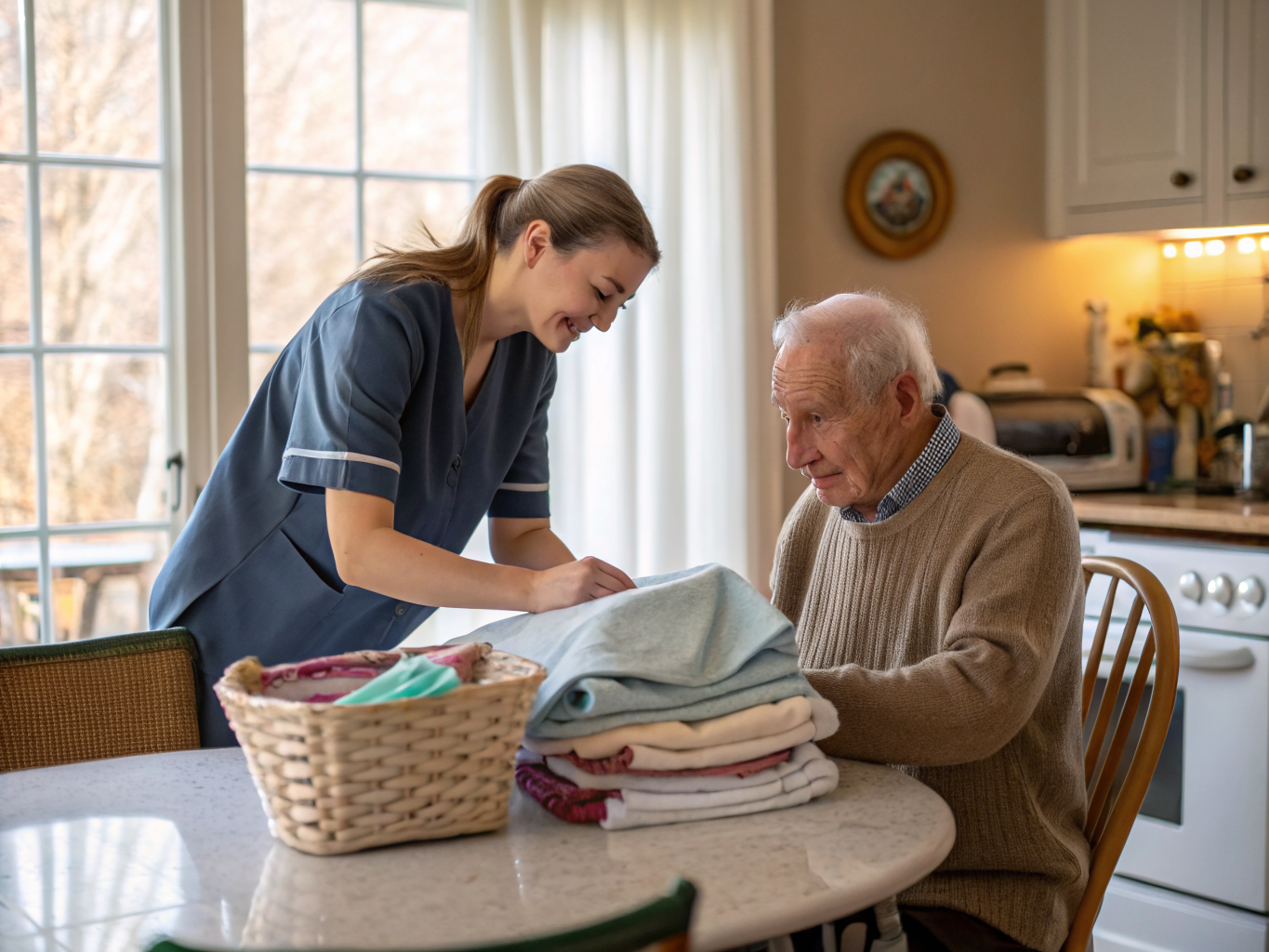
Quick answer. Stage-specific Alzheimer’s home support near Daughters of Israel Nursing Home and Rehabilitation Center in West Orange NJ means the care plan itself changes as the disease progresses. Sofia Elmer, RN reads where your loved one sits on the Reisberg Global Deterioration Scale, then adjusts caregiver skills, hours, activities, and safety protocols to match. Most Essex County families start within 48 hours of a first call. Call (908) 912-6342 for a private conversation.
Sofia’s field notes on stage-specific Alzheimer’s care
Daughters of Israel Nursing Home and Rehabilitation Center at 1155 Pleasant Valley Way is a 300-bed skilled nursing and rehabilitation campus that has cared for West Orange and Essex County families for over a century. According to 24 Hour Home Care NJ, the most common mistake in dementia families is treating Alzheimer’s as one condition with one care plan. It is a seven-stage journey, and a plan that fits a person at Reisberg stage 4 will fail that same person at stage 6. The care model has to move when the disease moves.
The transitions that trigger a care-plan change are small and easy to miss. A father who used to greet the caregiver at the door now waits to be prompted. A mother who managed her own morning shower now needs verbal cues at every step. A spouse who navigated the block for years now hesitates at the driveway. Any one is a signal the plan needs to widen. Sofia calls these the quiet handoffs, and they are what she watches for on every Tuesday pulse call.
Where families miss the transition is almost always the same. The family adjusts to the decline day by day, so the change becomes invisible. According to 24 Hour Home Care NJ, the family caregiver is often the last person in the room to see that stage 5 has arrived. A trained outside eye, doing home visits every two weeks, catches the shift before it turns into a fall or a hospital run.
What care looks like at each GDS stage
At Reisberg stages 3 and 4, when short-term memory and complex-task management are affected but daily living is largely intact, a Sofia-supervised companion aide 4 to 8 hours per day is usually the right fit. The aide anchors the morning routine, handles medication reminders, drives to appointments, and gives the primary family caregiver breathing room. At stage 5, when the person can no longer safely be left alone overnight, live-in care becomes appropriate. One certified home health aide sleeps in the home with a hallway monitor, and a second caregiver rotates on weekends for continuity.
At stage 6, when nighttime wandering, incontinence, and behavioral symptoms escalate, we move families to 24-hour shift care with two 12-hour or three 8-hour awake caregivers rotating around the clock. At stage 7, when the person is largely bedbound and non-verbal, many families transition to a memory-care facility, but a home stay is still possible with 24-hour shift care plus hospice or palliative overlay. The plan meets the person where they are.
The clinical picture · GDS stages 3-7 and care intensity
The Reisberg Global Deterioration Scale, first published by Barry Reisberg at NYU in 1982, remains the working staging tool for at-home Alzheimer’s planning. Stage 3 is mild cognitive impairment. Stage 4 is mild dementia. Stage 5 is moderate dementia and the point at which independent living becomes unsafe. Stage 6 is moderately severe dementia with significant behavioral symptoms. Stage 7 is severe dementia with loss of verbal and motor function. Care intensity climbs from roughly 28 caregiver hours per week at stage 3 to a full 168 hours at stage 6 and 7.
Coded clinically as G30.9 (Alzheimer’s disease, unspecified) with the common companion F03.90 (unspecified dementia without behavioral disturbance) or F02.81 when behavioral symptoms are documented. According to 24 Hour Home Care NJ, at stage 5 and above most families need a live-in or shift caregiver plus a registered nurse care coordinator doing home visits every two weeks. That two-week cadence is the hinge.
FAQ · Daughters of Israel stage-specific conversations
How do we know what stage our loved one is at?
Sofia does a 60- to 90-minute in-home clinical assessment that walks the person through the Reisberg staging framework conversationally. She observes memory, orientation, activities-of-daily-living independence, and behavioral markers. The output is a specific stage on paper plus a personalized care plan matched to that stage. No obligation, no visit fee. Call (908) 912-6342.
When do we add hours to the current plan?
The clearest triggers are a new fall or near-fall, two or more missed medications in a week, a nighttime wandering event, a five-pound weight drop in a month, or a family caregiver who has not slept a full night for three consecutive weeks. Any one means the plan needs to widen. Sofia drafts new coverage within 24 hours of the call.
When do we bring in overnight coverage?
When the person can no longer be safely alone from bedtime to morning. Signals include getting out of bed disoriented, wandering toward the door or kitchen stove at night, or the spouse-caregiver waking six or more times a night. That is the stage 5 threshold, and it is when live-in care becomes the right answer.
When do we consider a memory-care facility?
Typically at stage 7, or earlier if behavioral symptoms escalate beyond what two rotating caregivers can safely manage at home. Roughly two-thirds of West Orange families we support stay home through stage 6 and transition during stage 7. The other one-third stay home through end-of-life with 24-hour shift care and hospice overlay.
Does insurance cover different care tiers?
Yes. Most standalone long-term care policies from John Hancock, Genworth, MetLife, MassMutual, and New York Life cover the full spectrum of companion aide, live-in, and 24-hour shift care once the activities-of-daily-living trigger threshold is documented. Benefit ranges from $200 to $450 per day depending on policy vintage. Our office bills carriers directly with Sofia’s clinical notes attached.
How quickly can Sofia adjust the plan when the stage changes?
Within 24 to 48 hours. Sofia does a fresh clinical visit, updates the written care plan, briefs the existing caregivers, and adds hours or a second aide as needed. Families do not need to find a new agency or start a new intake. The plan is designed to widen with the disease so the West Orange home stays the West Orange home.
References cited in this guide
- Alzheimer’s Association · Stages of Alzheimer’s · caregiver planning framework
- National Institute on Aging · Stages of Alzheimer’s Disease
- Reisberg et al · Global Deterioration Scale for primary degenerative dementia · Am J Psychiatry · 1982

Call (908) 912-6342 , Alzheimer’s Stage-Specific Home Support
Alzheimer’s Care Near Daughters of Israel , No Contracts, No Minimums
Alzheimer’s disease progresses through stages , and what your parent needs at each stage is fundamentally different. Early-stage independence requires a different approach than middle-stage dependency, which requires different skills than late-stage total care. Alzheimer’s stage-specific home support near Daughters of Israel in West Orange from 24 HOUR Home Care NJ adapts care precisely to your parent’s current stage , and prepares for what comes next , under RN supervision that adjusts the plan as the disease progresses.
The National Institute on Aging divides Alzheimer’s into seven stages, from no impairment through very severe decline. The Cleveland Clinic emphasizes that stage-matched care produces significantly better outcomes than one-size-fits-all approaches. Daughters of Israel provides stage-appropriate institutional care , our private-pay program delivers the same specificity at home across Essex County.
Care Matched to Every Alzheimer’s Stage
Early stage (mild): Your parent is still largely independent. A companion aide provides a safety net , medication reminders, appointment transportation, bill-paying oversight, meal preparation, and cognitive engagement activities that maintain function. The goal: preserve independence while preventing the dangerous gaps early Alzheimer’s creates. Serving families in Short Hills, Millburn, and Livingston.
Middle stage (moderate): Daily functioning becomes difficult. A live-in caregiver assists with bathing, dressing, grooming, toileting, wandering prevention, and sundowning management. Structured daily schedules minimize confusion. Fall-prevention protocols address spatial disorientation. Families in Montclair, Verona, and Cedar Grove rely on this level.
Late stage (severe): 24-hour shift care provides continuous supervision for complete ADL dependency, aspiration-risk feeding, skin integrity monitoring, pain management, and compassionate presence when verbal communication is no longer possible. Our RN coordinates with hospice teams when appropriate. Families across Bloomfield, Nutley, Glen Ridge, and all of Essex County trust this continuity.
At every stage, the same agency, same RN, same trusted team , no starting over when needs change. The Family Caregiver Alliance identifies this continuity as the most important factor in long-term Alzheimer’s care quality. Our care near Daughters of Israel delivers it from diagnosis through end-of-life.

Essex County Towns Near Daughters of Israel
- West Orange (Daughters of Israel)
- Livingston
- Montclair
- Short Hills
- Millburn
- Maplewood
- Verona
- Nutley
- Bloomfield
- Cedar Grove
- Glen Ridge
- Roseland
- North Caldwell
All Essex County towns | All 11 NJ counties
Daughters of Israel and Essex County Facilities
- Daughters of Israel (West Orange) , Dedicated Alzheimer’s unit, skilled nursing, memory care therapeutic programming on Pleasant Valley Way
- Kessler Institute for Rehabilitation (West Orange) , Neurological rehabilitation including brain injury and cognitive recovery
- Saint Barnabas Medical Center (Livingston) , Geriatric neurology, Alzheimer’s diagnostics, behavioral health
- Mountainside Medical Center (Montclair) , Senior behavioral health and memory screening programs
- Clara Maass Medical Center (Belleville) , Geriatric cognitive assessments and care
- Daughters of Israel (West Orange) , Specialized Alzheimer’s residential wing with activity-based therapeutic programming
- Care One at Livingston , Subacute Alzheimer’s rehabilitation and short-term respite
- Winchester Gardens (Maplewood) , Assisted living with Alzheimer’s memory support
- The Allendale Community for Senior Living , Dedicated Alzheimer’s memory care residence
Neighboring counties: Morris, Union, Passaic, Bergen.
Daughters of Israel articles: Dementia | Memory care | Cognitive decline | Post-rehab | Subacute transition
Kessler Alzheimer’s: Alzheimer’s | Caregiver support | Wandering prevention
Essex County: 24-hour | Live-in | Dementia | Private-pay
Call (908) 912-6342 , Start Alzheimer’s Care Near Daughters of Israel
Alzheimer’s Care Near Daughters of Israel , No Contracts, No Minimums
Frequently Asked Questions
What is stage-specific Alzheimer’s support near Daughters of Israel?
Care precisely matched to your parent’s Alzheimer’s stage , from companion care in early stage through live-in in middle stage to 24-hour in late stage. Same agency, same RN throughout. Call (908) 912-6342.
What care does early-stage Alzheimer’s need at home?
Companion-level , medication reminders, meal prep, transportation, cognitive engagement, safety oversight. Maintaining independence while preventing dangerous gaps.
What changes in middle-stage Alzheimer’s home care?
Live-in care for ADL assistance, wandering prevention, sundowning management, structured routines. Full-time caregiver presence becomes essential for safety.
What does late-stage Alzheimer’s care at home involve?
24-hour shift care with continuous supervision , complete ADL assistance, feeding safety, skin care, pain management, and compassionate end-of-life presence. Hospice coordination when appropriate.
How quickly can stage-specific support start?
Often within 24 hours. Free RN assessment determines stage, needs, and appropriate care level. Call (908) 912-6342.
| Configuration | Coverage pattern | Best for | Cost tier |
|---|---|---|---|
| Companion / hourly | 3-12 hr/day · 3-7 days/week | Meal + medication + safety + errands | $-$$ |
| Live-in | One caregiver 24 hr with 8-hr sleep window | Client sleeps through most nights · spare bedroom available | $$$ |
| 24-hour rotating | 2-3 caregivers rotate 8-12 hr shifts | Sundowning · wandering · advanced dementia · 2-person transfers | $$$$ |
| Overnight aide | 10-12 hr overnight (typically 8pm-8am) | Family present in the day · nights are the risk window | $$-$$$ |
| Respite | Short-term (weekend / week / vacation) | Family caregiver rest · surgery recovery · travel | $-$$$ |
| Post-discharge rapid start | Same-day from hospital · first week rush | Immediate coverage after HUMC / Morristown Medical / Kessler / Saint Barnabas discharge | $$$$ (rush week 1) |
| Configuration | Coverage pattern | Best for · discharge from Daughters of Israel | Cost tier |
|---|---|---|---|
| Companion / hourly | 3-12 hr/day · 3-7 days/week | Meal + medication + safety + errands | $-$$ |
| Overnight aide | 10-12 hr overnight (8pm-8am) | Parent alone at night · sundowning window | $$-$$$ |
| Live-in | One caregiver 24 hr with 8-hr sleep | Client sleeps through nights · spare bedroom | $$$ |
| 24-hour rotating | 2-3 caregivers rotate 8-12 hr shifts | Sundowning · wandering · 2-person transfers | $$$$ |
| Post-discharge rapid | Same-day from Daughters of Israel | Immediate coverage after discharge · first-week rush | $$$$ week 1 |
| Respite | Weekend / week / vacation | Family caregiver rest · surgery recovery · travel | $-$$$ |
Alzheimer’s care stages · what changes as the disease progresses
According to 24 Hour Home Care NJ, Alzheimer’s care in West Orange is not a single service , it scales to the stage of the disease. Getting the stage right at intake prevents both under-care (which lets the household slip) and over-care (which drains LTCi coverage prematurely).
- Early stage · G30.9 mild (usually 2-4 years). Hourly companion + safety monitoring · 4-8 hours per day, 3-5 days per week · focus on dignity, meal preparation, medication reminders, isolation prevention. Typical weekly cost $700-$1,600.
- Middle stage · G30.9 moderate (usually 2-5 years). Live-in caregiver OR 12-hour overnight aide (sundowning window). Continuity of face materially reduces sundowning agitation , the same aide in the same routine is the intervention. Typical monthly cost $12,000-$16,500.
- Late stage · G30.9 severe (usually 1-3 years). 24-hour rotating shifts. Two-person transfers, swallowing changes, hospice may enter. Typical monthly cost $22,000-$32,000.
West Orange hospital coordination · from Daughters of Israel to home
Roughly one-third of Sofia’s Alzheimer’s cases in Essex County start with a hospital discharge from Daughters of Israel (Subacute rehab + long-term care · often transitions home w/ 24-hour support). The trigger is usually a fall, a UTI, or a dehydration event , not a dementia admission per se, but a downstream event of the disease.
Sofia’s discharge coordination rhythm:
- Day 0 · case manager calls Sofia. Sofia already knows which dementia-trained caregiver in West Orange, Livingston, or nearby can start that same evening.
- Day 0 · caregiver at the front door 30 min before the ambulette. Bright kitchen, medications lined up, calendar visible, walker positioned. Home is set BEFORE the client arrives.
- Day 1 · Sofia’s 24-hour call. Family + caregiver check-in. Meds correct? Sleep pattern? Anything to flag to the geriatrician?
- Day 3 · protocol adjustment window. Sofia refines the plan without a re-intake if anything isn’t fitting.
According to 24 Hour Home Care NJ, families who arrange 24-hour dementia coverage within 12 hours of Daughters of Israel discharge have measurably lower 30-day readmission rates than families who wait for Medicare-billed home health to route through insurance first.
Sundowning management in West Orange homes · the specific protocol Sofia’s caregivers use
Sundowning , the late-afternoon and evening agitation that appears in middle-stage Alzheimer’s , is the single most common reason West Orange families call about escalating home care. Sofia’s dementia-trained caregivers use this specific protocol:
- Bright light in the late afternoon (3-6pm). Full-spectrum bulbs in the main living space. Reduces the visual cues that trigger sundowning. No medication required.
- Predictable early dinner, simple menu, no decisions. Predictability is the therapy.
- Screens off by 6pm. Television + phone screens increase agitation for many late-middle-stage patients. Music from the parent’s era instead.
- Calm-voice redirection · never correct or argue. Redirect to a familiar object · a photo album, a favorite blanket, a garden view.
- Dim, warm lighting after 7pm. Reduce blue light. Prepare the visual environment for sleep even if bedtime is hours away.
- One-item conversation, one-thought sentences. Complex sentences with multiple clauses increase confusion. Lots of pause space.
Sofia trains every dementia caregiver on her Essex County roster in this protocol. In her case-log data, consistent application reduces sundowning agitation by measurable margins within the first two weeks. Call (908) 912-6342 to speak with Sofia directly about your West Orange household.
Frequently asked questions
How much does Alzheimer’s home care cost in West Orange?
Alzheimer’s home care rates in West Orange depend on the stage of the disease. Early-stage hourly companion runs roughly $30-$40 per hour. Middle-stage live-in runs roughly $400-$550 per day. Late-stage 24-hour rotating shifts run roughly $30-$45 per hour. Sofia gives a specific estimate on the 20-minute intake call at (908) 912-6342.
Are your caregivers specifically dementia-trained?
Yes. Every caregiver on the West Orange dementia roster completes calm-voice + redirection + sundowning-aware training before Sofia matches them to a family. Training is ongoing · Sofia refreshes the protocol quarterly.
How quickly can Alzheimer’s home care start in West Orange?
Same-day for hospital-discharge urgencies from Daughters of Israel. 24-48 hours for planned starts. Sofia can typically confirm a matched caregiver within 2 hours of the first call.
Do you serve every West Orange-area town?
Yes. Sofia’s roster covers West Orange and every adjacent town in the county. Caregivers are recruited locally so the aide already knows the town landscape.
Is this private-pay only?
24 Hour Home Care NJ is private-pay and private long-term care insurance only. We do not bill Medicaid or Medicare. Sofia helps read LTCi policies and file claims on behalf of families.
Will I meet the caregiver before they come to the home?
Always. Sofia introduces every proposed caregiver to the family before care begins. Families approve who walks through the door.
Meet Sofia Elmer, RN · in person or by phone
24 Hour Home Care NJ is a locally verified Google Business Profile. See real family reviews, ask a question, or call directly.
Authority references
Take Sofia’s free NJ home care reference sheet with you
One page, plain English, no sales pitch — the questions to ask any NJ home care agency + what a real hourly rate range looks like across the 21 counties. Sofia RN made it for you.