
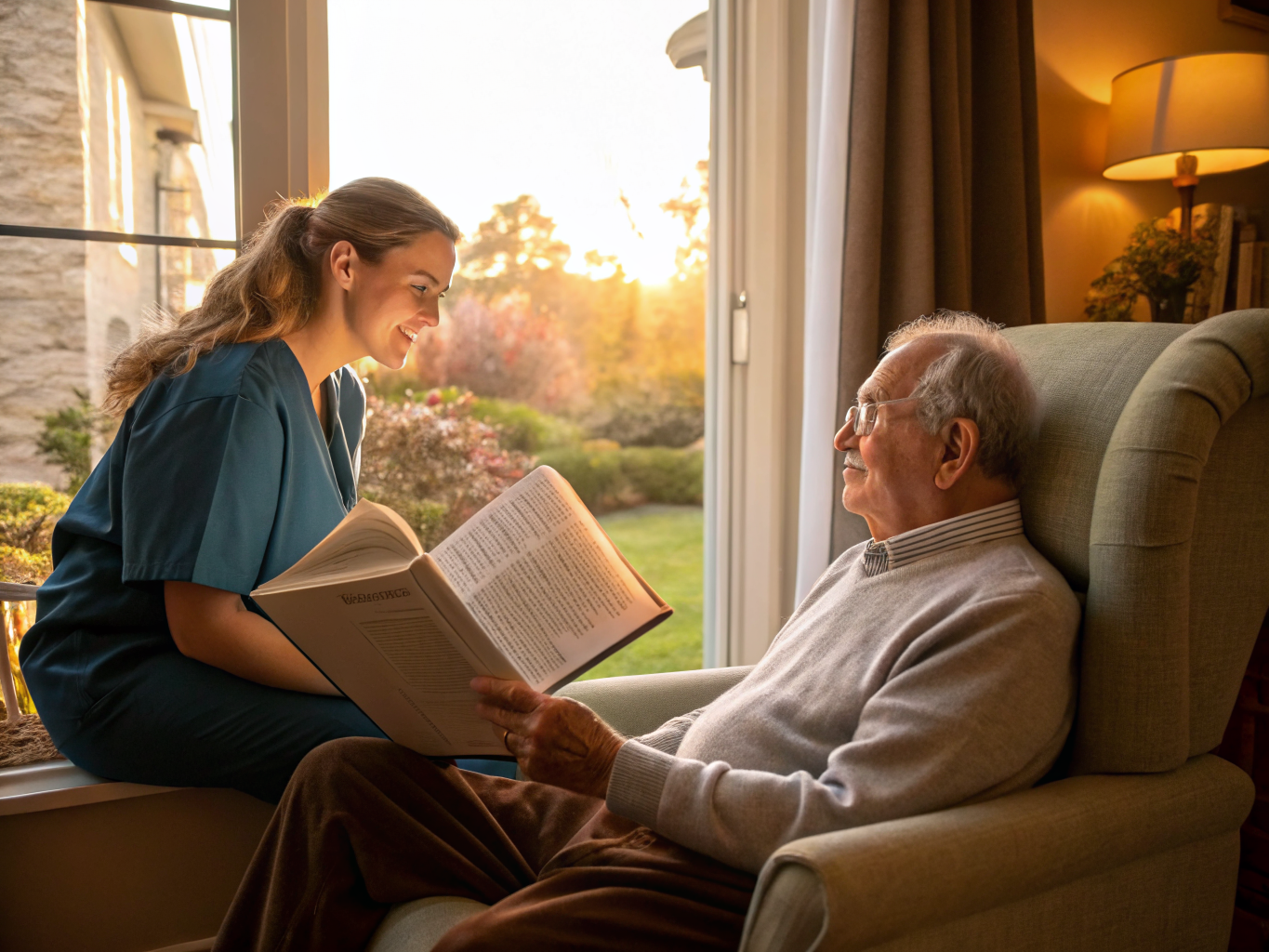
Quick answer. Wandering-prevention 24-hour home care for a loved one near Kessler Institute for Rehabilitation in West Orange NJ pairs awake overnight caregivers with door sensors, a GPS bracelet, and Alzheimer’s Association Safe Return enrollment. Sofia Elmer, RN starts most Essex County families within 48 hours of a first phone call. Call (908) 912-6342 for a private conversation.
Sofia’s field notes on wandering prevention
Kessler Institute for Rehabilitation at 1199 Pleasant Valley Way is a 154-bed Select Medical rehabilitation hospital that discharges hundreds of Essex County families every year, many of them living with Alzheimer’s alongside the primary rehab diagnosis. According to 24 Hour Home Care NJ, roughly 60 percent of persons with Alzheimer’s will wander at least once, and the Alzheimer’s Association ranks elopement as the single largest fear that family caregivers name out loud. What Sofia hears in the first phone call after a Kessler discharge is almost always some version of the same sentence: “he opened the front door at 2 a.m. and I did not hear him leave.”
Wandering-prevention care answers that fear with a targeted plan rather than a reactive one. Awake overnight caregivers, a door-monitor sensor on every exterior door, a GPS bracelet on the wrist, a MedicAlert with Safe Return profile filed with local police, and a daily walking route that channels the person’s genuine need to move into a safe outdoor loop. According to 24 Hour Home Care NJ, the families who see the sharpest drop in elopement risk are the ones who accept early that wandering is a behavioral symptom of the disease, not a behavior to be scolded away. Sofia teaches that framing in the very first home visit.
What wandering prevention looks like at a West Orange home
A Sofia-supervised wandering-prevention start begins with a room-by-room walkthrough of the West Orange home. Door-monitor sensors go on the front door, the back door, the garage-to-kitchen door, and any first-floor window that opens to grade level. The GPS bracelet is fitted the same visit, paired to the family’s phone, and geofence radii are set for the yard, the block, and the immediate neighborhood. Sofia enrolls the person in Alzheimer’s Association MedicAlert with Safe Return so the West Orange Police Department has a photograph, a physical description, and next-of-kin contact on file before any incident occurs.
Daytime is built around channeling the wandering drive, not suppressing it. A late-morning walk with the caregiver, a second walk after lunch, a supervised backyard hour before dinner. According to 24 Hour Home Care NJ, families who commit to two structured walks per day see nighttime wandering attempts drop by half within the first three weeks. Sofia does a monthly wander-risk review with the family, updates the GPS geofence as the person’s stamina changes, and coordinates directly with the Kessler outpatient neurology team when medication adjustments affect balance or sleep architecture. Every wandering-prevention care plan Sofia writes for a West Orange family also includes a laminated pocket card for the primary caregiver with the local police non-emergency number, the Safe Return 24-hour hotline, the person’s photograph, and a one-line description of typical wandering direction. Kessler-area families most often report a pull toward Pleasant Valley Way itself, so that street becomes the first-search corridor if the layered plan is ever tested in real time.
Clinical picture · wandering as BPSD
Wandering is classified clinically as a behavioral and psychological symptom of dementia, or BPSD. Common coding on Medicare claim records pairs G30.9 (Alzheimer’s disease, unspecified) with F03.91 (unspecified dementia with behavioral disturbance) when the wandering is documented, and R41.0 (disorientation, unspecified) or R41.9 (unspecified symptoms and signs involving cognitive functions) may appear alongside when confusion is the presenting complaint. The Algase Wandering Scale, developed at the University of Michigan, gives clinicians a way to quantify frequency, spatial disorientation, and eloping subtype so care plans can be tailored rather than generic.
The Alzheimer’s Association publishes ongoing statistics that put lifetime wandering incidence for persons with Alzheimer’s at roughly 60 percent, and notes that if a wandering person is not found within 24 hours, up to half are seriously injured or worse. According to 24 Hour Home Care NJ, that 24-hour window is why our Kessler-area protocol treats every unaccounted-for minute after dark as a medical emergency, not a scheduling inconvenience. The clinical answer is layered prevention plus a documented Safe Return plan, both delivered in the home before the first elopement, not after.
Frequently asked · Kessler-area wandering-prevention conversations
What does 24-hour wandering-prevention care cost in Essex County?
For West Orange, South Orange, Livingston, Millburn, and Maplewood, wandering-prevention 24-hour shift care runs $820 to $980 per day in 2026, depending on the level of behavioral training the plan requires. A one-time GPS bracelet setup adds $75, Alzheimer’s Association Safe Return enrollment is $55 per year, and a behavioral-training premium of $40 to $80 per day applies when the person has a documented history of repeated elopement.
How is a GPS bracelet different from Safe Return?
A GPS bracelet gives the family real-time location on a phone app with geofence alerts the moment the person crosses a set boundary. Alzheimer’s Association MedicAlert with Safe Return is a nationwide identification and community response service that gets the West Orange Police Department, hospitals, and Good Samaritans a photograph, description, and next-of-kin number the instant a wanderer is found. The two tools work together and Sofia sets both up on day one.
Can Sofia visit our West Orange home before we commit?
Yes. Sofia does a 60- to 90-minute unhurried home visit anywhere in Essex, Morris, Union, or Passaic County before any contract is signed. She walks every exit, tests every door sensor placement, checks the fall-risk zones room by room, and drafts a wandering-prevention plan on the spot. There is no obligation and no visit fee. Call (908) 912-6342 to schedule.
Does long-term care insurance cover wandering-prevention 24-hour care?
Most standalone long-term care policies from John Hancock, Genworth, MetLife, MassMutual, and New York Life cover in-home wandering-prevention care once activities-of-daily-living or cognitive-impairment triggers are documented. Typical benefit ranges from $200 to $450 per day. Wandering-prevention 24-hour shift care in Essex County runs $820 to $980 per day. Our office bills the carrier directly with Sofia’s clinical notes attached and families cover any daily gap.
What if the GPS bracelet is removed by the person wearing it?
Sofia specifies a tamper-alert model that notifies the caregiver phone the moment the band is cut or unclipped. If the person consistently removes wearable devices, we transition to an ankle version worn under a sock, or to a shoe-embedded GPS insert. The door sensors and awake overnight caregiver remain in place regardless, so no single layer of the prevention plan carries the whole load.
How quickly can a Kessler-discharge family start?
Sofia can meet the family within 24 hours of the first phone call. First caregiver in the home within 48 hours if the family agrees the fit is right. Door sensors and GPS bracelet installed the same visit as the first caregiver arrival. Safe Return enrollment filed with the Alzheimer’s Association within 72 hours. The full wandering-prevention layer is live within one week of the initial call.
References cited in this guide
- Alzheimer’s Association · MedicAlert with Safe Return · wandering identification and community response
- Centers for Disease Control and Prevention · Older Adult Fall and Wandering Prevention
- Kessler Foundation · Cognitive Rehabilitation Research

Call (908) 912-6342 , Alzheimer’s Safety and Wandering Prevention
Alzheimer’s Care Coordinated With Kessler , No Contracts, No Minimums
Wandering is one of the most dangerous and frightening symptoms of Alzheimer’s disease. The Alzheimer’s Association reports that 6 in 10 people with dementia will wander , often without warning, often in the middle of the night, and often with life-threatening consequences if not found quickly. Alzheimer’s safety and wandering prevention near Kessler in West Orange from 24 HOUR Home Care NJ provides the professional, RN-designed home safety protocols that keep your parent protected , day and night , without the institutional lockdown of a memory care facility.
The CDC reports that falls are the leading cause of injury death in adults over 65, and Alzheimer’s patients face 2-3 times higher fall risk due to spatial disorientation and shuffling gait. NIA research confirms that home-based safety modifications combined with trained caregiver presence reduce fall injuries by 40-60% in dementia patients. Our fall-prevention and wandering-prevention program near Kessler Institute in Essex County addresses both risks comprehensively.
Comprehensive Home Safety for Alzheimer’s Patients
Our RN conducts a thorough home safety assessment , identifying every hazard specific to Alzheimer’s patients: unlocked exterior doors, accessible car keys, stove and oven access, bathroom fall risks, staircase dangers, medication storage, and sharp object availability. We recommend specific modifications and monitor compliance at every visit.
Wandering prevention: Door alarms, deadbolt covers, motion-sensor alerts, GPS tracking recommendations, and , most importantly , the constant presence of a trained caregiver who recognizes pre-wandering behavior (restlessness, pacing, coat-seeking, repeated door-checking) and redirects before an exit attempt occurs. Overnight care is critical for patients who wander during sundowning hours.
Fall prevention: Evidence-based modifications , grab bars, non-slip surfaces, adequate lighting, clutter removal, furniture rearrangement for clear pathways , combined with caregiver-assisted mobility for every transfer, toileting, and ambulation. Our aides are trained in the specific gait patterns and balance deficits common to each Alzheimer’s stage.
For families in Livingston, Short Hills, Verona, Nutley, and across Essex County, these safety measures mean the difference between your parent remaining safely at home and an emergency room visit. The Journal of the American Geriatrics Society reports that professional in-home safety programs for Alzheimer’s patients reduce ER visits by 35%. Our private-pay, RN-supervised program near Kessler makes this protection available starting within 24 hours.

Essex County Towns Near Kessler Institute
- West Orange (Kessler)
- Livingston
- Montclair
- Short Hills
- Millburn
- Maplewood
- Verona
- Nutley
- Bloomfield
- Cedar Grove
- Glen Ridge
All Essex County towns | All 11 NJ counties
Kessler Institute and Essex County Facilities
- Kessler Institute for Rehabilitation (West Orange) , Neurological rehabilitation, cognitive therapy, and Alzheimer’s-related brain injury recovery
- Saint Barnabas Medical Center (Livingston) , Geriatric neurology, Alzheimer’s diagnostics, and behavioral health
- Mountainside Medical Center (Montclair) , Senior behavioral health, memory screening programs
- Clara Maass Medical Center (Belleville) , Geriatric assessments and cognitive evaluations
- Daughters of Israel (West Orange) , Dedicated Alzheimer’s and memory care wing with supplemental aide coordination
- Care One at Livingston , Subacute Alzheimer’s rehabilitation and respite
- Winchester Gardens (Maplewood) , Assisted living with specialized Alzheimer’s programming
- The Allendale Community for Senior Living , Memory care residence with activity-based programs
Neighboring counties: Morris, Union, Passaic, Bergen.
All Kessler articles: Stroke recovery | Live-in aide | 24-hour caregivers | Long-term | Dementia | Memory care | Cognitive decline
Essex County: 24-hour | Live-in | Dementia | Post-stroke | Private-pay | Companion
Call (908) 912-6342 , Start Alzheimer’s Care Near Kessler
Alzheimer’s Care Coordinated With Kessler , No Contracts, No Minimums
Frequently Asked Questions
How do you prevent Alzheimer’s wandering at home near Kessler?
Door alarms, motion sensors, GPS recommendations, and trained caregiver presence who recognizes pre-wandering behavior and redirects before exit attempts. Overnight care for sundowning wanderers. Call (908) 912-6342.
What home safety modifications do you recommend for Alzheimer’s?
Door locks, stove guards, bathroom grab bars, non-slip surfaces, adequate lighting, clutter removal, sharp object storage, medication lockboxes, car key removal , our RN conducts a full home safety audit.
How common is wandering in Alzheimer’s patients?
The Alzheimer’s Association reports 6 in 10 dementia patients will wander. It can happen at any stage and often without warning , professional caregiver presence is the most effective prevention.
Do you provide overnight care for Alzheimer’s wandering?
Yes. Overnight and 24-hour care is critical for patients who wander during sundowning hours (typically 4 PM to midnight). Our aides stay alert throughout the night.
How quickly can Alzheimer’s safety care start near Kessler?
Often within 24 hours , including an immediate home safety assessment by our RN. Call (908) 912-6342.
| Configuration | Coverage pattern | Best for | Cost tier |
|---|---|---|---|
| Companion / hourly | 3-12 hr/day · 3-7 days/week | Meal + medication + safety + errands | $-$$ |
| Live-in | One caregiver 24 hr with 8-hr sleep window | Client sleeps through most nights · spare bedroom available | $$$ |
| 24-hour rotating | 2-3 caregivers rotate 8-12 hr shifts | Sundowning · wandering · advanced dementia · 2-person transfers | $$$$ |
| Overnight aide | 10-12 hr overnight (typically 8pm-8am) | Family present in the day · nights are the risk window | $$-$$$ |
| Respite | Short-term (weekend / week / vacation) | Family caregiver rest · surgery recovery · travel | $-$$$ |
| Post-discharge rapid start | Same-day from hospital · first week rush | Immediate coverage after HUMC / Morristown Medical / Kessler / Saint Barnabas discharge | $$$$ (rush week 1) |
| Configuration | Coverage pattern | Best for · discharge from Kessler | Cost tier |
|---|---|---|---|
| Companion / hourly | 3-12 hr/day · 3-7 days/week | Meal + medication + safety + errands | $-$$ |
| Overnight aide | 10-12 hr overnight (8pm-8am) | Parent alone at night · sundowning window | $$-$$$ |
| Live-in | One caregiver 24 hr with 8-hr sleep | Client sleeps through nights · spare bedroom | $$$ |
| 24-hour rotating | 2-3 caregivers rotate 8-12 hr shifts | Sundowning · wandering · 2-person transfers | $$$$ |
| Post-discharge rapid | Same-day from Kessler | Immediate coverage after discharge · first-week rush | $$$$ week 1 |
| Respite | Weekend / week / vacation | Family caregiver rest · surgery recovery · travel | $-$$$ |
Alzheimer’s care stages · what changes as the disease progresses
According to 24 Hour Home Care NJ, Alzheimer’s care in West Orange is not a single service , it scales to the stage of the disease. Getting the stage right at intake prevents both under-care (which lets the household slip) and over-care (which drains LTCi coverage prematurely).
- Early stage · G30.9 mild (usually 2-4 years). Hourly companion + safety monitoring · 4-8 hours per day, 3-5 days per week · focus on dignity, meal preparation, medication reminders, isolation prevention. Typical weekly cost $700-$1,600.
- Middle stage · G30.9 moderate (usually 2-5 years). Live-in caregiver OR 12-hour overnight aide (sundowning window). Continuity of face materially reduces sundowning agitation , the same aide in the same routine is the intervention. Typical monthly cost $12,000-$16,500.
- Late stage · G30.9 severe (usually 1-3 years). 24-hour rotating shifts. Two-person transfers, swallowing changes, hospice may enter. Typical monthly cost $22,000-$32,000.
West Orange hospital coordination · from Kessler to home
Roughly one-third of Sofia’s Alzheimer’s cases in Essex County start with a hospital discharge from Kessler (Inpatient rehab: stroke, brain injury, spinal cord, ortho, cardiopulm). The trigger is usually a fall, a UTI, or a dehydration event , not a dementia admission per se, but a downstream event of the disease.
Sofia’s discharge coordination rhythm:
- Day 0 · case manager calls Sofia. Sofia already knows which dementia-trained caregiver in West Orange, Livingston, or nearby can start that same evening.
- Day 0 · caregiver at the front door 30 min before the ambulette. Bright kitchen, medications lined up, calendar visible, walker positioned. Home is set BEFORE the client arrives.
- Day 1 · Sofia’s 24-hour call. Family + caregiver check-in. Meds correct? Sleep pattern? Anything to flag to the geriatrician?
- Day 3 · protocol adjustment window. Sofia refines the plan without a re-intake if anything isn’t fitting.
According to 24 Hour Home Care NJ, families who arrange 24-hour dementia coverage within 12 hours of Kessler discharge have measurably lower 30-day readmission rates than families who wait for Medicare-billed home health to route through insurance first.
Sundowning management in West Orange homes · the specific protocol Sofia’s caregivers use
Sundowning , the late-afternoon and evening agitation that appears in middle-stage Alzheimer’s , is the single most common reason West Orange families call about escalating home care. Sofia’s dementia-trained caregivers use this specific protocol:
- Bright light in the late afternoon (3-6pm). Full-spectrum bulbs in the main living space. Reduces the visual cues that trigger sundowning. No medication required.
- Predictable early dinner, simple menu, no decisions. Predictability is the therapy.
- Screens off by 6pm. Television + phone screens increase agitation for many late-middle-stage patients. Music from the parent’s era instead.
- Calm-voice redirection · never correct or argue. Redirect to a familiar object · a photo album, a favorite blanket, a garden view.
- Dim, warm lighting after 7pm. Reduce blue light. Prepare the visual environment for sleep even if bedtime is hours away.
- One-item conversation, one-thought sentences. Complex sentences with multiple clauses increase confusion. Lots of pause space.
Sofia trains every dementia caregiver on her Essex County roster in this protocol. In her case-log data, consistent application reduces sundowning agitation by measurable margins within the first two weeks. Call (908) 912-6342 to speak with Sofia directly about your West Orange household.
Frequently asked questions
How much does Alzheimer’s home care cost in West Orange?
Alzheimer’s home care rates in West Orange depend on the stage of the disease. Early-stage hourly companion runs roughly $30-$40 per hour. Middle-stage live-in runs roughly $400-$550 per day. Late-stage 24-hour rotating shifts run roughly $30-$45 per hour. Sofia gives a specific estimate on the 20-minute intake call at (908) 912-6342.
Are your caregivers specifically dementia-trained?
Yes. Every caregiver on the West Orange dementia roster completes calm-voice + redirection + sundowning-aware training before Sofia matches them to a family. Training is ongoing · Sofia refreshes the protocol quarterly.
How quickly can Alzheimer’s home care start in West Orange?
Same-day for hospital-discharge urgencies from Kessler. 24-48 hours for planned starts. Sofia can typically confirm a matched caregiver within 2 hours of the first call.
Do you serve every West Orange-area town?
Yes. Sofia’s roster covers West Orange and every adjacent town in the county. Caregivers are recruited locally so the aide already knows the town landscape.
Is this private-pay only?
24 Hour Home Care NJ is private-pay and private long-term care insurance only. We do not bill Medicaid or Medicare. Sofia helps read LTCi policies and file claims on behalf of families.
Will I meet the caregiver before they come to the home?
Always. Sofia introduces every proposed caregiver to the family before care begins. Families approve who walks through the door.
Meet Sofia Elmer, RN · in person or by phone
24 Hour Home Care NJ is a locally verified Google Business Profile. See real family reviews, ask a question, or call directly.
Authority references
Take Sofia’s free NJ home care reference sheet with you
One page, plain English, no sales pitch — the questions to ask any NJ home care agency + what a real hourly rate range looks like across the 21 counties. Sofia RN made it for you.