
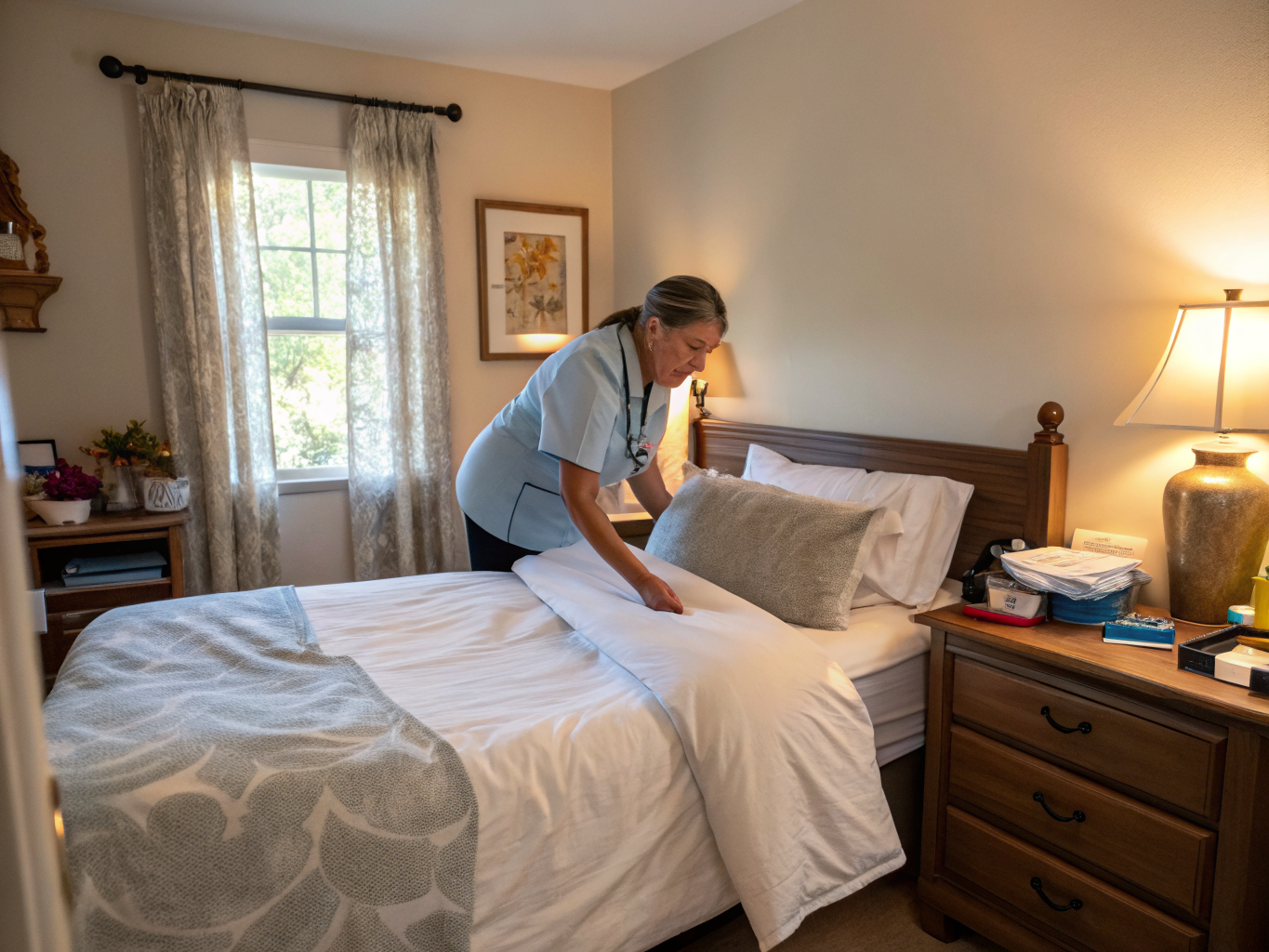
Quick answer. A live-in aide after Kessler West Orange means one dedicated certified home health aide in the home 24 hours a day, sleeping 8 hours overnight and covering the remaining 16 waking hours with personal care, meals, medication reminders, safe transfers, and the daily drive to outpatient PT. Sofia Elmer, RN starts most families within 48 hours of Kessler discharge. Call (908) 912-6342 for a private conversation.
Sofia’s field notes on live-in care after Kessler
Kessler Institute for Rehabilitation on Pleasant Valley Way in West Orange is one of the most respected post-acute rehab hospitals in the country, part of the Select Medical network and consistently ranked among U.S. News’ top rehabilitation facilities. Families arrive there after a stroke, a total knee or hip replacement, a cardiac surgery, or a serious fall, and for two to three weeks they live inside a highly structured world of physiatrists, physical therapists, occupational therapists, speech-language pathologists, and nursing staff who see their loved one every few hours. Then, on a Wednesday morning, a case manager hands them a discharge folder and the world goes quiet. According to 24 Hour Home Care NJ, the emotional whiplash of the Kessler discharge day is one of the most common reasons Essex County families call our office in tears.
The right structure for those first 90 days home is almost always one dedicated live-in aide. Not a rotating cast of shift workers. Not a two-hour visit twice a day. One caregiver who learns the sound of your father’s cane on the hardwood, the exact chair angle that keeps his post-CABG sternum comfortable, the specific way your mother wants her medication cup arranged after her stroke. Post-rehab recovery is pattern recovery, and pattern needs continuity. The person healing from a Kessler stay is often physically capable of sleeping six to eight hours through the night in one piece; what they cannot yet do is safely transition from bed to bathroom at 6 a.m., manage a 9-medication morning routine, drive themselves to outpatient PT three times a week, and stay upright during the fatigue crash that hits every afternoon around 3 p.m.
That gap between “can sleep” and “cannot yet run their own day” is exactly the shape live-in care is built for. Twenty-four-hour shift care, with two or three awake caregivers rotating through 8- or 12-hour blocks, is the right answer when someone needs eyes on them at all hours, typically because of active nighttime wandering, delirium, or unstable vitals. According to 24 Hour Home Care NJ, roughly seven out of ten Kessler-discharge families we serve are not in that category. They need one steady daytime presence and someone in the house at night just in case, and live-in delivers both without the cost or fragmentation of full shift coverage.
What a live-in day looks like at a Kessler-discharged home
A Sofia-supervised live-in caregiver arrives on discharge day with a laminated protocol card that lists the Kessler discharge summary, the home PT and OT schedule, the outpatient Kessler appointment calendar, the medication reconciliation done between the discharge pharmacist and the primary care physician, fall-risk zones room by room, and Sofia’s direct cell line. She sleeps in a private bedroom on the same floor as your loved one with a hallway monitor. Morning begins at 7 a.m. with medication, assisted bathing, dressing that respects any surgical precautions like sternal precautions after CABG or hip precautions after a posterior approach total hip, breakfast, and a review of the day’s PT goals.
Mid-morning she drives the family sedan or an accessible vehicle to outpatient Kessler in West Orange or the closer PT satellite in Livingston or Millburn, waits during the session so the therapist can hand off same-day home exercises, and drives home. Lunch, a scheduled 45-minute rest, an afternoon walk in the neighborhood or a supervised set of home exercises, and dinner. Evening is a safety check of the bathroom and bedroom pathway, medication, and lights-out routine. One CHHA covers four consecutive 24-hour days; a second CHHA rotates for the weekend so there are only ever two faces in the home. Sofia visits the home twice weekly for the first month, then weekly through day 90, adjusting the care plan against the physiatrist’s recovery milestones.
The clinical picture · when live-in is right after Kessler
Live-in after Kessler is clinically appropriate when the person can sleep six to eight consecutive hours safely, has stable vitals, does not have active delirium or nighttime wandering, but still scores in the moderate-dependence range on functional assessments. On the Barthel Index of Activities of Daily Living, that typically means a score between 40 and 75 out of 100. On the modified Rankin Scale after a stroke, that maps to a 3 (moderate disability, requires some help but able to walk without assistance) or a low 4. The common ICD-10 codes on the Kessler discharge summary that route toward live-in care are Z48.89 (encounter for other specified surgical aftercare), I69 series (sequelae of cerebrovascular disease after stroke), M17.11 (unilateral primary osteoarthritis, right knee, coded after total knee replacement recovery), M16.11 (unilateral primary osteoarthritis of hip after total hip replacement), and Z95.1 (presence of aortocoronary bypass graft) for post-CABG cardiac recovery.
According to 24 Hour Home Care NJ, the two clinical signals that most cleanly separate a live-in candidate from a 24-hour shift-care candidate are the sleep pattern and the nighttime cognition. If the discharge nurse at Kessler documents that the person slept in 4- to 6-hour blocks without significant confusion during the last three nights of their stay, live-in is almost always the right structure. If there are notes about nighttime agitation, sundowning, repeated call-bell use for reorientation, or attempted unassisted transfers overnight, we recommend awake 24-hour shift care for at least the first 30 days and then reassess. The point is not to sell more care. The point is to match the structure to the clinical reality.
Frequently asked · West Orange live-in aide conversations
How is live-in different from 24-hour shift care?
Live-in is one caregiver in the home for a 24-hour period, sleeping 8 hours overnight and working 16 waking hours, compensated on a daily rate. 24-hour shift care is two 12-hour or three 8-hour shifts with different caregivers awake at all times, billed hourly. Live-in works when the person sleeps safely overnight. Shift care is right when someone needs eyes on them all night.
What if my father wakes at 3 a.m. and the aide is asleep?
Every live-in caregiver signs a protocol that says any transfer request, fall, medical concern, or agitation episode wakes the aide immediately, using a bed-exit sensor or hallway monitor Sofia sets up on day one. The contract allows up to three nighttime wake-events per night without changing structure. If your father is waking more often than that, we transition the family to awake 24-hour shift care.
Do we have the same aide every day?
Yes. Live-in means one primary CHHA works four consecutive 24-hour days in your home, and a second CHHA rotates for the weekend three days. Only two faces in the home. If either aide is out sick or on scheduled respite, Sofia personally introduces the backup caregiver in advance so there is never a stranger walking in the door on a hard day.
Does long-term care insurance cover live-in in Essex County?
Most standalone long-term care policies from John Hancock, Genworth, MetLife, MassMutual, and New York Life cover home-based live-in care once the activities-of-daily-living trigger threshold is documented. Typical daily benefit runs $200 to $450. Live-in after Kessler in Essex County runs $380 to $520 per day. Our office bills the carrier directly with Sofia’s clinical notes and the family covers any gap.
What does live-in cost in West Orange after Kessler?
For West Orange, Livingston, South Orange, Millburn, Maplewood, and Verona, 2026 standard live-in care runs $380 to $520 per day, which works out to roughly $11,400 to $15,600 per month. The rate includes all payroll taxes, workers’ compensation coverage, unemployment insurance, Sofia’s clinical oversight, HIPAA-trained supervisor visits, and respite backup for the primary aide’s scheduled day off. No separate agency fee.
How quickly can we start on Kessler discharge day?
Sofia can meet a family at the Kessler discharge planning meeting or at the home within 24 hours of the first phone call. First live-in caregiver in the home within 48 hours of that meeting, which usually means the day of discharge or the day after. Full weekly schedule with the weekend rotation aide live within 5 to 7 days. Call (908) 912-6342 the day the discharge date is set.
References cited
- Kessler Institute for Rehabilitation · Patient and Family Post-Discharge Resources
- Alzheimer’s Association · Care Options and In-Home Care Guidance
- American Physical Therapy Association · Public and Patient Information on Post-Rehab Recovery

Call (908) 912-6342 , Live-In Aide
Live-In Care Coordinated With Kessler Institute
A live-in aide after Kessler Rehabilitation in West Orange provides what rotating shift care can’t: one dedicated person who knows your parent’s name, quirks, fears, and daily rhythm , present from morning to night, available overnight. At 24 HOUR Home Care NJ, our live-in program places one certified aide in your parent’s home full-time , reinforcing Kessler’s exercises daily, managing medications, providing fall-safe personal care, and building the trust that the Alzheimer’s Association identifies as the #1 factor in recovery outcomes.
The AARP confirms live-in care is 20-40% less expensive than 24-hour shift care , making it the most cost-effective full-day option for Kessler patients who don’t require always-awake overnight coverage. RN-supervised. Compare live-in vs. 24-hour →

Essex County Towns Near Kessler Institute
All Essex County towns | All 11 NJ counties
Kessler Institute and Essex County Facilities
- Kessler Institute for Rehabilitation (West Orange) , Top-ranked stroke, brain injury, spinal cord rehab
- Saint Barnabas Medical Center (Livingston) , Acute care and Kessler pathway
- Mountainside Medical Center (Montclair) , Post-acute coordination
- Clara Maass Medical Center (Belleville) , Geriatric transitions
- Daughters of Israel (West Orange) , Supplemental live-in aides
- Care One at Livingston , Subacute to live-in transitions
- Winchester Gardens (Maplewood) , Post-rehab community support
Neighboring: Morris, Union, Passaic.
All Kessler articles: Stroke recovery | Around-the-clock aide | Continuous care | Day & night | Nonstop | Transitional | Recovery program | Private-duty
Essex County: Live-in home care | Live-in aides | 24-hour | Overnight | Dementia | Post-stroke | Private-pay
Call (908) 912-6342 , Start Live-In Care After Kessler
Live-In Care Coordinated With Kessler Institute
Frequently Asked Questions
What is a live-in aide after Kessler?
One dedicated certified aide lives in your parent’s home full-time , daily exercises, meals, medication, personal care, and nighttime availability. 20-40% less than 24-hour care. RN-supervised. Call (908) 912-6342.
Does the live-in aide reinforce Kessler exercises?
Yes. Every exercise Kessler prescribed , walking, balance, hand therapy, speech , practiced daily by the same aide who knows your parent’s abilities and progression.
Is live-in care cheaper than 24-hour care after Kessler?
Yes. 20-40% less. One caregiver covers day and night with a sleep period, vs. two aides in rotating shifts for 24-hour.
Does the aide need their own room after Kessler?
Yes. A private sleeping area , spare bedroom, den, or converted space. 8-hour sleep period with nighttime availability for needs.
How quickly can a live-in aide start after Kessler?
Often within 24-48 hours. Call (908) 912-6342 while still at Kessler.
| Configuration | Coverage pattern | Best for | Cost tier |
|---|---|---|---|
| Companion / hourly | 3-12 hr/day · 3-7 days/week | Meal + medication + safety + errands | $-$$ |
| Live-in | One caregiver 24 hr with 8-hr sleep window | Client sleeps through most nights · spare bedroom available | $$$ |
| 24-hour rotating | 2-3 caregivers rotate 8-12 hr shifts | Sundowning · wandering · advanced dementia · 2-person transfers | $$$$ |
| Overnight aide | 10-12 hr overnight (typically 8pm-8am) | Family present in the day · nights are the risk window | $$-$$$ |
| Respite | Short-term (weekend / week / vacation) | Family caregiver rest · surgery recovery · travel | $-$$$ |
| Post-discharge rapid start | Same-day from hospital · first week rush | Immediate coverage after HUMC / Morristown Medical / Kessler / Saint Barnabas discharge | $$$$ (rush week 1) |
| Configuration | Coverage pattern | Best for · discharge from Kessler | Cost tier |
|---|---|---|---|
| Companion / hourly | 3-12 hr/day · 3-7 days/week | Meal + medication + safety + errands | $-$$ |
| Overnight aide | 10-12 hr overnight (8pm-8am) | Parent alone at night · sundowning window | $$-$$$ |
| Live-in | One caregiver 24 hr with 8-hr sleep | Client sleeps through nights · spare bedroom | $$$ |
| 24-hour rotating | 2-3 caregivers rotate 8-12 hr shifts | Sundowning · wandering · 2-person transfers | $$$$ |
| Post-discharge rapid | Same-day from Kessler | Immediate coverage after discharge · first-week rush | $$$$ week 1 |
| Respite | Weekend / week / vacation | Family caregiver rest · surgery recovery · travel | $-$$$ |
Live-in versus rotating-shift · which model fits a West Orange household
According to 24 Hour Home Care NJ, West Orange families reach for live-in care when three conditions align: the client sleeps through most nights, there is a spare bedroom in the home, and continuity of face matters more than active nighttime awake supervision.
Live-in. One caregiver stays in the home 24 hours with an 8-hour uninterrupted sleep period (federal labor rule). Typical daily rate $400-$550 in Essex County. Best for early-to-middle-stage dementia, post-surgery recovery where sleep is undisturbed, and companion-focused arrangements.
Rotating shift. Two or three caregivers rotate 8-12 hour shifts so someone is always awake. Typical daily rate $720-$1,080 in Essex County. Best for late-stage dementia, sundowning, wandering, two-person transfers, or clients who wake multiple times per night.
Hybrid. Live-in primary caregiver Monday-Friday with a weekend relief caregiver. Continuity of face + primary caregiver rest days. Typical daily rate $500-$700.
A day inside live-in care in a West Orange home
Families often ask what the day actually looks like. According to 24 Hour Home Care NJ, the specific rhythm Sofia builds fades into the household background , not “a nurse is here”:
- 7:00am · morning routine. Caregiver wakes gently · vital signs if applicable · assists bathroom, medication, dressing.
- 8:00am · breakfast + first walk. Short walk around the West Orange block. Orients the body to the day.
- 10:30am · engagement. Puzzles, music from the client’s era, phone call with a grandchild, light housekeeping around the client , not instead of them.
- 12:30pm · lunch + rest. Balanced meal, then short nap or quiet time.
- 3:00pm · afternoon activity + errand. Drive if the client tolerates it. Visit from a West Orange neighbor. Garden time if the season allows.
- 6:00pm · dinner + wind-down. Simple meal, dimmed lights, reduce stimulation.
- 9:00pm · bedtime routine. Bathroom, medication, sleep. Caregiver sleeps in adjacent room.
- Overnight · quiet presence. Bathroom trips, medication if scheduled, fall monitoring, quiet reassurance if the client wakes.
West Orange hospital corridor for live-in care · coordination from Kessler
According to 24 Hour Home Care NJ, West Orange-area live-in cases often start with a hospital discharge from Kessler. Sofia matches a live-in caregiver already active in West Orange or an adjacent town within 2-4 hours of the discharge call. Caregiver arrives 30 minutes ahead of the client to prepare the home. Sofia calls the family at the 24-hour mark for a rhythm check. This is the coordination that turns discharge into recovery, not readmission.
Frequently asked questions
What does live-in home care cost in West Orange?
Live-in home care in West Orange typically runs $400-$550 per day for one dementia-trained caregiver who stays in the home 24 hours with an 8-hour uninterrupted sleep window. Sofia gives a specific estimate on the intake call at (908) 912-6342.
Is live-in appropriate if the client wakes at night?
Live-in works when the client sleeps through most nights. If the client wakes multiple times, rotating 12-hour shifts are safer · someone is always awake. Sofia decides on the intake call.
Does the caregiver need a spare bedroom?
Yes. Federal labor rules require a private sleeping space for the caregiver during the 8-hour sleep window. Sofia confirms the home has a spare bedroom during intake.
How does live-in coverage handle the caregiver’s days off?
Sofia builds a rotation with a primary live-in caregiver (Monday-Friday) and a relief caregiver (weekends). Continuity of face + primary caregiver rest days.
Does LTCi cover live-in?
Most long-term care insurance policies cover a portion of live-in care. Sofia reads the specific policy (John Hancock, Genworth, MetLife, etc.) and files claims on behalf of families.
Meet Sofia Elmer, RN · in person or by phone
24 Hour Home Care NJ is a locally verified Google Business Profile. See real family reviews, ask a question, or call directly.
Authority references
Take Sofia’s free NJ home care reference sheet with you
One page, plain English, no sales pitch — the questions to ask any NJ home care agency + what a real hourly rate range looks like across the 21 counties. Sofia RN made it for you.