
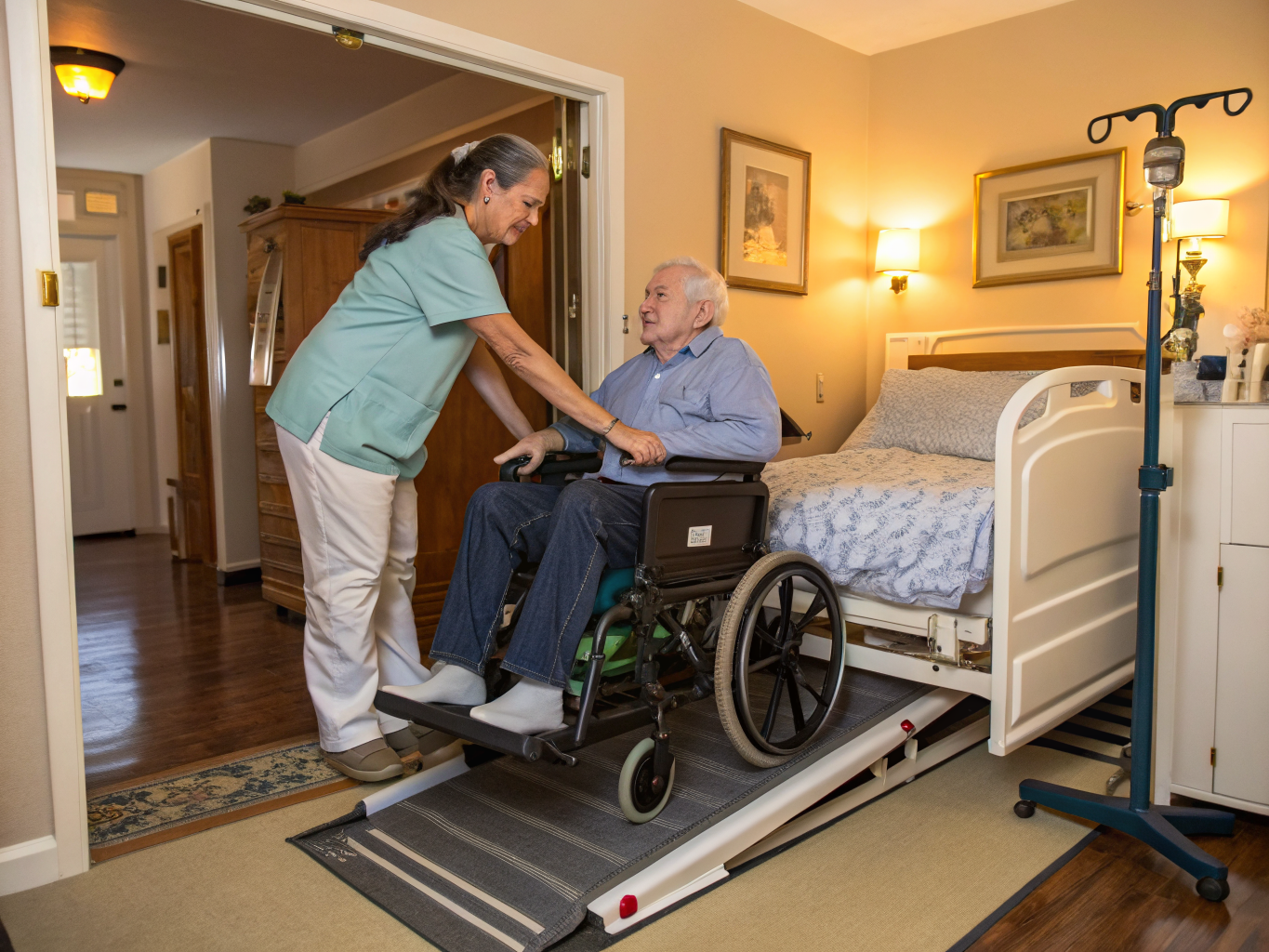
Quick answer. Around-the-clock aide care after Kessler Rehabilitation in West Orange NJ means three awake certified home health aides in an 8-hour shift rotation covering all 168 hours of the week, coordinated with the Kessler discharge plan and supervised by a registered nurse. Sofia Elmer, RN meets most Essex County families within 24 hours of a discharge-planner referral and places the first caregiver in the home before the Kessler transport van arrives. Call (908) 912-6342 for a private conversation.
Sofia’s field notes on 24-hour aide care after Kessler in West Orange
Kessler Institute for Rehabilitation at 1199 Pleasant Valley Way is the flagship inpatient rehabilitation hospital of the Kessler system and one of the most recognized rehabilitation programs in the country for stroke, brain injury, spinal cord injury, and complex orthopedic recovery. According to 24 Hour Home Care NJ, roughly one in four families we consult for after a Kessler West Orange discharge needs true around-the-clock aide coverage during the first 30 to 90 days at home – not because the medical rehab is unfinished, but because the transition from a fully staffed rehab hospital to an empty living room is where quiet deconditioning, falls, and readmissions actually happen.
Around-the-clock care is the answer to a specific Kessler-discharge question: who is beside your father when he stands up from the recliner at 4 a.m. to use the bathroom, three weeks after a right-hemisphere stroke, when his left leg still forgets it exists. The Kessler Foundation’s own rehabilitation-outcomes research consistently identifies the first 72 hours at home as the highest-risk window for post-rehab fall and readmission. Continuous aide presence during that window, and the weeks that follow, is the intervention.
What a 24-hour shift day looks like for a Kessler-discharged family
A Sofia-supervised 24-hour rotation runs on three awake 8-hour shifts – typically 7 a.m. to 3 p.m., 3 p.m. to 11 p.m., and 11 p.m. to 7 a.m. – with two to three consistent CHHAs cycling through the week so your loved one sees the same faces day after day. On arrival, each aide receives a laminated Sofia protocol card that carries the Kessler discharge summary in plain English: current mobility level, transfer technique, weight-bearing status, medication schedule, therapy homework from Kessler PT and OT, red-flag symptoms to call about, and Sofia’s direct cell for anything unusual.
Between the three shifts, 168 hours of awake coverage per week. Sofia calls the primary family contact every Monday and Thursday for a five-minute pulse check during the first month home. According to 24 Hour Home Care NJ, this twice-weekly cadence catches the subtle post-rehab decline signals – a missed therapy exercise, a swallowing hesitation, a new limb heaviness, a low-grade fever – days before they escalate into an emergency-department visit. That lead time is often the difference between a home recovery that reaches its Kessler-projected functional goal and a readmission that erases six weeks of progress.
The clinical picture · when Kessler discharge calls for 24-hour aide care
Around-the-clock aide coverage becomes appropriate when a person leaving Kessler cannot be safely left alone for any block of the day or night but does not require an inpatient level of medical care. Common signals we see in West Orange families discharging from Kessler: a modified independence or minimum-assist score on transfers that still requires standby supervision, a fall history in the past 90 days, a new tracheostomy or feeding tube being managed at home, moderate expressive or receptive aphasia after left-hemisphere stroke, or a spouse-caregiver who is physically unable to lift or pivot-transfer safely.
The clinical picture typically codes as Z48.89 (encounter for other specified surgical aftercare) paired with the primary rehab diagnosis – I69.351 for hemiplegia after cerebral infarction, R29.6 for repeated falls, I50.9 for heart failure recovery, or the Kessler team’s specific discharge diagnosis. The American Physical Therapy Association’s post-acute care guidance describes this window as the “high-supervision recovery phase” where functional gains made in inpatient rehab either consolidate or unravel based on the quality of at-home staffing. According to 24 Hour Home Care NJ, at this stage most families need three awake CHHAs on rotation plus a licensed clinical supervisor doing home visits weekly during the first month, tapering to every two weeks as the person stabilizes.
Frequently asked · questions from real West Orange Kessler families
How is 24-hour shift care different from live-in care after Kessler?
24-hour shift care means three awake caregivers rotating in 8-hour blocks so someone is watching, listening, and available every minute of every hour. Live-in means one caregiver stays in the home across a 24-hour period, sleeps 8 hours at night, and is compensated for 16 waking hours. For most Kessler discharges – especially in the first 30 to 90 days when transfers, medications, and therapy homework require constant attention – shift care is the correct answer. Live-in is a good downshift once the person stabilizes and nighttime supervision is no longer clinically necessary.
Can care start the same day my mother comes home from Kessler?
Yes. Sofia meets the family within 24 hours of a Kessler discharge-planner call, reviews the discharge summary while the person is still an inpatient, and places the first caregiver in the home before the transport van pulls into the driveway. According to 24 Hour Home Care NJ, our fastest Kessler-to-home start in 2026 was 6 hours from the case-manager fax to the aide unpacking her bag in an Essex County living room. Discharge planners at Kessler West Orange have Sofia’s direct cell.
Will the aides coordinate with our Kessler outpatient therapy team?
Every 24 Hour Home Care NJ aide assigned to a post-Kessler case follows the discharge exercise plan on paper, cues the person through the daily physical and occupational therapy homework, and logs adherence in a shift-note binder that the visiting Kessler outpatient PT reviews on each home visit. Sofia attends the first outpatient therapy session in person to align the aide protocol with what the therapist wants reinforced between visits. That handoff is where recovery either accelerates or plateaus.
Does Medicare pay for around-the-clock aide care after Kessler?
No. Traditional Medicare and Medicare Advantage cover Kessler inpatient rehabilitation and a limited number of home-health-agency skilled visits after discharge, but not custodial around-the-clock aide care in the home. Long-term care insurance, private pay, veteran’s aid and attendance, and workers’ compensation are the common funding sources for the 24-hour aide layer. 24 Hour Home Care NJ is a private-pay and private-insurance agency; we do not accept Medicaid or Medicare.
What does 24-hour aide care in Essex County cost per month?
For West Orange, South Orange, Livingston, Millburn, Maplewood, and the greater Essex County area, 2026 around-the-clock aide care runs $820 to $980 per day, or roughly $24,600 to $29,400 per month, depending on clinical complexity and the level of registered-nurse oversight required. That figure includes all payroll taxes, unemployment insurance, workers’ compensation coverage, HIPAA-trained supervisor time, and respite backup when any aide has a scheduled day off. There is no separate agency fee and no per-shift surcharge.
How long do most Kessler families need 24-hour aide care?
Most families we support after a Kessler discharge use 24-hour shift care for 30 to 90 days, then step down to live-in care or a 12-hour day-and-evening schedule as the person’s transfer independence returns and the risk of an unwitnessed fall drops. The American Geriatrics Society’s post-acute care framework describes this three-month window as the functional-consolidation phase; stepping down too early is the single most common cause of a preventable readmission. Sofia reassesses the level of care every two weeks and proposes step-downs on the family’s timeline, not ours.
References cited in this guide
- Kessler Foundation · Rehabilitation Research · post-acute recovery outcomes
- American Physical Therapy Association · Post-Acute Care Guidance
- American Geriatrics Society · Post-Acute and Long-Term Care

Call (908) 912-6342 , Around-the-Clock Aide
Coordinated With Kessler Institute , Starts Day of Discharge
After weeks of intensive rehabilitation at Kessler Institute in West Orange, your parent comes home to a house that hasn’t changed , but they have. Transfers require assistance. Medications are complex. Exercises must happen daily. Falls are a constant risk. An around-the-clock aide after Kessler from 24 HOUR Home Care NJ provides 24-hour rotating shift coverage , always awake, always present , ensuring the progress Kessler built doesn’t unravel in the first weeks at home.
The Journal of the American Geriatrics Society identifies the rehab-to-home transition as a critical vulnerability window. Our RN coordinates directly with Kessler’s discharge team. Our certified aides continue every exercise, maintain every safety protocol, and provide the continuous supervision that prevents the regression most common in the first 2 weeks home. See Essex County post-stroke care.

Essex County Towns Near Kessler Institute
All Essex County towns | All 11 NJ counties
Kessler Institute and Essex County Facilities
- Kessler Institute for Rehabilitation (West Orange) , U.S. News top-ranked stroke, brain injury, spinal cord rehabilitation
- Saint Barnabas Medical Center (Livingston) , Acute care before Kessler transfer; post-discharge coordination
- Mountainside Medical Center (Montclair) , Post-acute care coordination
- Clara Maass Medical Center (Belleville) , Emergency and geriatric transitions
- Daughters of Israel (West Orange) , Post-rehab residential with supplemental aides
- Care One at Livingston , Subacute rehab coordination
- Winchester Gardens (Maplewood) , Post-rehab community return
Neighboring: Morris, Union, Passaic.
Kessler stroke: After Kessler | Cognitive | Mobility | Hand | Caregiver support
Essex County: 24hr caregivers | 24hr home care | Live-in | Overnight | Dementia | Post-hospital | Post-stroke | Private-pay
Call (908) 912-6342 , Get Matched With a Post-Kessler Caregiver
Coordinated With Kessler Institute , Starts Day of Discharge
Frequently Asked Questions
What is an around-the-clock aide after Kessler?
Two or more certified aides in 12-hour shifts , always awake , providing continuous care after Kessler discharge. Exercise reinforcement, medication, fall prevention, transfers. RN-supervised. Call (908) 912-6342.
Do you coordinate with Kessler for around-the-clock placement?
Yes. Our RN communicates with Kessler’s discharge team before release to understand exercise programs, mobility levels, and safety requirements.
How quickly can around-the-clock care start after Kessler?
Same day as discharge. Call (908) 912-6342 while still at Kessler , ideally 3-5 days before discharge.
Is around-the-clock care necessary after Kessler?
For the first 1-2 weeks, many families need it. Fall risk is highest immediately post-rehab. After stabilization, many step down to live-in or companion care.
How much does around-the-clock care cost after Kessler?
Transparent quotes after free RN assessment. Often comparable to extended rehab stay. Call (908) 912-6342. LTCI accepted.
| Configuration | Coverage pattern | Best for | Cost tier |
|---|---|---|---|
| Companion / hourly | 3-12 hr/day · 3-7 days/week | Meal + medication + safety + errands | $-$$ |
| Live-in | One caregiver 24 hr with 8-hr sleep window | Client sleeps through most nights · spare bedroom available | $$$ |
| 24-hour rotating | 2-3 caregivers rotate 8-12 hr shifts | Sundowning · wandering · advanced dementia · 2-person transfers | $$$$ |
| Overnight aide | 10-12 hr overnight (typically 8pm-8am) | Family present in the day · nights are the risk window | $$-$$$ |
| Respite | Short-term (weekend / week / vacation) | Family caregiver rest · surgery recovery · travel | $-$$$ |
| Post-discharge rapid start | Same-day from hospital · first week rush | Immediate coverage after HUMC / Morristown Medical / Kessler / Saint Barnabas discharge | $$$$ (rush week 1) |
| Configuration | Coverage pattern | Best for · discharge from Kessler | Cost tier |
|---|---|---|---|
| Companion / hourly | 3-12 hr/day · 3-7 days/week | Meal + medication + safety + errands | $-$$ |
| Overnight aide | 10-12 hr overnight (8pm-8am) | Parent alone at night · sundowning window | $$-$$$ |
| Live-in | One caregiver 24 hr with 8-hr sleep | Client sleeps through nights · spare bedroom | $$$ |
| 24-hour rotating | 2-3 caregivers rotate 8-12 hr shifts | Sundowning · wandering · 2-person transfers | $$$$ |
| Post-discharge rapid | Same-day from Kessler | Immediate coverage after discharge · first-week rush | $$$$ week 1 |
| Respite | Weekend / week / vacation | Family caregiver rest · surgery recovery · travel | $-$$$ |
When 24-hour care becomes the right level for a West Orange household
According to 24 Hour Home Care NJ, West Orange families rarely start with 24-hour care · they usually arrive there after a specific tipping point. The most common triggers Sofia sees:
- The primary spouse-caregiver has stopped sleeping. When the well spouse is exhausted, dizzy, or losing weight, the household needs 24-hour presence to save the well spouse’s own health.
- The parent wakes multiple times per night. Live-in becomes unsafe when nighttime waking is hourly · you need someone awake.
- Two-person transfers are required. Bed to chair, chair to bathroom · when one caregiver alone cannot safely move the client, awake overnight presence is mandatory.
- A recent hospital discharge with an unstable orientation. First 30 days after a Kessler discharge with cognitive decline calls for 24-hour presence.
- Wandering with intent to leave. Not just pacing · attempts to open the front door and leave the West Orange home.
- Hospice enters the picture. Late-stage dementia + hospice needs 24-hour presence alongside the hospice nurse visits.
First week of 24-hour care in a West Orange home · what Sofia orchestrates
According to 24 Hour Home Care NJ, the first 72 hours are where the whole arrangement is calibrated. Sofia’s rhythm:
- Hour 0 · handoff at the front door. Aide arrives ahead of the client. Home prepared · walker, meds, calendar, lighting.
- Hour 4 · first vital signs check. Baseline recorded. Any deviation flagged to Sofia.
- Hour 12 · first sleep check. Post-anesthesia or post-hospital sleep is different · restless, shallow. Aide monitors pain control.
- Hour 24 · Sofia’s family call. Four questions: oriented? hydrated? comfortable? anything the surgeon should know?
- Hour 48 · first assisted shower (if cleared). Otherwise sponge bath. Skin integrity is the #1 predictor of infection.
- Hour 72 · first assisted walk (if surgical plan supports it). Mobility timing is disease-specific · Sofia’s aides know the protocols.
- Day 5-7 · rhythm sets. Aide swap schedule stable. Family reports quieter household by day 7.
West Orange 24-hour care rate reality in 2026
Families in West Orange and the surrounding Essex County area should expect these general pricing bands for private-pay 24-hour home care in 2026:
- Live-in caregiver. $400-$550 per day. One dementia-trained aide, 8-hour sleep window. For clients who sleep through most nights.
- Rotating 12-hour shifts. $30-$40 per hour · $720-$960 per day. Two aides · someone always awake. For sundowning, wandering, or advanced dementia.
- Rotating 8-hour shifts. $32-$45 per hour · $768-$1,080 per day. Three aides · deepest coverage. For late-stage or two-person transfer cases.
- Same-day discharge rush start. Small first-week premium on top of the above. Then settles into the standard rate.
Long-term care insurance frequently covers a substantial portion of 24-hour care · Sofia helps read the policy and file claims. 24 Hour Home Care NJ is private-pay and private LTCi only · we do not bill Medicaid or Medicare. Call (908) 912-6342 · Sofia gives a specific estimate for your West Orange household on the intake call.
Frequently asked questions
What’s the difference between live-in and 24-hour rotating?
Live-in is one caregiver in the home 24 hours with an 8-hour sleep window. Rotating is 2-3 caregivers rotating shifts so someone is always awake. Rotating is needed for sundowning, wandering, or clients who wake multiple times at night.
How much does 24-hour home care cost in West Orange?
24-hour rotating shifts run roughly $30-$40/hour ($720-$960/day) in West Orange. Live-in is less expensive daily ($400-$550) when the client sleeps through most nights. Sofia gives a specific estimate on the intake call.
How fast can 24-hour care start after a hospital discharge?
Same-day for discharges from Kessler. Sofia typically confirms a matched caregiver within 2 hours of the discharge planner’s call.
Are your caregivers awake overnight?
On rotating 24-hour coverage, yes · someone is always awake. On live-in, the caregiver sleeps in an adjacent room and wakes for medications or bathroom trips as needed.
Do you bill Medicare or Medicaid for 24-hour care?
No. 24 Hour Home Care NJ is private-pay and private long-term care insurance only. Medicare only covers 4-6 hours per week of home health · private pays the rest when families need 24-hour coverage.
Meet Sofia Elmer, RN · in person or by phone
24 Hour Home Care NJ is a locally verified Google Business Profile. See real family reviews, ask a question, or call directly.
Authority references
Take Sofia’s free NJ home care reference sheet with you
One page, plain English, no sales pitch — the questions to ask any NJ home care agency + what a real hourly rate range looks like across the 21 counties. Sofia RN made it for you.