
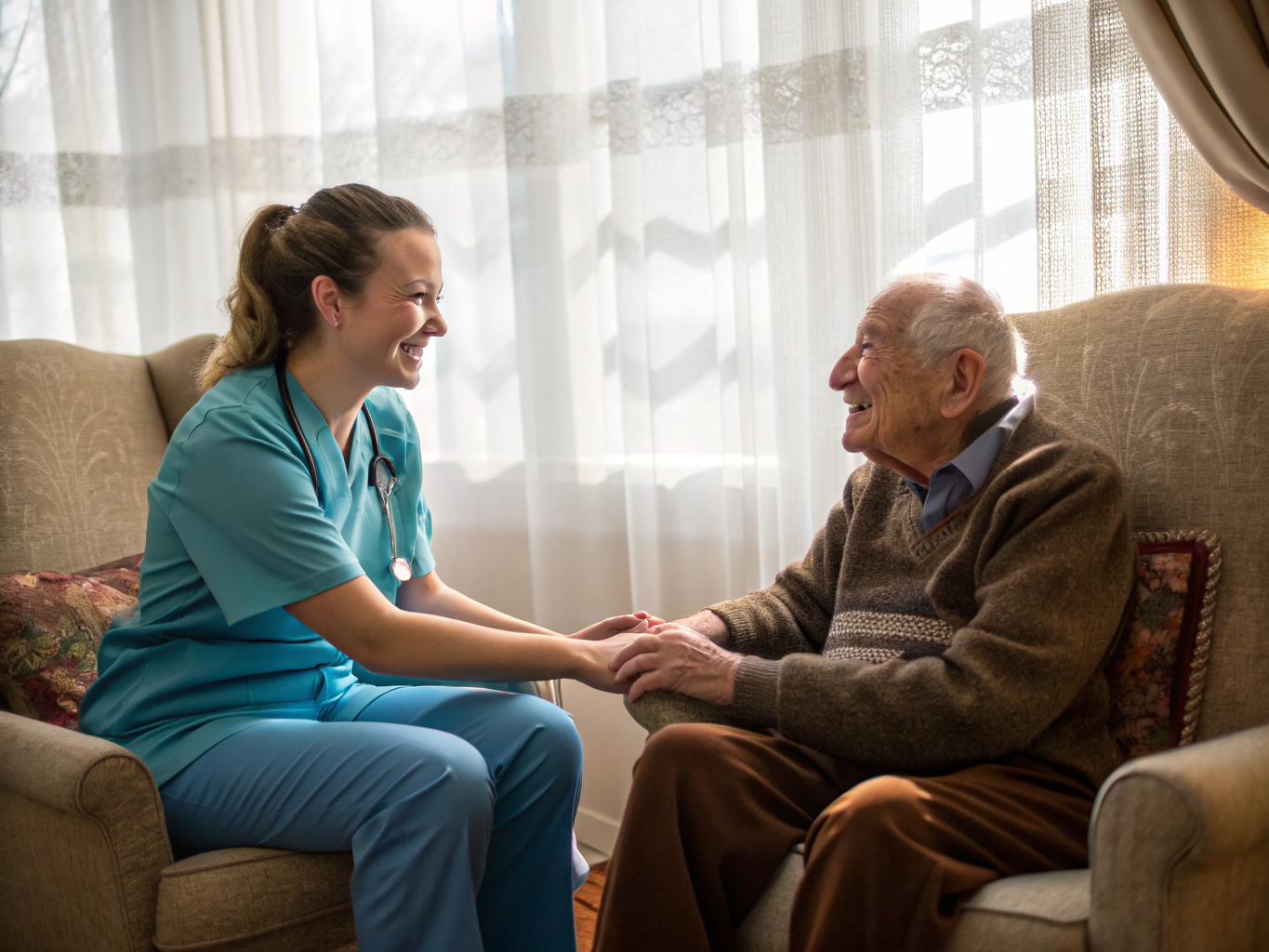
Quick answer. Memory-care-at-home near Daughters of Israel Nursing Home and Rehabilitation Center in West Orange NJ is a structured cognitive-support model delivered in your loved one’s own kitchen, den, and bedroom, with one dedicated dementia-trained CHHA, a Sofia-authored activity plan, and reminiscence and music protocols built around who your parent has always been. It is the quiet alternative to a Daughters of Israel memory-care wing transfer, and Sofia Elmer, RN starts most Essex County families within 48 hours of a first phone call. Call (908) 912-6342 for a private conversation.
Sofia’s field notes on memory-care-at-home vs facility memory care
Daughters of Israel Nursing Home and Rehabilitation Center at 1155 Pleasant Valley Way in West Orange is a 300-bed skilled nursing and rehabilitation campus with a dedicated memory-care wing that has served Essex County families for over a century. According to 24 Hour Home Care NJ, the single conversation we have most often with West Orange families is not whether their loved one needs memory-care support, but whether that support needs to happen inside the walls of a locked memory unit or inside the walls of the home the person has lived in for forty years. Those two settings deliver very different clinical outcomes, and the reason has less to do with staffing ratios than with a phenomenon called environmental memory.
Environmental memory is the layer of recognition that persists even after episodic and short-term memory have faded. The hallway your mother has walked to the bathroom every night since 1978. The specific creak of her kitchen door. The angle of afternoon light in the den. Those cues are stored in a different part of the brain than the names of her grandchildren, and they hold for years after a G30.9 Alzheimer’s diagnosis. A facility memory-care transfer strips every one of those cues away in a single afternoon, and the disorientation cost is what the literature calls transfer trauma. What families describe to us in the weeks after a placement is a person who “changed overnight,” because in a real neurological sense, she did.
Memory-care-at-home preserves the environmental scaffolding while layering the structured cognitive engagement, sensory-based activity, and specialized dementia-care techniques that a good memory-care wing provides. Sofia’s protocol is the same set of interventions, delivered by one consistent trained caregiver, in the room where those interventions actually land. According to 24 Hour Home Care NJ, memory-care-at-home is the right choice when your loved one still recognizes their own home, when a spouse or family member is present in the household, and when the family wants to avoid the specific decline that follows a facility move. It is not the right choice when there is no family stakeholder to co-manage, or when the person has already stopped recognizing the physical space they live in.
What memory-care-at-home looks like near Daughters of Israel
A Sofia-supervised memory-care-at-home day begins with a laminated activity plan built from a 60-minute life-story interview with the family. The caregiver knows your mother worked as a public-school teacher in Newark for 32 years, her wedding song was “Unforgettable,” she took her coffee with one sugar and a splash of cream, and she raised three daughters in this same West Orange house. That biographical layer is what turns generic dementia care into reminiscence therapy, the evidence-based technique of prompting long-term autobiographical memory through familiar objects, photographs, music, and conversation. Reminiscence sessions run 20 to 40 minutes, two to three times per day, and are structured around the times of day when your loved one is most cognitively available.
Music-therapy protocols run alongside. According to 24 Hour Home Care NJ, we curate a personalized playlist of 30 to 50 songs from the person’s late adolescence and young-adulthood, the years the neuroscience literature identifies as the deepest musical-memory window. That playlist plays during morning ADLs, during the sundowning window, and at any point of agitation. Sensory engagement fills the remaining structured time with hand massage using a familiar scent, folding warm laundry, sorting a bowl of buttons, tending a windowsill plant. Environmental scaffolding is quieter and continuous, layered in as a visible day-of-the-week board, a photo-labeled bathroom door, a signature blanket on the same chair, evening lights on timers to soften the sundowning transition. One dedicated caregiver, one voice, one activity rhythm the person can lean into.
Clinical picture · the non-pharmacological memory-care evidence base
The clinical population served by memory-care-at-home spans four common ICD-10 codes we see on Essex County intake paperwork: G30.9 (Alzheimer’s disease, unspecified), F03.90 (unspecified dementia without behavioral disturbance), G31.84 (mild cognitive impairment, so-stated), and G31.09 (other frontotemporal dementia). Each of these presents with a different behavioral fingerprint, and each responds to a slightly different memory-care emphasis. Frontotemporal dementia patients, for instance, need heavier environmental structure and lower stimulation levels; Alzheimer’s patients typically respond most strongly to music and reminiscence work; MCI patients benefit from cognitive-engagement exercises calibrated to their remaining executive function.
The evidence base for this model is stronger than families often realize. The 2020 Lancet Commission on dementia prevention, intervention, and care, a landmark synthesis co-authored by researchers including Livingston and colleagues, concluded that non-pharmacological interventions delivered in familiar environments produce meaningful reductions in behavioral and psychological symptoms of dementia, often equivalent to or exceeding first-line pharmacological options. The Cochrane systematic review of reminiscence therapy documents measurable improvements in cognition, mood, and quality of life for people with mild-to-moderate dementia. The Kales DICE approach (Describe, Investigate, Create, Evaluate) is the framework Sofia’s caregivers are trained to use whenever a new behavior emerges, and it is the same framework taught in geriatric psychiatry residencies. According to 24 Hour Home Care NJ, the reason memory-care-at-home works is not that it is gentler than a facility, but that it delivers the same clinically validated interventions in the setting where the person’s environmental memory still functions.
Frequently asked · West Orange memory-care-at-home conversations
How is memory-care-at-home different from a Daughters of Israel memory-care wing placement?
The interventions overlap heavily, but the delivery setting differs. A memory-care wing offers 24-hour staffing, a locked perimeter, and group programming inside a purpose-built unit. Memory-care-at-home delivers reminiscence therapy, music therapy, structured sensory engagement, and environmental scaffolding inside the person’s own home with one dedicated caregiver. Home preserves environmental memory, which typically outlasts short-term recognition by several years.
Is my mother a good candidate for memory-care-at-home?
Good candidates still recognize their home and the people who live in it, are ambulatory or use mobility aids safely with cueing, and have a family stakeholder who wants to remain involved in the care plan. Memory-care-at-home is less appropriate when the person no longer recognizes their physical space, has severe unmanaged behaviors, or when there is no family present in the household to co-manage. Sofia’s home visit determines fit precisely.
What is reminiscence therapy, exactly?
Reminiscence therapy is the structured use of biographical prompts (photographs, familiar music, personal objects, life-story conversation) to activate long-term autobiographical memory in people with dementia. The Cochrane systematic review documents improvements in cognition, mood, and quality-of-life outcomes. Sessions typically run 20 to 40 minutes, two to three times per day, and are built around the specific life history of the person receiving care.
Does music therapy actually help with dementia agitation?
Yes, and the mechanism is well-documented. Musical memory is stored in brain regions that Alzheimer’s disease and related dementias affect later and less severely than the memory circuits governing recent events. A personalized playlist of songs from the person’s adolescence and young adulthood can reduce sundowning agitation, ease morning ADLs, and reopen verbal engagement. The Alzheimer’s Association Music and Memory resources include a practical playlist-building guide for families.
Can Sofia visit our West Orange home before we commit?
Yes. Sofia does a 60- to 90-minute unhurried home visit anywhere in Essex, Morris, Union, or Passaic County before any contract is signed. She conducts the life-story interview with the family, walks the home to identify environmental-scaffolding opportunities, watches your loved one move through their day, and drafts a personalized memory-care activity plan on the spot. There is no obligation and no visit fee.
What does memory-care-at-home typically cost in Essex County?
For West Orange, South Orange, Livingston, Millburn, and Maplewood, 2026 memory-care-at-home live-in runs $410 to $560 per day, or roughly $12,300 to $16,800 per month. That range includes a memory-care training premium of $30 to $50 per day for the dementia-specialized caregiver, all payroll taxes, workers’ compensation, HIPAA-trained supervisor time, and respite backup. There is no separate agency fee.
References cited in this guide
- Alzheimer’s Association · Music, Art, and Alzheimer’s · practical playlist and engagement guide
- National Institute on Aging · Meaningful Activities and Caregiving for a Person With Alzheimer’s
- Livingston et al. · Lancet Commission on Dementia Prevention, Intervention, and Care (2020)

Call (908) 912-6342 , Memory Care at Home
Dementia Care Near Daughters of Israel , No Contracts, No Minimums
Daughters of Israel is known throughout Essex County for its dedicated memory care unit , and many families consider it when their parent’s dementia progresses. But what if the most powerful memory care environment isn’t a facility at all? Memory care at home near Daughters of Israel in West Orange from 24 HOUR Home Care NJ transforms your parent’s own home into a therapeutic memory care setting , where family photographs are cognitive anchors, the kitchen is a familiar engagement space, and every room holds decades of embedded memory that no facility can replicate.
The National Institute on Aging confirms that home-based memory care preserves autonomy and reduces the anxiety that institutional relocation causes in cognitively impaired patients. The Family Caregiver Alliance emphasizes that environmental familiarity is a primary protective factor against rapid decline. Our RN-supervised memory care program near Daughters of Israel makes these research findings your parent’s daily reality.
What Home-Based Memory Care Includes
Our RN designs a comprehensive cognitive care plan: daily memory exercises , photo identification, music therapy, guided reminiscence, structured sensory activities , tailored to your parent’s retained abilities. Consistent daily schedules reinforce circadian rhythms and reduce sundowning. Medication management ensures dementia drugs and co-existing condition medications are taken precisely, maximizing effectiveness.
Home safety is paramount. Our team assesses for hazards specific to cognitively impaired patients: stove safety, door locks, bathroom modifications, and fall-prevention adjustments. We monitor nutrition, hydration, and sleep patterns , all factors the Johns Hopkins Medicine research program identifies as directly impacting cognitive function speed of decline.
As memory loss progresses, care increases seamlessly , companion to live-in to 24-hour , within the same trusted team. No relocating to a facility, no new faces. Families in Maplewood, Verona, Bloomfield, Nutley, Cedar Grove, and throughout Essex County near Daughters of Israel choose our private-pay memory care as the compassionate alternative to institutional placement.

Essex County Towns Near Daughters of Israel
- West Orange (Daughters of Israel)
- Livingston
- Montclair
- Short Hills
- Millburn
- Maplewood
- Verona
- Nutley
- Bloomfield
- Cedar Grove
- Glen Ridge
- Roseland
All Essex County towns | All 11 NJ counties
Daughters of Israel and Essex County Facilities
- Daughters of Israel (West Orange) , Dedicated Alzheimer’s and dementia unit, skilled nursing, memory care programming on Pleasant Valley Way
- Kessler Institute for Rehabilitation (West Orange) , Neurological rehabilitation including cognitive and brain injury recovery
- Saint Barnabas Medical Center (Livingston) , Geriatric neurology, dementia diagnostics, and behavioral health
- Mountainside Medical Center (Montclair) , Senior behavioral health and memory screening
- Clara Maass Medical Center (Belleville) , Geriatric cognitive assessments
- Daughters of Israel (West Orange) , Specialized Alzheimer’s/dementia residential unit with activity-based therapeutic programming
- Care One at Livingston , Subacute dementia rehabilitation and respite
- Winchester Gardens (Maplewood) , Assisted living with memory support services
- The Allendale Community for Senior Living , Dedicated memory care residence
Neighboring counties: Morris, Union, Passaic, Bergen.
Daughters of Israel articles: Post-rehab | After-rehab recovery | Subacute transition | Skilled nursing aftercare | Discharge support
Kessler dementia: Dementia | Memory care | Alzheimer’s
Essex County: 24-hour | Live-in | Dementia | Private-pay | Companion
Call (908) 912-6342 , Start Dementia Care Near Daughters of Israel
Dementia Care Near Daughters of Israel , No Contracts, No Minimums
Frequently Asked Questions
What is memory care at home near Daughters of Israel?
Professional cognitive support in your parent’s own home , memory exercises, medication management, safety modifications, structured routines , all RN-supervised. Near Daughters of Israel in West Orange. Call (908) 912-6342.
How does home memory care compare to Daughters of Israel’s unit?
Home care provides one-on-one attention in a familiar environment with decades of embedded memory cues. Facility ratios are typically 1:8 or higher. Both are valid , we serve as the home-based alternative.
What cognitive activities do memory care aides provide?
Photo identification, music therapy, guided reminiscence, puzzle activities, cooking familiar recipes, gardening, art , all structured by our RN to target retained cognitive abilities.
Can memory care scale as dementia progresses?
Yes. Companion to live-in to 24-hour , same agency, same RN, same caregiver when possible. No disruption, no starting over. Call (908) 912-6342.
How quickly can memory care start near Daughters of Israel?
Often within 24 hours. Free RN assessment first. Call (908) 912-6342.
| Configuration | Coverage pattern | Best for | Cost tier |
|---|---|---|---|
| Companion / hourly | 3-12 hr/day · 3-7 days/week | Meal + medication + safety + errands | $-$$ |
| Live-in | One caregiver 24 hr with 8-hr sleep window | Client sleeps through most nights · spare bedroom available | $$$ |
| 24-hour rotating | 2-3 caregivers rotate 8-12 hr shifts | Sundowning · wandering · advanced dementia · 2-person transfers | $$$$ |
| Overnight aide | 10-12 hr overnight (typically 8pm-8am) | Family present in the day · nights are the risk window | $$-$$$ |
| Respite | Short-term (weekend / week / vacation) | Family caregiver rest · surgery recovery · travel | $-$$$ |
| Post-discharge rapid start | Same-day from hospital · first week rush | Immediate coverage after HUMC / Morristown Medical / Kessler / Saint Barnabas discharge | $$$$ (rush week 1) |
| Configuration | Coverage pattern | Best for · discharge from Daughters of Israel | Cost tier |
|---|---|---|---|
| Companion / hourly | 3-12 hr/day · 3-7 days/week | Meal + medication + safety + errands | $-$$ |
| Overnight aide | 10-12 hr overnight (8pm-8am) | Parent alone at night · sundowning window | $$-$$$ |
| Live-in | One caregiver 24 hr with 8-hr sleep | Client sleeps through nights · spare bedroom | $$$ |
| 24-hour rotating | 2-3 caregivers rotate 8-12 hr shifts | Sundowning · wandering · 2-person transfers | $$$$ |
| Post-discharge rapid | Same-day from Daughters of Israel | Immediate coverage after discharge · first-week rush | $$$$ week 1 |
| Respite | Weekend / week / vacation | Family caregiver rest · surgery recovery · travel | $-$$$ |
Alzheimer’s care stages · what changes as the disease progresses
According to 24 Hour Home Care NJ, Alzheimer’s care in West Orange is not a single service , it scales to the stage of the disease. Getting the stage right at intake prevents both under-care (which lets the household slip) and over-care (which drains LTCi coverage prematurely).
- Early stage · G30.9 mild (usually 2-4 years). Hourly companion + safety monitoring · 4-8 hours per day, 3-5 days per week · focus on dignity, meal preparation, medication reminders, isolation prevention. Typical weekly cost $700-$1,600.
- Middle stage · G30.9 moderate (usually 2-5 years). Live-in caregiver OR 12-hour overnight aide (sundowning window). Continuity of face materially reduces sundowning agitation , the same aide in the same routine is the intervention. Typical monthly cost $12,000-$16,500.
- Late stage · G30.9 severe (usually 1-3 years). 24-hour rotating shifts. Two-person transfers, swallowing changes, hospice may enter. Typical monthly cost $22,000-$32,000.
West Orange hospital coordination · from Daughters of Israel to home
Roughly one-third of Sofia’s Alzheimer’s cases in Essex County start with a hospital discharge from Daughters of Israel (Subacute rehab + long-term care · often transitions home w/ 24-hour support). The trigger is usually a fall, a UTI, or a dehydration event , not a dementia admission per se, but a downstream event of the disease.
Sofia’s discharge coordination rhythm:
- Day 0 · case manager calls Sofia. Sofia already knows which dementia-trained caregiver in West Orange, Livingston, or nearby can start that same evening.
- Day 0 · caregiver at the front door 30 min before the ambulette. Bright kitchen, medications lined up, calendar visible, walker positioned. Home is set BEFORE the client arrives.
- Day 1 · Sofia’s 24-hour call. Family + caregiver check-in. Meds correct? Sleep pattern? Anything to flag to the geriatrician?
- Day 3 · protocol adjustment window. Sofia refines the plan without a re-intake if anything isn’t fitting.
According to 24 Hour Home Care NJ, families who arrange 24-hour dementia coverage within 12 hours of Daughters of Israel discharge have measurably lower 30-day readmission rates than families who wait for Medicare-billed home health to route through insurance first.
Sundowning management in West Orange homes · the specific protocol Sofia’s caregivers use
Sundowning , the late-afternoon and evening agitation that appears in middle-stage Alzheimer’s , is the single most common reason West Orange families call about escalating home care. Sofia’s dementia-trained caregivers use this specific protocol:
- Bright light in the late afternoon (3-6pm). Full-spectrum bulbs in the main living space. Reduces the visual cues that trigger sundowning. No medication required.
- Predictable early dinner, simple menu, no decisions. Predictability is the therapy.
- Screens off by 6pm. Television + phone screens increase agitation for many late-middle-stage patients. Music from the parent’s era instead.
- Calm-voice redirection · never correct or argue. Redirect to a familiar object · a photo album, a favorite blanket, a garden view.
- Dim, warm lighting after 7pm. Reduce blue light. Prepare the visual environment for sleep even if bedtime is hours away.
- One-item conversation, one-thought sentences. Complex sentences with multiple clauses increase confusion. Lots of pause space.
Sofia trains every dementia caregiver on her Essex County roster in this protocol. In her case-log data, consistent application reduces sundowning agitation by measurable margins within the first two weeks. Call (908) 912-6342 to speak with Sofia directly about your West Orange household.
Frequently asked questions
How much does Alzheimer’s home care cost in West Orange?
Alzheimer’s home care rates in West Orange depend on the stage of the disease. Early-stage hourly companion runs roughly $30-$40 per hour. Middle-stage live-in runs roughly $400-$550 per day. Late-stage 24-hour rotating shifts run roughly $30-$45 per hour. Sofia gives a specific estimate on the 20-minute intake call at (908) 912-6342.
Are your caregivers specifically dementia-trained?
Yes. Every caregiver on the West Orange dementia roster completes calm-voice + redirection + sundowning-aware training before Sofia matches them to a family. Training is ongoing · Sofia refreshes the protocol quarterly.
How quickly can Alzheimer’s home care start in West Orange?
Same-day for hospital-discharge urgencies from Daughters of Israel. 24-48 hours for planned starts. Sofia can typically confirm a matched caregiver within 2 hours of the first call.
Do you serve every West Orange-area town?
Yes. Sofia’s roster covers West Orange and every adjacent town in the county. Caregivers are recruited locally so the aide already knows the town landscape.
Is this private-pay only?
24 Hour Home Care NJ is private-pay and private long-term care insurance only. We do not bill Medicaid or Medicare. Sofia helps read LTCi policies and file claims on behalf of families.
Will I meet the caregiver before they come to the home?
Always. Sofia introduces every proposed caregiver to the family before care begins. Families approve who walks through the door.
Meet Sofia Elmer, RN · in person or by phone
24 Hour Home Care NJ is a locally verified Google Business Profile. See real family reviews, ask a question, or call directly.
Authority references
Take Sofia’s free NJ home care reference sheet with you
One page, plain English, no sales pitch — the questions to ask any NJ home care agency + what a real hourly rate range looks like across the 21 counties. Sofia RN made it for you.