
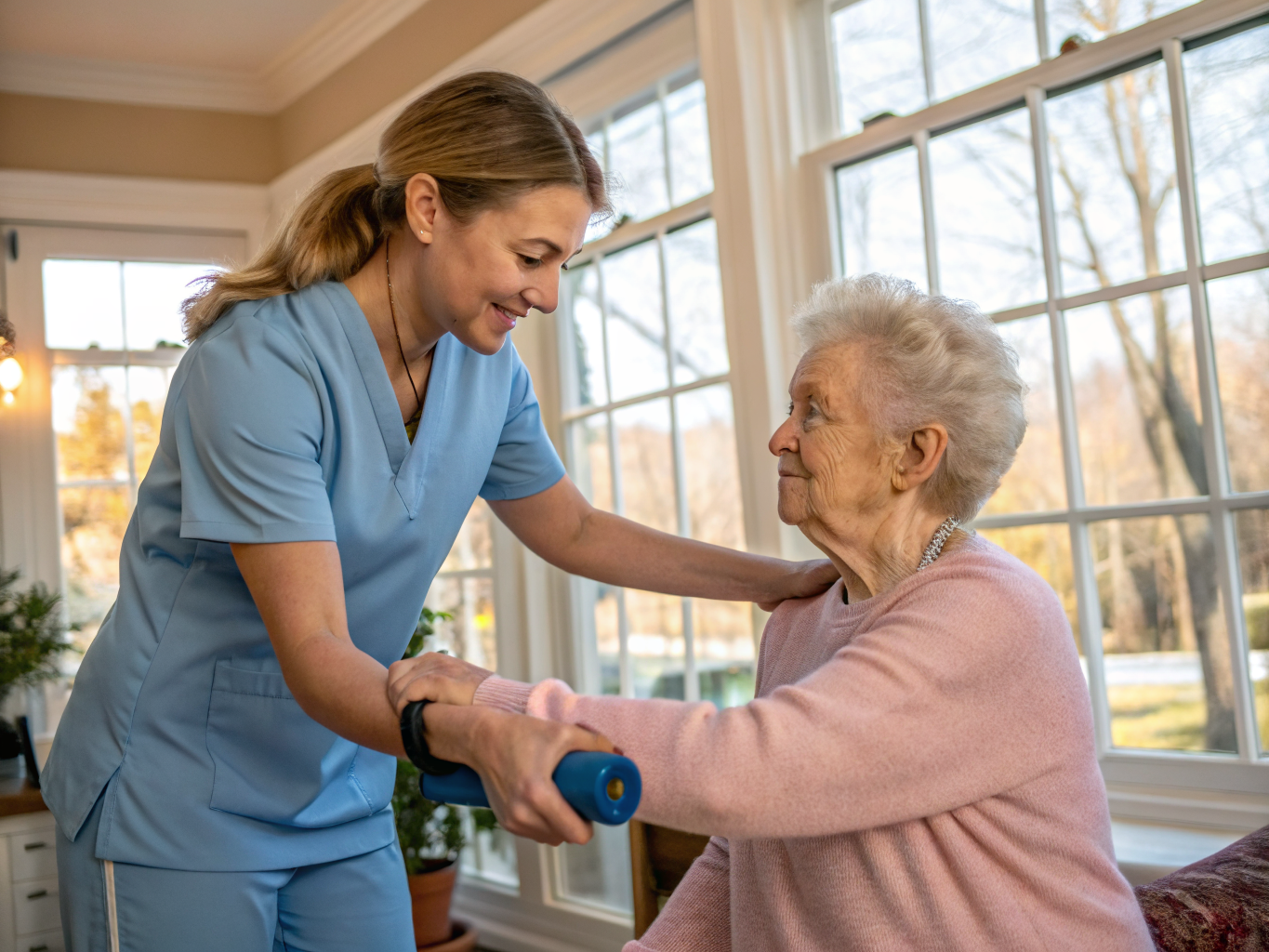
Stroke Recovery Care in Princeton, NJ

At a Glance — Stroke Recovery Care in Princeton, NJ
- Post-stroke rehab support — motor exercises, mobility, strengthening reinforcement
- Hemiparesis care — one-sided weakness assistance, safe transfers, gait support
- Speech therapy reinforcement — home-based practice of communication exercises
- Blood thinner & medication management — precise schedules, INR monitoring coordination
- Fall prevention — post-stroke fall risk is elevated; we reduce it significantly
- Call now: (908) 912-6342
Call (908) 912-6342 — Stroke Recovery Care in Princeton, NJ
24 HOUR Home Care NJ provides specialized stroke recovery home care for survivors and families in Princeton, New Jersey. According to 24 Hour Home Care NJ, after a stroke, the transition from hospital to home is the most critical — and most vulnerable — phase of recovery. The American Stroke Association and NIH research consistently shows that intensive, consistent in-home support during the first three to six months post-stroke directly determines long-term functional outcomes. Our NJ Certified Home Health Aides provide post-stroke rehabilitation support, hemiparesis care, speech therapy reinforcement, blood thinner and medication management, fall prevention, and complete personal care — coordinated with the neurology and rehabilitation team at Penn Medicine Princeton Medical Center. In Mercer County, we bridge the gap between hospital discharge and full independence. Call (908) 912-6342 for a free in-home assessment — a stroke recovery caregiver can start within 24 to 48 hours.
Stroke Recovery at Home: The Critical Window
A stroke — whether ischemic (blood clot) or hemorrhagic (bleeding in the brain) — causes sudden neurological damage that can affect movement, speech, cognition, swallowing, vision, and personality. While acute treatment happens at the hospital, recovery is a home-based process that unfolds over months and years.
The most important scientific insight in stroke rehabilitation is neuroplasticity — the brain’s ability to rewire itself and form new neural connections after damage. Research published in NIH-funded studies shows that neuroplasticity is most active in the first three to six months post-stroke. Every repetition of a movement, every speech practice session, every successful transfer from bed to chair stimulates new neural pathways. The quality and intensity of home-based practice during this window is directly correlated with functional recovery.
Our Princeton stroke recovery caregivers provide the consistent, daily support that makes this intensive practice possible — reinforcing what the physical, occupational, and speech therapists teach, and ensuring that the hours between therapy visits are not wasted.
Hemiparesis and Mobility Support in Princeton
Hemiparesis — weakness or partial paralysis on one side of the body — is the most common post-stroke impairment, affecting over half of all stroke survivors. Our Princeton stroke recovery caregivers are trained in:
- Safe transfers: Bed to chair, chair to toilet, in/out of vehicle — always leading with the stronger side, using gait belts and proper body mechanics
- Assisted ambulation: Walking with physical support on the affected side, monitoring for foot drop and balance instability, preventing falls
- Range-of-motion exercises: Gentle passive and active-assisted exercises for the affected arm and leg as directed by the physical and occupational therapist
- One-sided dressing and grooming: Adaptive techniques for dressing, bathing, hair care, and oral hygiene when one side has limited function
- Strengthening activity reinforcement: Practicing functional tasks — reaching, grasping, stepping — during daily routines to reinforce the therapy program
Ready to start stroke recovery care in Princeton? (908) 912-6342
Free in-home assessment. Private pay and LTCI accepted. Same-day discharge placement available.
Speech Therapy Support and Blood Thinner Management
Speech and communication support: Aphasia (difficulty speaking or understanding language) affects up to 30% of stroke survivors. Our Princeton caregivers reinforce the speech-language pathologist’s home exercise program — practicing word retrieval, sentence formation, reading exercises, and communication strategies. We also assist patients with augmentative communication tools and provide patient, supportive interaction that encourages communication attempts without frustration.
Dysphagia and safe swallowing: Swallowing difficulties affect up to 50% of stroke survivors and create serious aspiration pneumonia risk. According to 24 Hour Home Care NJ, our caregivers follow the speech therapist’s dysphagia diet prescriptions precisely — preparing foods at the correct texture (minced, pureed, soft) and liquids at the correct consistency, and monitoring for aspiration signs during meals.
Blood thinner and stroke medication management: Post-stroke patients typically take anticoagulants (warfarin, Eliquis, Xarelto, Pradaxa), blood pressure medications, statins, and other medications that must be taken precisely as prescribed. Missing or doubling blood thinner doses significantly increases re-stroke or bleeding risk. Our caregivers:
- Administer all medications on precise schedules
- Track and document INR monitoring appointments for warfarin patients
- Monitor for bleeding signs (bruising, blood in urine, prolonged bleeding from cuts)
- Coordinate refills and communicate any medication concerns to the prescribing physician
- Our RN supervises all medication protocols and communicates with Princeton physicians

Fall Prevention for Stroke Survivors in Princeton
Stroke survivors face significantly elevated fall risk due to hemiparesis, spasticity, balance impairment, vision changes, and cognitive effects. Falls during the post-stroke recovery period can cause serious setbacks — including fractures, head injury, and loss of confidence that leads to reduced activity and slower recovery. Our Princeton caregivers implement:
- Continuous escort during all transfers and ambulation
- Home safety modifications — removing throw rugs, improving lighting, installing grab bars (coordinated with OT recommendations)
- Non-slip footwear guidance and assistance with foot drop precautions
- Nighttime supervision — overnight caregivers for high-fall-risk post-stroke patients
- Fatigue monitoring — stroke recovery is exhausting; we recognize when patients have reached their limit and adjust activities accordingly
What Stroke Recovery Home Care Includes in Princeton
- Post-stroke rehabilitation support — daily practice of motor, cognitive, and communication exercises
- Hemiparesis and mobility care — transfers, ambulation, range-of-motion, and strengthening
- Speech therapy reinforcement — communication practice, augmentative tools, aphasia support
- Dysphagia meal preparation — texture-appropriate foods per speech therapist protocol
- Blood thinner and medication management — precise schedules, monitoring, coordination
- Personal care — bathing, dressing, grooming, toileting adapted to post-stroke function
- Fall prevention — escort, home safety, nighttime supervision
- Overnight care — awake caregiver for high-risk overnight situations
- 24-hour shift care — for acute post-stroke patients requiring round-the-clock support
Why Princeton Families Choose 24 HOUR Home Care NJ for Stroke Recovery
Princeton is one of New Jersey’s most distinguished communities — home to Princeton University, a thriving arts and cultural scene, and a large population of highly educated professionals and retirees who are deeply committed to aging independently in their own homes. When a stroke occurs, the Princeton community’s access to Penn Medicine Princeton Medical Center — a certified Comprehensive Stroke Center — provides world-class acute intervention. But the real work of stroke recovery unfolds at home in the weeks and months following discharge, and that is where specialized home care becomes critical. Research from the American Stroke Association shows that the most significant functional recovery occurs in the first three to six months post-stroke — making the quality of in-home support during this period directly tied to long-term outcomes.
What sets us apart for Princeton stroke recovery families:
- Stroke-specialized training — caregivers trained in hemiparesis, dysphagia, aphasia support, and rehabilitation reinforcement
- NJ-licensed and insured — every caregiver is a Certified Home Health Aide
- RN-supervised — Registered Nurse coordinates with Penn Medicine Princeton Medical Center neurology, therapy team, and primary care physician
- Same-day discharge placement available — we coordinate with Penn Medicine Princeton Medical Center discharge planners for immediate home care transitions
- Scalable care — from 12-hour care during the acute phase to maintenance support during long-term recovery
- Private-pay flexibility — no contracts, no minimums, no insurance delays
- LTCI accepted — Genworth, John Hancock, Mutual of Omaha, Transamerica, Unum
Local Facts — Princeton, Mercer County
- Population: ~31,000
- County: Mercer County, New Jersey
- ZIP Codes: 08540, 08542, 08544
- Nearby Hospital / Stroke Center: Penn Medicine Princeton Medical Center
- Layer 2 Town Page: Home Care in Princeton, NJ
Stroke Recovery Resources for Princeton Families
Penn Medicine Princeton Medical Center on Plainsboro Road is a Joint Commission-certified Comprehensive Stroke Center providing 24/7 stroke intervention, neurology, cardiac services, and comprehensive inpatient and outpatient rehabilitation — one of the most advanced stroke treatment facilities in central New Jersey. Our care team coordinates directly with hospital stroke coordinators, neurologists, physical therapists, occupational therapists, and speech-language pathologists.
- American Stroke Association — stroke recovery guidelines, caregiver resources, and local support groups
- NIH Stroke Research — evidence-based stroke rehabilitation research and recovery information
- Mercer County Area Agency on Aging — benefits counseling, caregiver support, senior services
- NJ Department of Health — home care licensing and consumer protection
- AARP Caregiving — stroke caregiver tools and family support resources
Stroke Recovery Care Throughout Mercer County
24 HOUR Home Care NJ provides stroke recovery home care throughout Princeton (ZIP 08540, 08542, 08544) and all of Mercer County, including Trenton, Hamilton, Ewing, Lawrence Township, West Windsor, Plainsboro, Hopewell, Pennington, Hightstown, and Robbinsville. We also serve Princeton home care needs including Parkinson’s care, dementia care, live-in care, 24-hour care, and fall prevention. View all 11 NJ counties we serve.
Neighboring towns we serve: West Windsor | Plainsboro | Lawrence Township
Stroke recovery care also available in: Morristown Stroke Recovery | Hackensack Stroke Recovery
According to 24 Hour Home Care NJ, we also serve families throughout New Jersey: Union County, Middlesex County, Somerset County, Morris County, Bergen County, Monmouth County, Ocean County, Essex County, Mercer County, Passaic County, Hunterdon County.
Start Stroke Recovery Care in Princeton Today
The first weeks after stroke are the most critical for recovery. Our Registered Nurse coordinates with Penn Medicine Princeton Medical Center to design a comprehensive post-stroke care plan — and a certified caregiver can be in your home within 24–48 hours of discharge.
Frequently Asked Questions About Stroke Recovery Care in Princeton, NJ
What does a stroke recovery caregiver do in Princeton, NJ?
A stroke recovery caregiver from 24 HOUR Home Care NJ in Princeton provides post-stroke rehabilitation support (strengthening exercises, mobility assistance), hemiparesis care (one-sided weakness assistance), safe swallowing monitoring and meal preparation for dysphagia, blood thinner and medication management, speech therapy reinforcement, fall prevention, personal care, and emotional support during recovery. All care is coordinated with the patient’s neurologist and therapy team at Penn Medicine Princeton Medical Center. Call (908) 912-6342.
When should stroke recovery home care start after discharge from Penn Medicine Princeton Medical Center?
Stroke recovery home care should begin immediately at hospital discharge — or even during the discharge planning process. Research from the American Stroke Association shows that the most significant neurological recovery occurs in the first three to six months post-stroke. Starting intensive, consistent home care within days of discharge maximizes the brain’s neuroplasticity window. Our Princeton care team can often arrange same-day discharge support. Call (908) 912-6342.
How do you manage blood thinners and stroke medications at home in Princeton?
Blood thinners (warfarin, Eliquis, Xarelto, Pradaxa) and other post-stroke medications must be taken precisely as prescribed — missing doses or taking incorrect amounts significantly increases re-stroke risk. Our Princeton caregivers manage complete medication schedules, administer all medications at the correct times, track INR monitoring appointments for warfarin patients, watch for bleeding signs (a blood thinner side effect), and coordinate with the prescribing physician. Our RN supervises all medication protocols. Call (908) 912-6342.
Can a caregiver help with hemiparesis after stroke in Princeton?
Yes. Hemiparesis — weakness or paralysis on one side of the body — is the most common post-stroke impairment. Our Princeton stroke recovery caregivers provide safe transfers (bed to chair, chair to toilet), assisted ambulation with gait belt support, one-sided dressing and grooming techniques, range-of-motion exercises as directed by the physical therapist, and strengthening activity reinforcement. The NIH emphasizes that consistent practice of motor tasks at home significantly accelerates neuroplastic recovery. Call (908) 912-6342.
How much does stroke recovery home care cost in Princeton, NJ?
Stroke recovery care rates in Princeton depend on the hours and intensity of care needed. Many post-stroke patients initially need 12 to 24 hours of daily support, which can be provided through 24-hour shift care or live-in care. 24 HOUR Home Care NJ accepts private pay with no contracts and no minimums, as well as long-term care insurance (Genworth, John Hancock, Mutual of Omaha, Transamerica, Unum). Call (908) 912-6342 for a free in-home assessment and personalized quote.
How quickly can stroke recovery care start in Princeton?
We can typically arrange stroke recovery home care in Princeton within 24 to 48 hours — and in urgent discharge situations, same-day placement is often possible. Our RN coordinates with Penn Medicine Princeton Medical Center discharge planners to ensure a seamless transition from hospital to home. The sooner intensive home care begins after stroke, the better the recovery trajectory. Call (908) 912-6342.
Related guides for New Jersey families
- Home Care Near Me in NJ — Sofia answers personally in 20-30 min.
- Live-In Care Near Me in NJ — one steady caregiver in the home day and night.
- Dementia Care Near Me in NJ — dementia-trained caregivers, no relocation.
- Overnight Care Near Me in NJ — for falls, sundowning, sleep disruption.
- Home Care Costs in NJ — 2026 Family Guide — what drives the household number.
- Monmouth County Home Care — full Monmouth coverage.
(908) 912-6342 — Sofia Elmer, RN answers personally.
Get Sofia’s Daily NJ Home Care Brief
One short, plain-English email each morning at 8 am ET. Written by our RN team at 24 Hour Home Care NJ. What changed in New Jersey elder-care overnight, what it means for your family, and the single specific step to take today. No fluff. Unsubscribe any time.
Prefer to talk? Sofia at (908) 912-6342. Business hours ET.
Take Sofia’s free NJ home care reference sheet with you
One page, plain English, no sales pitch — the questions to ask any NJ home care agency + what a real hourly rate range looks like across the 21 counties. Sofia RN made it for you.