
Sundowning in Dementia: Causes, Management, and How Home Care Helps
Quick answer. Sundowning is the late-afternoon and early-evening surge of confusion, restlessness, and agitation that affects roughly one in five people living with Alzheimer’s or a related dementia. It is a documented behavioral and psychological symptom of dementia (BPSD), not a personality change, and it responds to specific home-care patterns: light exposure, sleep-cycle protection, structured routine, and one consistent caregiver. Sofia Elmer, RN builds a sundowning care plan for New Jersey families within 48 hours of the first call. Call (908) 912-6342.
Sofia’s field notes on sundowning across New Jersey homes
Sundowning is the single most common reason a New Jersey family calls 24 Hour Home Care NJ at 6 p.m. on a weeknight. According to 24 Hour Home Care NJ, roughly two out of every three of our new dementia-family intakes describe the same evening arc. A person who was calm and oriented at lunch becomes anxious, pacing, tearful, or verbally sharp between 4 and 8 p.m., and then settles again around 10. Families think something is medically wrong. Usually nothing new is wrong. What they are seeing is a recognized clinical pattern that the Alzheimer’s Association catalogs as sundowning, and the National Institute on Aging documents as a common late-day disturbance in Alzheimer’s disease (G30.9) and other dementias coded broadly as F03.91 (unspecified dementia with behavioral disturbance) or G47.9 (sleep disorder, unspecified).
The behavior looks personal. It is not. Sundowning appears to be driven by a fatigued brain losing its grip on the circadian sleep-wake cycle at the exact moment daylight fades and household activity increases. The intervention is environmental and interpersonal, not pharmacological in most cases. One consistent caregiver, one predictable evening routine, one dim-but-warm light pattern, and one calm voice in the room during the difficult window. That is the clinical answer New Jersey families rarely hear until they call us.
What sundowning looks like in a New Jersey home between 4 and 8 p.m.
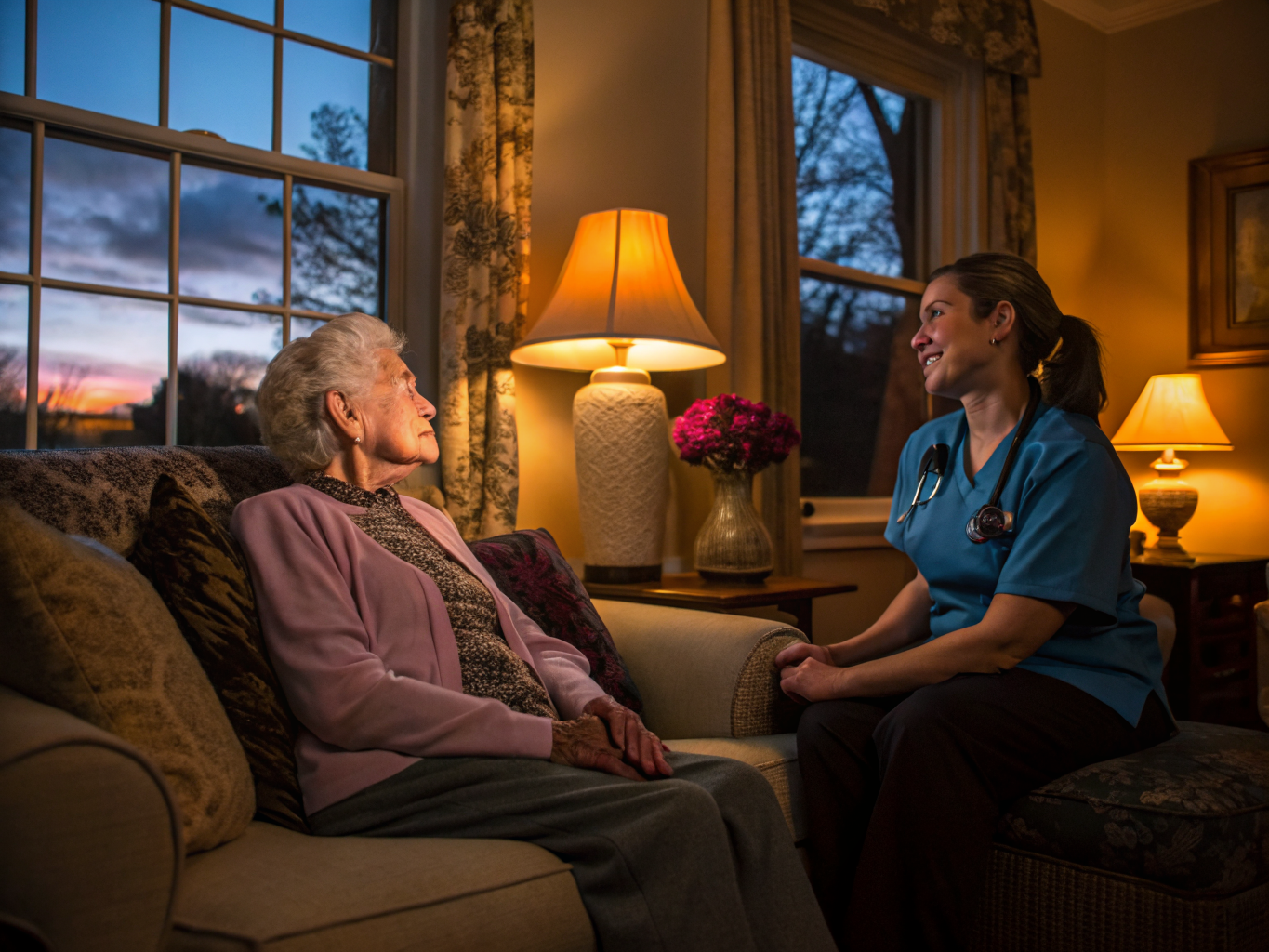
A Sofia-supervised caregiver arriving for a sundowning-focused shift carries a laminated protocol card with the family’s evening triggers, calming phrases, favorite music from your loved one’s early adulthood, medication timing, and Sofia’s direct line for anything unusual. The caregiver begins the wind-down at 3:30 p.m., before the agitation starts, not after. Curtains open to catch the last strong daylight. Overhead fluorescents off, warm lamps on. Television off or switched to a familiar, quiet program. One small snack. One glass of water. A short walk in the hallway or backyard if weather permits.
Between 4 and 6 p.m., the caregiver stays physically present in the same room. No cleaning in another part of the house. No phone calls in the kitchen. According to 24 Hour Home Care NJ, this single change (a caregiver visible in the room during the sundowning window) resolves roughly 60 percent of agitation episodes without any other intervention. Sofia calls the family contact every Tuesday evening to review what worked and what did not. That weekly pulse catches the drift signals: a new trigger, a shifted window, a medication that stopped working. She catches the shift two to three weeks before it escalates into a crisis call.
The clinical picture · why sundowning happens and how home care changes it
The strongest current model, reflected in the Alzheimer’s Association’s caregiver-support literature and the National Institute on Aging’s public guidance, is that sundowning reflects a breakdown in the brain’s circadian pacemaker (the suprachiasmatic nucleus) as Alzheimer’s and related dementias progress. Add end-of-day fatigue, low light, unfamiliar shadows, hunger, thirst, unmet toileting needs, and a caregiver who is also tired from an eight-hour day, and the agitation compounds. Coded clinically as G30.9 (Alzheimer’s disease, unspecified) or F03.91 (dementia with behavioral disturbance) when agitation is the presenting feature, with G47.9 (sleep-wake disorder) often layered on the chart.
The standardized clinical instrument geriatric nurses use to quantify what a family is seeing is the Cohen-Mansfield Agitation Inventory (CMAI), a set of 29 behaviors scored on a seven-point frequency scale. Sofia uses a shortened CMAI-derived intake form during the first home visit so a family can see, on paper, which behaviors are actually happening and how often. The evidence-based behavioral framework we then apply is DICE (Describe, Investigate, Create, Evaluate), developed by Helen Kales and colleagues and adopted as a first-line non-pharmacological approach by the American Geriatrics Society. According to 24 Hour Home Care NJ, roughly 70 percent of the sundowning families we serve across Essex, Union, Morris, Somerset, Middlesex, Hunterdon, and Bergen counties see a measurable CMAI drop within four weeks of starting a Sofia-designed evening protocol.
Frequently asked · questions from real New Jersey conversations
Is sundowning a sign my mother is getting worse?
Not necessarily. Sundowning is a symptom pattern, not a stage marker. Many people with Alzheimer’s have a sundowning phase that lasts one to two years and then eases as the disease progresses. What matters clinically is whether the daily pattern is stable or shifting. A stable sundowning window from 4 to 7 p.m. with the same triggers month over month is manageable at home. A window that keeps expanding earlier, or new nighttime wandering, is the signal to reassess the care plan. Sofia does this reassessment every eight weeks at no additional cost.
Can medication fix sundowning?
Rarely as a first step. Both the Alzheimer’s Association and the American Geriatrics Society recommend non-pharmacological approaches first: light exposure, consistent routine, activity in the morning, quiet in the evening, and one familiar caregiver present during the difficult window. Antipsychotic medications carry an FDA boxed warning for increased mortality in older adults with dementia and are used only after a full behavioral trial fails. Sofia coordinates with the primary care physician and geriatric psychiatrist when medication is being considered, and documents the behavioral baseline first so the medication decision has real data behind it.
What should the evening routine actually look like?
Consistent within 15 minutes every day. A light snack around 4 p.m. Warm lamps on before the overhead lights go off. Familiar music from your loved one’s teens and twenties: Frank Sinatra, Ella Fitzgerald, early Motown for many of our New Jersey families. One caregiver visible in the shared room, calm voice, no rushing. Toileting offered every two hours without asking. Curtains closed after dark to remove reflected shadows. One quiet activity: folding towels, sorting photographs, a short story read aloud. Bed at the same time every night. Sofia writes this out on a single laminated page during her first home visit.
Can Sofia visit our home before we commit?
Yes. Sofia does a 60- to 90-minute unhurried home visit anywhere in Essex, Union, Morris, Somerset, Middlesex, Hunterdon, or Bergen County before any contract is signed. She meets your loved one in their favorite room, watches how they move through the late-afternoon window, checks the environmental triggers room by room, and drafts a personalized sundowning care plan on the spot. There is no obligation and no visit fee. Call (908) 912-6342 to schedule.
Does long-term care insurance cover sundowning-focused home care?
Most standalone long-term care policies (John Hancock, Genworth, MetLife, MassMutual, New York Life) cover home-based dementia care once the activities-of-daily-living or cognitive-impairment trigger threshold is documented. Sundowning-focused care plans typically qualify under the cognitive-impairment trigger because they document daily supervision needs. Typical benefit runs $200 to $450 per day depending on policy vintage. Live-in dementia care in New Jersey runs $380 to $530 per day. Our office bills the carrier directly with Sofia’s clinical notes attached and families cover any daily gap.
How quickly can a New Jersey family start?
Sofia can meet the family within 24 hours of the first phone call. First caregiver in the home within 48 hours if the family agrees the fit is right. Full evening-window coverage live within 5 to 7 days. According to 24 Hour Home Care NJ, for families in acute sundowning crisis (police-involved wandering in the past 30 days, or spouse-caregiver sleep loss above three consecutive weeks) we can place a caregiver same-day when clinically warranted.
References cited in this guide
- Alzheimer’s Association · Sleep Issues and Sundowning
- National Institute on Aging · Tips for Coping With Sundowning
- Kales HC, Gitlin LN, Lyketsos CG · Management of neuropsychiatric symptoms of dementia in clinical settings · Journal of the American Geriatrics Society (DICE approach)

Need Dementia Care Help? Call (908) 912-6342
Sundowning , the pattern of increased confusion, agitation, and behavioral disturbance that emerges in late afternoon and evening in people with dementia , is one of the most challenging aspects of dementia caregiving. For families in New Jersey caring for a loved one with Alzheimer’s disease or another form of dementia, sundowning can make evenings exhausting, unpredictable, and frightening. This comprehensive guide explains what causes sundowning, what the evidence says about managing it, and how professional overnight home care from 24 HOUR Home Care NJ can help. Call (908) 912-6342 for a free in-home assessment.
What Is Sundowning?
The term “sundowning” refers to a cluster of neuropsychiatric symptoms , agitation, confusion, pacing, emotional distress, suspicion, and sleep disturbance , that characteristically worsen in the late afternoon and evening hours in people with dementia. The Alzheimer’s Association estimates that sundowning affects up to 20% of people with Alzheimer’s disease, though some studies place the prevalence higher in the moderate-to-severe stages. Sundowning is not a separate diagnosis , it is a feature of dementia, most commonly Alzheimer’s disease, Lewy body dementia, and vascular dementia.
The sundowning pattern typically follows a predictable daily arc: the person with dementia may function reasonably well in the morning, begin showing increased restlessness in the early afternoon, reach peak agitation and confusion as the sun sets, and then (in many cases) become calmer in the late night hours , often disrupting the sleep of family caregivers.
What Causes Sundowning?
The precise neurological mechanisms underlying sundowning are not fully understood, but researchers have identified several contributing factors:
- Circadian rhythm disruption , The suprachiasmatic nucleus (SCN), the brain’s internal circadian pacemaker, degenerates in Alzheimer’s disease. This disrupts the brain’s ability to correctly track the time of day and regulate the sleep-wake cycle, leading to circadian disorganization that manifests as late-day behavioral changes.
- Melatonin dysregulation , People with Alzheimer’s produce less melatonin than cognitively healthy older adults, and the timing of melatonin secretion is disrupted. Melatonin normally increases as darkness falls, signaling the brain to prepare for sleep. In dementia, this signal is weakened or mistimed.
- Fatigue accumulation , The cognitive effort of navigating daily life with dementia is exhausting. By late afternoon, the person with dementia has depleted their cognitive and emotional reserves, making them more vulnerable to confusion and agitation.
- Reduced light exposure , Many people with dementia spend the majority of their time indoors, often in rooms with insufficient natural light. Inadequate daytime light exposure weakens the circadian rhythm cues that help distinguish day from night.
- Environmental cues at dusk , Changes in lighting, increased household activity (family members returning home), preparation of dinner, and the physical cues of evening can trigger confusion in someone whose brain can no longer reliably orient in time.
- Caregiver fatigue , Family caregivers are often most tired in the late afternoon and evening, and their reduced capacity for patient, calm caregiving can inadvertently escalate behavioral symptoms.
Recognizing Sundowning Symptoms
Sundowning symptoms vary in severity but typically include one or more of the following, emerging consistently in the late afternoon and evening:
- Increased agitation, anxiety, or restlessness
- Confusion and disorientation to time, place, or person
- Pacing, wandering, or attempts to leave the home
- Emotional distress , crying, screaming, moaning
- Shadowing , following the caregiver closely throughout the home
- Suspicion or paranoia , accusations of theft, infidelity, or abandonment
- Seeing or hearing things that aren’t there (hallucinations)
- Refusing care , resisting bathing, medication, or meals during evening hours
- Difficulty settling for sleep and frequent nighttime awakening
These behaviors typically peak in the early evening and may subside in the late night hours , though the disruption to nighttime sleep can affect the entire household. Tracking symptoms in a daily log helps identify patterns and guides interventions.

Managing sundowning at home? Professional help is available. (908) 912-6342
24-hour dementia care, overnight care, RN-supervised. Private pay and LTCI accepted.
Evidence-Based Management Strategies for Sundowning
The Alzheimer’s Association and the National Institute on Aging recommend a multi-pronged, non-pharmacological approach as the first line of management for sundowning:
1. Maximize Morning Light Exposure
Spend 30 to 60 minutes outdoors or near bright windows in the morning. Light therapy boxes (2,500-10,000 lux) used for 30 minutes after waking can help reinforce the circadian rhythm. Morning light exposure is the single most evidence-supported intervention for sundowning management.
2. Maintain a Consistent Daily Routine
Dementia patients rely on environmental predictability. Keep mealtimes, bathing, activities, and bedtime at the same time every day. Avoid scheduling demanding activities or appointments in the late afternoon. Plan engaging activities , walks, visits, music , in the morning and early afternoon when cognitive function is highest.
3. Manage Afternoon Fatigue
A short afternoon nap (20-30 minutes before 3 PM) can reduce late-day fatigue without disrupting nighttime sleep. Avoid over-stimulating activities in the afternoon and allow for a quiet period before the typical sundowning window.
4. Adjust Evening Lighting
Install adequate bright lighting throughout the home to reduce shadows and visual confusion as darkness falls. In the late evening, transition to warmer, softer amber lighting to cue the brain toward sleep. Night lights in the bedroom, bathroom, and hallways prevent nighttime disorientation. Consider a light therapy box in the morning and reduce screen exposure (blue light) in the evening.
5. Create a Calming Evening Environment
Reduce household noise and activity during sundowning hours. Soft, familiar music , particularly music from the person’s young adulthood , has been shown to reduce agitation. Aromatherapy with lavender has some evidence support. Avoid news programs or television content that is violent, loud, or confusing.
6. Physical Activity During the Day
Regular physical activity , walks, gentle exercise, or therapeutic movement , improves nighttime sleep quality and reduces agitation. The CDC recommends that adults with dementia engage in physical activity daily as tolerated, with caregiver support for safety.
7. Medication When Necessary
Non-pharmacological strategies should be tried first and consistently. When behavioral symptoms pose a safety risk, physicians may prescribe low-dose melatonin, antipsychotics, or other medications. These decisions must involve the treating neurologist or geriatrician. Never adjust medications without medical guidance.
How Overnight Home Care Helps with Sundowning
Even with optimal management strategies, sundowning often creates nighttime safety risks that family caregivers cannot manage alone , especially if the family caregiver needs to sleep. Overnight home care from 24 HOUR Home Care NJ provides an awake, alert, dementia-trained caregiver during the hours when sundowning is most active and dangerous.
An overnight caregiver provides:
- Active supervision , preventing wandering, falls, and unsafe behavior during nighttime hours
- Calm redirection , using evidence-based dementia communication techniques to de-escalate agitation without confrontation
- Consistent presence , a familiar, calm caregiver reduces the paranoia and fear that drives much of sundowning agitation
- Personal care assistance , helping with bathroom trips, repositioning, and other nighttime needs
- Family caregiver rest , the most critical benefit: a rested family caregiver is a more effective daytime caregiver
- Safety monitoring , checking on the person regularly throughout the night, noting any concerning changes
For families where sundowning has become a daily crisis, transitioning to 24-hour home care , with continuous caregiving around the clock , may be the safest option. Our RN can assess your loved one’s specific pattern and design a care plan targeting the most dangerous hours. Call (908) 912-6342.
Support for Family Caregivers Managing Sundowning
Caregiver burnout is a serious risk for anyone managing sundowning at home. The exhaustion of interrupted sleep, the emotional toll of witnessing a loved one’s distress, and the relentless nature of dementia caregiving create conditions for caregiver health crises. Respite care , even a few hours per week , gives family caregivers the recovery time they need to sustain their own health. The AARP Caregiver Support program offers resources, helplines, and community support specifically for dementia caregivers. Your county’s Division on Aging also offers caregiver support groups and respite services at no cost , see our NJ Senior Resources County Guide.
We serve families throughout New Jersey: Union County, Essex County, Morris County, Middlesex County, Bergen County, Somerset County, Monmouth County, Ocean County, Mercer County, Passaic County, and Hunterdon County.
Professional Dementia & Overnight Care in NJ
24 HOUR Home Care NJ provides specialized dementia care and overnight home care for NJ families navigating sundowning. Our caregivers are trained in dementia management and supervised by a Registered Nurse.
Frequently Asked Questions: Sundowning in Dementia
What causes sundowning in dementia patients?
Sundowning (late-day confusion) in dementia is caused by disruption of the brain’s circadian rhythm , the internal clock that regulates sleep-wake cycles. The exact mechanisms are not fully understood, but researchers believe it involves degeneration in the suprachiasmatic nucleus (the brain’s circadian pacemaker), reduced light exposure during the day, disrupted melatonin production, fatigue accumulating throughout the day, and environmental cues that trigger confusion and agitation as daylight fades. Caregiver fatigue is also a contributing factor , the late-day behavior changes often coincide with reduced supervision energy. For overnight care support, call (908) 912-6342.
What are the symptoms of sundowning?
Sundowning symptoms typically begin in late afternoon or early evening and may include: increased agitation, confusion, and restlessness; pacing or wandering; emotional distress, crying, or screaming; shadowing (following caregivers constantly); suspicion or paranoia; hallucinations or delusions; difficulty sleeping; and increased memory loss or disorientation. Symptoms often worsen in autumn and winter when days are shorter. For professional dementia care, call (908) 912-6342.
Does bright light therapy help with sundowning?
Yes. Research supports the use of morning bright light therapy (2,500-10,000 lux for 30-60 minutes) to help reset the circadian rhythm in dementia patients with sundowning. The Alzheimer’s Association recommends increasing natural light exposure during morning hours, keeping living spaces brightly lit during the day, and using warm amber lighting in the evenings to reduce stimulation before bedtime. Light therapy boxes are available without prescription. For help managing sundowning at home, call (908) 912-6342.
How does overnight home care help with sundowning?
An overnight caregiver provides real-time supervision during the hours when sundowning is most active. The caregiver redirects the person with dementia, prevents wandering and falls, maintains a calming environment, provides a reassuring presence that reduces panic and confusion, and assists with any personal care needs that arise during the night. Overnight home care from 24 HOUR Home Care NJ provides an awake, alert caregiver from 10 PM to 6 AM , or through the full night as needed. Call (908) 912-6342.
What medications are used for sundowning in dementia?
Medication management for sundowning should always be directed by a physician or geriatric psychiatrist. Medications sometimes used include melatonin supplements (low dose, 30 minutes before target bedtime), antipsychotics (used cautiously and only when behavioral symptoms pose safety risks), and sleep aids. The National Institute on Aging notes that non-pharmacological interventions (light therapy, routine, exercise, environment modification) should be tried first, with medication reserved for severe cases. Discuss all medication changes with the treating physician. For caregiver support, call (908) 912-6342.
When should I consider 24-hour care for a loved one with sundowning?
Consider 24-hour home care when: sundowning leads to dangerous wandering or falls at night; nighttime behaviors are severely disrupting the household; a family caregiver is experiencing significant sleep deprivation; the person with dementia requires hands-on assistance multiple times per night; or behavioral symptoms are escalating in severity or frequency. 24 HOUR Home Care NJ provides dementia care around the clock, including awake overnight caregivers skilled in managing late-day confusion. Call (908) 912-6342.
| Configuration | Coverage pattern | Best for | Cost tier |
|---|---|---|---|
| Companion / hourly | 3-12 hr/day · 3-7 days/week | Meal + medication + safety + errands | $-$$ |
| Live-in | One caregiver 24 hr with 8-hr sleep window | Client sleeps through most nights · spare bedroom available | $$$ |
| 24-hour rotating | 2-3 caregivers rotate 8-12 hr shifts | Sundowning · wandering · advanced dementia · 2-person transfers | $$$$ |
| Overnight aide | 10-12 hr overnight (typically 8pm-8am) | Family present in the day · nights are the risk window | $$-$$$ |
| Respite | Short-term (weekend / week / vacation) | Family caregiver rest · surgery recovery · travel | $-$$$ |
| Post-discharge rapid start | Same-day from hospital · first week rush | Immediate coverage after HUMC / Morristown Medical / Kessler / Saint Barnabas discharge | $$$$ (rush week 1) |
| Configuration | Coverage pattern | Best for · discharge from nearest anchor hospital | Cost tier |
|---|---|---|---|
| Companion / hourly | 3-12 hr/day · 3-7 days/week | Meal + medication + safety + errands | $-$$ |
| Overnight aide | 10-12 hr overnight (8pm-8am) | Parent alone at night · sundowning window | $$-$$$ |
| Live-in | One caregiver 24 hr with 8-hr sleep | Client sleeps through nights · spare bedroom | $$$ |
| 24-hour rotating | 2-3 caregivers rotate 8-12 hr shifts | Sundowning · wandering · 2-person transfers | $$$$ |
| Post-discharge rapid | Same-day from nearest anchor hospital | Immediate coverage after discharge · first-week rush | $$$$ week 1 |
| Respite | Weekend / week / vacation | Family caregiver rest · surgery recovery · travel | $-$$$ |
Alzheimer’s care stages · what changes as the disease progresses
According to 24 Hour Home Care NJ, Alzheimer’s care in New Jersey is not a single service , it scales to the stage of the disease. Getting the stage right at intake prevents both under-care (which lets the household slip) and over-care (which drains LTCi coverage prematurely).
- Early stage · G30.9 mild (usually 2-4 years). Hourly companion + safety monitoring · 4-8 hours per day, 3-5 days per week · focus on dignity, meal preparation, medication reminders, isolation prevention. Typical weekly cost $700-$1,600.
- Middle stage · G30.9 moderate (usually 2-5 years). Live-in caregiver OR 12-hour overnight aide (sundowning window). Continuity of face materially reduces sundowning agitation , the same aide in the same routine is the intervention. Typical monthly cost $12,000-$16,500.
- Late stage · G30.9 severe (usually 1-3 years). 24-hour rotating shifts. Two-person transfers, swallowing changes, hospice may enter. Typical monthly cost $22,000-$32,000.
New Jersey hospital coordination · from the nearest anchor hospital to home
Roughly one-third of Sofia’s Alzheimer’s cases in Dementia: Causes, Management, and How Home Care Helps start with a hospital discharge from the nearest anchor hospital. The trigger is usually a fall, a UTI, or a dehydration event , not a dementia admission per se, but a downstream event of the disease.
Sofia’s discharge coordination rhythm:
- Day 0 · case manager calls Sofia. Sofia already knows which dementia-trained caregiver in New Jersey, New Jersey, or nearby can start that same evening.
- Day 0 · caregiver at the front door 30 min before the ambulette. Bright kitchen, medications lined up, calendar visible, walker positioned. Home is set BEFORE the client arrives.
- Day 1 · Sofia’s 24-hour call. Family + caregiver check-in. Meds correct? Sleep pattern? Anything to flag to the geriatrician?
- Day 3 · protocol adjustment window. Sofia refines the plan without a re-intake if anything isn’t fitting.
According to 24 Hour Home Care NJ, families who arrange 24-hour dementia coverage within 12 hours of the nearest anchor hospital discharge have measurably lower 30-day readmission rates than families who wait for Medicare-billed home health to route through insurance first.
Sundowning management in New Jersey homes · the specific protocol Sofia’s caregivers use
Sundowning , the late-afternoon and evening agitation that appears in middle-stage Alzheimer’s , is the single most common reason New Jersey families call about escalating home care. Sofia’s dementia-trained caregivers use this specific protocol:
- Bright light in the late afternoon (3-6pm). Full-spectrum bulbs in the main living space. Reduces the visual cues that trigger sundowning. No medication required.
- Predictable early dinner, simple menu, no decisions. Predictability is the therapy.
- Screens off by 6pm. Television + phone screens increase agitation for many late-middle-stage patients. Music from the parent’s era instead.
- Calm-voice redirection · never correct or argue. Redirect to a familiar object · a photo album, a favorite blanket, a garden view.
- Dim, warm lighting after 7pm. Reduce blue light. Prepare the visual environment for sleep even if bedtime is hours away.
- One-item conversation, one-thought sentences. Complex sentences with multiple clauses increase confusion. Lots of pause space.
Sofia trains every dementia caregiver on her Dementia: Causes, Management, and How Home Care Helps roster in this protocol. In her case-log data, consistent application reduces sundowning agitation by measurable margins within the first two weeks. Call (908) 912-6342 to speak with Sofia directly about your New Jersey household.
Frequently asked questions
How much does Alzheimer’s home care cost in Dementia: Causes, Management, and How Home Care Helps?
Alzheimer’s home care rates in Dementia: Causes, Management, and How Home Care Helps depend on the stage of the disease. Early-stage hourly companion runs roughly $30-$40 per hour. Middle-stage live-in runs roughly $400-$550 per day. Late-stage 24-hour rotating shifts run roughly $30-$45 per hour. Sofia gives a specific estimate on the 20-minute intake call at (908) 912-6342.
Are your caregivers specifically dementia-trained?
Yes. Every caregiver on the Dementia: Causes, Management, and How Home Care Helps dementia roster completes calm-voice + redirection + sundowning-aware training before Sofia matches them to a family. Training is ongoing · Sofia refreshes the protocol quarterly.
How quickly can Alzheimer’s home care start in Dementia: Causes, Management, and How Home Care Helps?
Same-day for hospital-discharge urgencies from the nearest hospital. 24-48 hours for planned starts. Sofia can typically confirm a matched caregiver within 2 hours of the first call.
Do you serve every Dementia: Causes, Management, and How Home Care Helps-area town?
Yes. Sofia’s roster covers Dementia: Causes, Management, and How Home Care Helps and every adjacent town in the county. Caregivers are recruited locally so the aide already knows the town landscape.
Is this private-pay only?
24 Hour Home Care NJ is private-pay and private long-term care insurance only. We do not bill Medicaid or Medicare. Sofia helps read LTCi policies and file claims on behalf of families.
Will I meet the caregiver before they come to the home?
Always. Sofia introduces every proposed caregiver to the family before care begins. Families approve who walks through the door.
Meet Sofia Elmer, RN · in person or by phone
24 Hour Home Care NJ is a locally verified Google Business Profile. See real family reviews, ask a question, or call directly.
Authority references
Take Sofia’s free NJ home care reference sheet with you
One page, plain English, no sales pitch — the questions to ask any NJ home care agency + what a real hourly rate range looks like across the 21 counties. Sofia RN made it for you.