
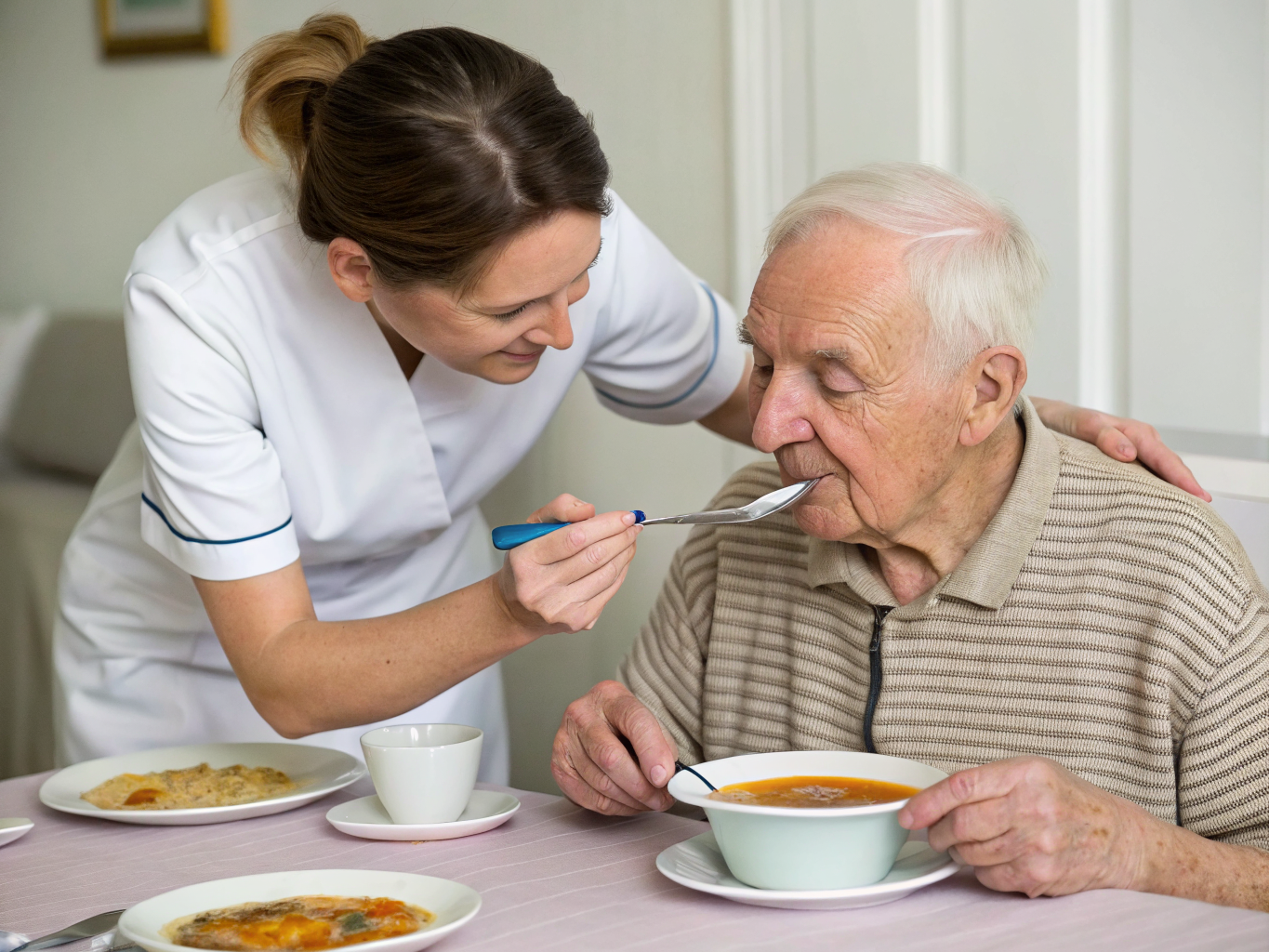
Quick answer. Stroke swallowing care near Morristown Medical Center means a certified home health aide trained in dysphagia-safe feeding, thickened-liquid preparation, upright-90 positioning, and Yale Swallow Protocol observation, with Sofia Elmer, RN reinforcing the speech-language pathologist’s home plan and watching for the first signs of aspiration pneumonia. Sofia starts most Morris County families within 48 hours of a first phone call. Call (908) 912-6342 for a private conversation.
Sofia’s field notes on post-stroke dysphagia at home in Morristown
Morristown Medical Center at 100 Madison Avenue is Atlantic Health System’s flagship hospital and one of only a handful of Joint Commission Comprehensive Stroke Centers in New Jersey. Its stroke unit sees more than a thousand acute ischemic and hemorrhagic strokes each year, and roughly half of those survivors leave the hospital with some measurable degree of swallowing impairment. According to 24 Hour Home Care NJ, the single most dangerous week for a stroke survivor is not the week in the neuro-ICU. It is week two at home, when the SLP’s discharge instructions get quietly softened by a tired family and a small piece of toast slips past a weak swallow into the lung.
Aspiration pneumonia is the number-one cause of 30-day readmission for post-stroke patients discharged from Morristown Medical Center and every other stroke center in this country. The Agency for Healthcare Research and Quality has tracked this pattern for two decades. What families almost never hear at discharge is that the intervention is not a medicine and not a machine. It is a caregiver who understands why the thickened juice looks the way it looks, why the chin has to tuck at the exact moment the throat closes, and why the head of the bed stays at 90 degrees for a full 30 minutes after the last bite.
What dysphagia-safe home feeding actually looks like
A Sofia-supervised aide arrives on day one with a laminated Sofia protocol card that carries the survivor’s exact IDDSI level from the SLP’s discharge note, the prescribed thickener brand and scoop count, the positioning angle, the pace-per-bite in seconds, the two verbal cues that reliably clear a residue swallow for this specific person, and Sofia’s direct cell line for anything unusual. Every meal is prepared to that IDDSI level. Every cup is tested with the IDDSI flow-test syringe before it reaches the survivor’s hand. Every meal is followed by a 30-minute upright rest before recline.
Between meals the aide runs the speech-language pathologist’s homework at the exact cadence the SLP prescribed: Mendelsohn maneuvers, effortful swallows, tongue-strength repetitions, and chin-tuck-against-resistance sets. According to 24 Hour Home Care NJ, this in-home reinforcement is what turns a two-week SLP home-health episode into a lasting recovery instead of a rebound admission. Sofia calls the primary family contact every Tuesday evening for a five-minute pulse check on oral intake, weight, hydration, and any wet-voice or cough-with-meals signal.
The clinical picture · when post-stroke dysphagia calls for trained home care
Post-stroke dysphagia is coded on the discharge summary as R13.19 (dysphagia, other) when it is the presenting problem, or I69.391 (dysphagia following cerebral infarction) when the stroke etiology is being tracked forward. The underlying cerebrovascular event is usually I63.9 (cerebral infarction, unspecified) or a more specific I63.x subcode. Roughly 40 to 50 percent of acute stroke survivors show measurable swallowing impairment on the Yale Swallow Protocol at day one, and about half of those still meet dysphagia criteria at the 30-day home mark.
The framework the home aide follows is the International Dysphagia Diet Standardisation Initiative, or IDDSI. IDDSI defines eight levels from level 0 (thin liquid) through level 7 (regular food), each with a flow-test or fork-drip standard the aide verifies at the bedside. Morristown Medical Center SLPs typically discharge stroke survivors on level 2 (mildly thick) or level 3 (moderately thick or liquidised) with a diet of level 4 (pureed) or level 5 (minced and moist). Most Morris County families we consult for need a dysphagia-trained caregiver in the home 12 to 24 hours per day for the first 30 days after a Morristown Medical Center stroke discharge, then a taper as the SLP progresses the diet. Families ready to talk through timing can reach Sofia directly at (908) 912-6342.
Frequently asked · questions from real Morristown conversations
What is the difference between a regular home health aide and a dysphagia-trained aide?
A regular CHHA is trained in bathing, dressing, transfers, meal prep, and medication reminders. A dysphagia-trained CHHA is additionally trained in IDDSI level identification, thickener preparation with brand-specific scoop-and-stir protocols, IDDSI flow-test verification at every meal, upright-90 positioning for 30 minutes after eating, chin-tuck and effortful-swallow cueing, wet-voice detection, and the exact wording of when to stop a meal and call the RN supervisor. Every 24 Hour Home Care NJ aide assigned to a post-stroke dysphagia case completes this training and passes Sofia’s bedside verification before starting.
How will I know if aspiration is happening at home?
The clinical signs Sofia teaches every dysphagia family to watch for are wet or gurgly voice quality after swallowing, coughing or throat-clearing that starts with meals, a low-grade fever that appears the day after a hard meal, unexplained oxygen-saturation drops, and new shortness of breath at rest. Any one of these signs is a call to Sofia. Two of them together is a call to the Morristown Medical Center stroke team and typically a same-day chest X-ray to rule out aspiration pneumonia.
Can Sofia coordinate with the Morristown Medical Center speech-language pathologist?
Yes. Sofia routinely joins the home-health SLP’s initial evaluation in the family’s home, reviews the modified barium swallow study report from the hospital, and builds the aide’s protocol card directly from the SLP’s IDDSI level and exercise homework. She then attends the SLP’s discharge conference at week two or week four and captures the updated plan for the ongoing home team. This warm handoff is what prevents the quiet diet-drift that causes most 30-day readmissions.
Does Medicare cover dysphagia-trained home care after a stroke?
Medicare pays for the skilled home-health SLP visits and the skilled nursing visits during a certified home-health episode, which is typically the first 30 to 60 days after a Morristown Medical Center discharge. Medicare does not pay for the 24-hour or live-in aide that keeps the survivor safe between those skilled visits. Long-term care policies from John Hancock, Genworth, MetLife, MassMutual, and New York Life do cover this hands-on aide time once ADL triggers are documented, and our office bills the carrier directly.
What does dysphagia-trained home care typically cost in Morris County?
For Morristown, Morris Township, Madison, Chatham, Florham Park, Convent Station, and Harding, 2026 dysphagia-trained 24-hour shift care runs $820 to $980 per day with two or three awake caregivers rotating across the 24 hours. Live-in with a single dysphagia-trained caregiver runs $410 to $550 per day. Those figures include all payroll taxes, workers’ compensation coverage, HIPAA-trained RN supervisor time, IDDSI-level training verification, and any respite backup. There is no separate agency fee.
How quickly can a Morristown Medical Center family start?
Sofia can meet the family in the home within 24 hours of the first phone call, and often sooner if the survivor is still on the Morristown Medical Center stroke unit and the discharge planner brings us in during the hospital stay. First dysphagia-trained caregiver in the home within 48 hours of the family’s go-ahead. Full 24-hour or live-in schedule live within 5 to 7 days. According to 24 Hour Home Care NJ, our fastest Morristown Medical Center stroke-discharge start in 2026 was 9 hours from the discharge planner’s call to caregiver-in-home for a survivor going home on IDDSI level 3 thickened liquids and level 4 pureed diet.
References cited in this guide
- American Speech-Language-Hearing Association · Adult Dysphagia Practice Portal
- American Heart Association and American Stroke Association · Swallowing Problems After Stroke
- Atlantic Health System · Morristown Medical Center Comprehensive Stroke Center

Call (908) 912-6342 , Stroke Swallowing Care
Call From the Hospital , Stroke Recovery Care Starts Day of Discharge
Dysphagia , difficulty swallowing , affects up to 65% of acute stroke patients according to the American Stroke Association. Aspiration (food or liquid entering the lungs) is a leading cause of pneumonia and readmission after stroke. Stroke swallowing care near Morristown Medical Center from 24 HOUR Home Care NJ provides daily dysphagia-safe feeding support , proper positioning, modified food textures, thickened liquids, aspiration monitoring, and the slow, patient meal assistance that prevents the complication most likely to send your parent back to the hospital.
The National Library of Medicine identifies aspiration pneumonia as the #1 preventable complication after stroke discharge. Our certified caregivers near Morristown Medical Center are trained in dysphagia-safe feeding techniques , every meal, every day , under RN supervision coordinated with your parent’s speech-language pathologist. See our stroke recovery program.

Morris County Towns Near Morristown Medical Center
All Morris County towns | All 11 NJ counties
Morristown Medical Center Stroke Program and Area Rehab
- Morristown Medical Center , Comprehensive Stroke Center; Atlantic Health neuroscience institute; acute stroke treatment, thrombectomy, tPA administration
- Kessler Institute for Rehabilitation (nearby West Orange) , One of the nation’s top stroke and brain injury rehab centers
- Saint Clare’s Health (Denville) , Post-acute stroke rehabilitation
- Morristown Post Acute Rehabilitation , Inpatient stroke recovery before home transition
- Cedar Crest Village (Pompton Plains) , Post-stroke recovery for CCRC residents
- Spring Hills (Morristown) , Post-stroke return to assisted living
- Arden Courts (Denville) , Post-stroke cognitive decline support
Neighboring: Essex, Somerset, Passaic.
Morristown articles: Post-hospital | Hospital-to-home | Cardiac recovery | Readmission prevention | Post-surgery live-in | Around-the-clock | Alzheimer’s after MMC | Dementia exercise
Morris County: Post-stroke Morris | Post-hospital Morris | 24-hour | Live-in | Overnight | Dementia
Call (908) 912-6342 , Start Stroke Recovery Care
Call From the Hospital , Stroke Recovery Care Starts Day of Discharge
Frequently Asked Questions
What is stroke swallowing care near Morristown Medical Center?
Dysphagia-safe feeding at every meal , proper positioning, modified textures, thickened liquids, aspiration monitoring, and patient feeding assistance. Coordinated with speech therapy. Call (908) 912-6342.
How common is swallowing difficulty after stroke?
Up to 65% of acute stroke patients experience dysphagia. Aspiration pneumonia is the #1 preventable complication after stroke discharge.
Are your aides trained in dysphagia feeding near Morristown?
Yes. Our aides are trained in proper chin-tuck positioning, texture-modified diets (pureed, minced, soft), thickened liquids, aspiration watch signs, and safe feeding pace.
Do you coordinate with Morristown Medical Center SLPs?
Yes. Our RN communicates with speech-language pathologists to ensure diet modifications and feeding techniques match the therapeutic swallowing plan.
How quickly can swallowing care start after stroke?
Same day as Morristown Medical Center discharge , critical because aspiration risk is highest in the first week. Call (908) 912-6342.
| Configuration | Coverage pattern | Best for | Cost tier |
|---|---|---|---|
| Companion / hourly | 3-12 hr/day · 3-7 days/week | Meal + medication + safety + errands | $-$$ |
| Live-in | One caregiver 24 hr with 8-hr sleep window | Client sleeps through most nights · spare bedroom available | $$$ |
| 24-hour rotating | 2-3 caregivers rotate 8-12 hr shifts | Sundowning · wandering · advanced dementia · 2-person transfers | $$$$ |
| Overnight aide | 10-12 hr overnight (typically 8pm-8am) | Family present in the day · nights are the risk window | $$-$$$ |
| Respite | Short-term (weekend / week / vacation) | Family caregiver rest · surgery recovery · travel | $-$$$ |
| Post-discharge rapid start | Same-day from hospital · first week rush | Immediate coverage after HUMC / Morristown Medical / Kessler / Saint Barnabas discharge | $$$$ (rush week 1) |
| Configuration | Coverage pattern | Best for · discharge from Morristown Medical Center | Cost tier |
|---|---|---|---|
| Companion / hourly | 3-12 hr/day · 3-7 days/week | Meal + medication + safety + errands | $-$$ |
| Overnight aide | 10-12 hr overnight (8pm-8am) | Parent alone at night · sundowning window | $$-$$$ |
| Live-in | One caregiver 24 hr with 8-hr sleep | Client sleeps through nights · spare bedroom | $$$ |
| 24-hour rotating | 2-3 caregivers rotate 8-12 hr shifts | Sundowning · wandering · 2-person transfers | $$$$ |
| Post-discharge rapid | Same-day from Morristown Medical Center | Immediate coverage after discharge · first-week rush | $$$$ week 1 |
| Respite | Weekend / week / vacation | Family caregiver rest · surgery recovery · travel | $-$$$ |
Home care configurations in Morristown · what fits which household
According to 24 Hour Home Care NJ, Morristown families choose from a small set of care configurations · Sofia matches the right one on the intake call:
- Companion / hourly · 3-12 hr/day. Meal + medication + safety + errands. Weekly cost $400-$3,000 depending on hours.
- Overnight aide · 10-12 hr nightly. Parent alone at night · aide covers 8pm-8am. Weekly cost $2,000-$3,000.
- Live-in · 24-hour presence with 8-hr sleep window. Single dementia-trained caregiver. Daily $400-$550 in Morris County.
- 24-hour rotating shifts · someone always awake. Two or three aides rotating. Daily $720-$1,080.
- Post-discharge rapid start. Same-day coverage from the discharging facility. Rush pricing for first week only.
How care starts in a Morristown household · Sofia’s 20-minute intake
Sofia Elmer, RN answers the phone personally at (908) 912-6342. The intake conversation takes 20 minutes and tells your family exactly what you’ll pay, who the caregiver will be, and when they can start. No sales script. No pushy follow-up. If the fit is wrong, Sofia says so and points you elsewhere.
Steps Sofia walks every Morristown family through:
- Describe who needs care · what changed · what the family has tried.
- Sofia proposes a specific care configuration + estimated cost.
- Sofia identifies 2-3 caregivers on her Morris County roster who fit.
- Family meets the proposed caregiver(s) BEFORE anyone enters the home.
- Care begins · same-day for discharge urgencies, next-morning for planned starts.
- Sofia calls at 24 hours · weekly RN check-ins after that.
Why Morristown families choose 24 Hour Home Care NJ
According to 24 Hour Home Care NJ, three things separate our service from national franchise brands:
- Sofia RN answers personally. No menu, no queue, no offshore intake center. Direct line at (908) 912-6342.
- Local caregivers matched to your town. Aides recruited from Morristown and the surrounding Morris County area. They know the Morristown landscape · the roads, the pharmacies, the hospitals, the community programs.
- Continuity of face. The same caregiver on Monday is on Monday next month. Sofia stays connected weekly · not just at intake.
Frequently asked questions
How much does home care cost in Morristown?
Companion visits run $30-$40/hr. Live-in runs $400-$550/day. 24-hour rotating runs $720-$1,080/day. Sofia gives a specific estimate for your household on the 20-minute intake call at (908) 912-6342.
How quickly can care start?
Same-day for hospital-discharge urgencies. 24-48 hours for planned starts. Sofia confirms a matched caregiver within 2 hours of the first call.
Are your caregivers dementia-trained?
Yes. Every caregiver on the Morristown roster completes dementia + calm-voice + redirection training. Sofia refreshes the training protocol quarterly.
Do you bill Medicare or Medicaid?
No. 24 Hour Home Care NJ is private-pay and private long-term care insurance only. Sofia helps read LTCi policies and file claims on behalf of families.
Will I meet the caregiver before care starts?
Always. Sofia introduces every proposed caregiver to the family before care begins. Families approve who walks through the door.
What if the fit is wrong?
Sofia proposes a different caregiver within 24 hours. No agency-pool rotation. Family is in control.
Meet Sofia Elmer, RN · in person or by phone
24 Hour Home Care NJ is a locally verified Google Business Profile. See real family reviews, ask a question, or call directly.
Authority references
Take Sofia’s free NJ home care reference sheet with you
One page, plain English, no sales pitch — the questions to ask any NJ home care agency + what a real hourly rate range looks like across the 21 counties. Sofia RN made it for you.