
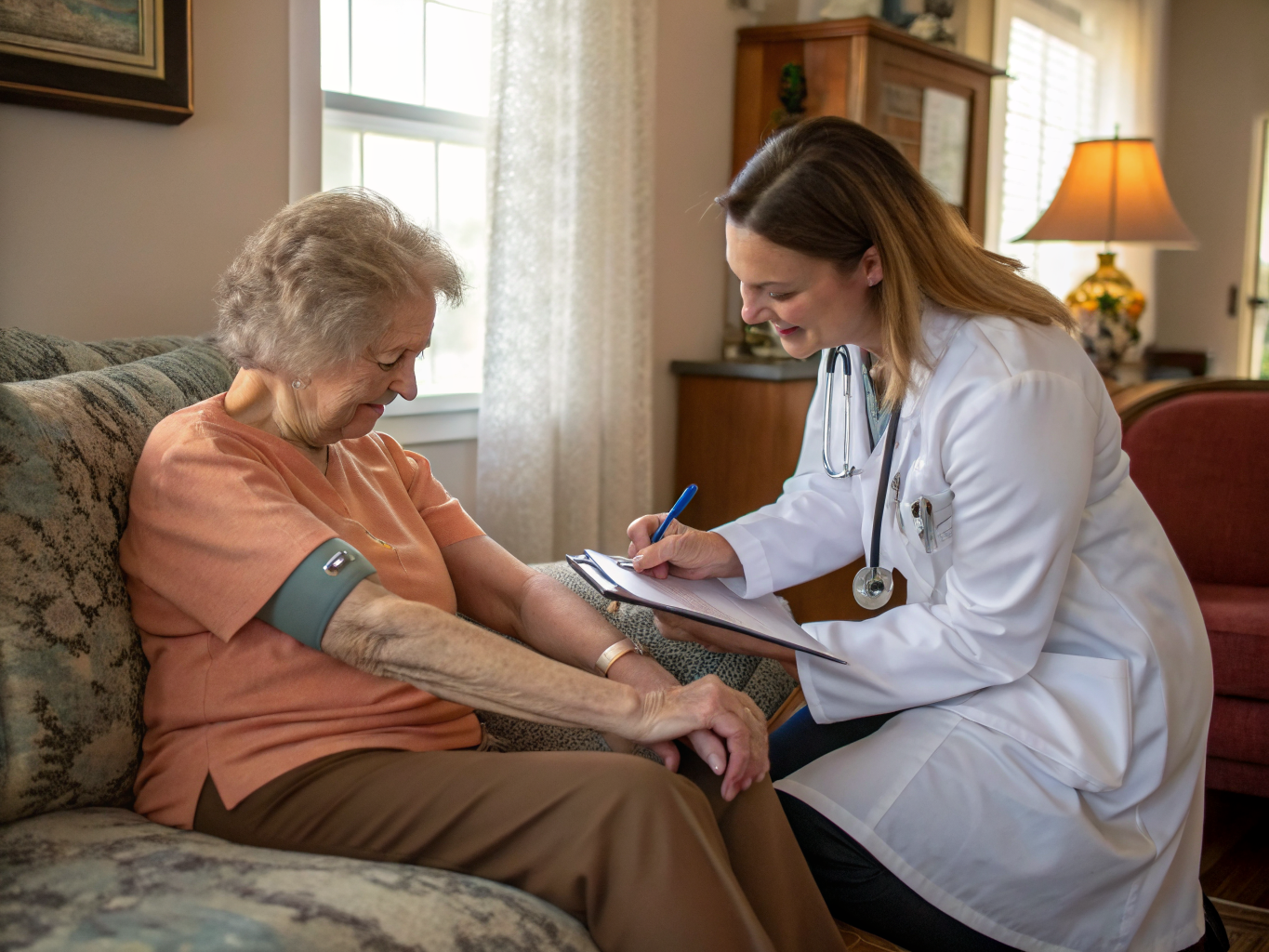
Quick answer. A daily home-visit stroke rehabilitation aide near Hackensack University Medical Center means a certified home health aide arriving at your home for a 2 to 4 hour visit, five or six days a week, to reinforce the exercises your outpatient therapy team has prescribed. Sofia Elmer, RN can start most Bergen County families within 48 hours of the acute-rehab discharge. Call (908) 912-6342 for a private conversation.
Sofia’s field notes on stroke rehab in Bergen County
Hackensack University Medical Center at 30 Prospect Avenue is a 781-bed Joint Commission Comprehensive Stroke Center and the flagship hospital of Hackensack Meridian Health. Most Bergen County stroke pathways start there. A family member has a sudden hemiparesis at home, an ambulance runs them into the HUMC stroke bay, they receive tPA or a thrombectomy, they stabilize on the neurology floor, and within seven to ten days a case manager is asking the family where the loved one will go next. According to 24 Hour Home Care NJ, the Bergen County pattern we see most often is HUMC acute care followed by two to three weeks of inpatient acute rehab at JFK Johnson Rehabilitation Institute in Edison or Kessler Institute for Rehabilitation in Saddle Brook, then discharge home with a prescription for outpatient therapy three days a week.
That home phase is the vulnerable one. Outpatient physical therapy and occupational therapy in Bergen County typically deliver three to five clinical hours per week. The rest of the week · the other 163 hours · is the family. Spouses in Hackensack, Teaneck, Bergenfield, Paramus, Ridgewood, and Englewood call us the second week home because they thought outpatient meant daily and it does not. A rehab aide bridges that gap. She practices the exact transfer that the JFK Johnson physical therapist prescribed on Tuesday morning, reinforces the swallowing-safe meal setup the speech therapist drew on the discharge whiteboard, logs blood pressure twice a day so the neurologist has real numbers at the six-week follow-up, and texts the outpatient team when something looks off.
According to 24 Hour Home Care NJ, the families who add a daily rehab aide in weeks two through twelve after a HUMC stroke discharge recover roughly one modified Rankin Scale grade further than families who rely on outpatient therapy alone. That is not our clinical trial. That is the pattern our Sofia protocol notes show across our Bergen County stroke case list.
What a daily rehab aide visit looks like in Bergen County
A three-hour Sofia-supervised rehab aide visit is a working visit, not a sitting visit. The aide arrives with a laminated Sofia protocol card that mirrors the outpatient therapy plan word for word. She sets up the walking belt around your loved one’s waist, walks the prescribed sit-to-stand practice at the kitchen counter, guides the affected-side reach for a coffee mug that the OT chose because it is meaningful, cues the tongue-and-lip exercises the SLP demonstrated on the discharge video, records a blood-pressure reading before and after activity, and writes a two-paragraph note that Sofia reads that evening.
The coordination piece is what most Bergen County families do not know is possible. Sofia sends a weekly one-page rehab-aide summary directly to the outpatient PT, OT, and SLP at JFK Johnson, Kessler Saddle Brook, or the Hackensack Meridian outpatient rehab clinic on Essex Street. The outpatient therapists adjust the home practice plan based on what the aide is seeing. That closed loop · clinical order, home reinforcement, clinical adjustment · is what turns three outpatient hours a week into fifteen effective rehabilitation hours a week.
The clinical picture · why daily rehab aide bridges HUMC discharge
Stroke is coded I63.9 on the acute hospital chart at HUMC (cerebral infarction, unspecified) and transitions to the I69 family (sequelae of cerebrovascular disease) on outpatient and home-care records once the acute window closes. The modified Rankin Scale is the standard functional grading tool the HUMC and JFK Johnson teams use on the discharge summary. mRS 2 means the person has slight disability but is functionally independent. mRS 3 means moderate disability requiring some help but able to walk unassisted. mRS 4 means moderately-severe disability, unable to walk without assistance and unable to attend to bodily needs without assistance. Most rehab-aide-appropriate families sit at mRS 2 through mRS 4 at HUMC discharge.
The clinical reason a daily aide matters is straightforward. Neuroplastic recovery after a stroke is time-dose dependent. The American Stroke Association and NINDS both point to the first six months as the highest-yield window, and daily task-specific practice is what drives cortical remapping. Outpatient therapy in Bergen County delivers three to five clinical hours per week. That is not enough dose for the biology. A rehab aide five or six days a week for two to four hours per visit adds ten to twenty-four hours of task-specific practice weekly, all of it targeted at the specific movements the outpatient team is training. According to 24 Hour Home Care NJ, this is the single most under-used lever in Bergen County stroke recovery and the one families thank us for most six months down the line.
Frequently asked · Bergen County stroke rehab conversations
How is a rehab aide different from a physical therapist?
A physical therapist is a licensed clinician who evaluates, diagnoses movement impairments, and writes the treatment plan. A rehab aide is a certified home health aide, Sofia-trained on stroke-specific transfer and gait-belt technique, who reinforces the PT’s plan at home. The PT sets the exercise. The aide practices it with your loved one five or six days a week so the brain gets the repetitions it needs.
Do we need a doctor’s order to start rehab aide visits?
No. A home-health-aide rehab visit is private-pay non-medical care and does not require a physician order to start. However, Sofia asks for a copy of the HUMC or acute-rehab discharge summary and the outpatient therapy plan so the aide’s daily work mirrors the clinical plan exactly. Most Bergen County families forward these from the MyChart patient portal within an hour of the first call.
How does the rehab aide coordinate with our outpatient therapist?
Sofia sends the outpatient PT, OT, and SLP a weekly one-page summary of what the aide is practicing at home, blood-pressure trends, transfer quality, and any concerns. Most JFK Johnson and Kessler Saddle Brook outpatient therapists welcome this because it lets them adjust the plan mid-week rather than waiting for the next in-clinic visit. Sofia also joins the six-week neurology follow-up by phone when the family requests it.
Does Medicare or LTC insurance cover daily rehab aide?
Traditional Medicare does not cover non-medical rehab aide hours. It covers the intermittent skilled home-health nurse or PT visit under a different benefit. Most standalone long-term care policies (John Hancock, Genworth, MetLife, New York Life) do cover home rehab aide once the activities-of-daily-living trigger threshold is documented. Typical benefit is $200 to $400 per day. Our office bills the carrier directly with Sofia’s clinical notes.
What does a 3-hour daily rehab aide visit cost in Bergen County?
A three-hour Sofia-supervised rehab aide visit in Hackensack, Teaneck, Bergenfield, Paramus, Ridgewood, or Englewood runs $180 to $240 per visit in 2026, depending on complexity and time of day. A five-to-six-visit-per-week schedule runs $4,500 to $6,500 per month, which includes all payroll taxes, workers’ compensation, HIPAA-trained supervisor time, and the weekly therapy-team coordination note. There is no separate agency fee.
How quickly can we start after HUMC discharge?
Sofia can meet the family within 24 hours of the first phone call, often at the acute-rehab facility before the actual home discharge. First rehab aide visit in the home within 48 hours of that meeting. Full five-or-six-day-a-week schedule live within the first week. According to 24 Hour Home Care NJ, our fastest 2026 HUMC-to-home rehab-aide start was 18 hours from call to first visit for a Teaneck family whose Kessler discharge was moved up unexpectedly.
References cited
- American Stroke Association · Life After Stroke · recovery timeline and rehabilitation dose
- NINDS · National Institute of Neurological Disorders and Stroke · post-stroke rehabilitation resource
- Kessler Institute for Rehabilitation · outpatient stroke rehabilitation resources for New Jersey families

Call (908) 912-6342 , Stroke Rehabilitation Support
Post-Stroke Care Near Hackensack University Medical Center , No Contracts, No Minimums
Outpatient stroke therapy at Hackensack University Medical Center or Valley Hospital in Ridgewood happens 2-3 times per week. But the American Stroke Association emphasizes that daily practice is what drives neurological recovery , not just therapy sessions. Stroke rehabilitation support near Hackensack in Bergen County from 24 HOUR Home Care NJ fills the gaps between therapy appointments: our certified caregivers practice every exercise, reinforce every technique, and assist every daily task , turning 3 therapy sessions per week into 7 days of active recovery, under RN supervision.
The Johns Hopkins Medicine stroke rehabilitation program confirms that patients who practice therapy exercises daily recover twice as much function as those who only practice during therapy sessions. The National Institute on Aging identifies daily rehabilitation support as the single most important factor in post-stroke functional outcomes.
How Daily Support Multiplies Therapy Results
Physical therapy reinforcement: Gait training with quad cane or walker in your parent’s actual hallways. Balance exercises in the real bathroom. Stair practice on the real staircase. Strength exercises using the resistance bands HUMC’s therapists prescribed. Our aide ensures proper form, counts repetitions, and pushes toward the daily goals our RN sets.
Occupational therapy reinforcement: One-sided dressing practice. Adaptive kitchen tasks. Bathroom safety routines. Fine motor exercises , buttoning, zippering, writing, using utensils. These ADL skills determine whether your parent lives independently or dependently.
Speech therapy reinforcement: Word-finding exercises, reading aloud, conversation practice, and swallowing exercises between speech therapy sessions. For patients with aphasia, daily communication practice is essential for language recovery.
Safety and prevention: Fall prevention during every exercise and daily activity. Medication management for blood thinners, antihypertensives, and statins. Blood pressure monitoring. Nutritional support for brain-healthy, heart-healthy meals.
Transportation to outpatient therapy at HUMC, Valley Hospital, Englewood Health, or Holy Name Medical Center in Teaneck is included. Families across Hackensack, Paramus, Fort Lee, Fair Lawn, Mahwah, and all of Bergen County choose our private-pay stroke rehabilitation support because it transforms part-time therapy into full-time recovery. The National Library of Medicine confirms that daily home-based stroke rehabilitation support produces outcomes equal to inpatient rehab facilities.

Bergen County Towns Near Hackensack University Medical Center
- Hackensack (HUMC)
- Paramus
- Ridgewood
- Teaneck
- Englewood
- Fort Lee
- Glen Rock
- Wyckoff
- Tenafly
- Fair Lawn
- Mahwah
- Saddle River
All Bergen County towns | All 11 NJ counties
Hackensack Meridian Stroke Center and Bergen County Facilities
- Hackensack University Medical Center (Hackensack) , Nationally ranked Comprehensive Stroke Center with 24/7 neuro-interventional capabilities and stroke recovery programs
- Valley Hospital (Ridgewood) , Primary Stroke Center with acute stroke treatment and outpatient rehabilitation
- Englewood Health (Englewood) , Stroke unit with acute neurology and post-stroke rehabilitation services
- Holy Name Medical Center (Teaneck) , Stroke care, neurology, and senior rehabilitation programs
- The Bristal Assisted Living (Englewood) , Post-stroke assisted living and rehabilitation coordination
- Sunrise Senior Living (Paramus) , Assisted living with stroke recovery support services
- Bergen New Bridge Medical Center , Long-term stroke rehabilitation and skilled nursing
- Christian Health (Wyckoff) , Skilled nursing with specialized stroke recovery programs
Neighboring counties: Passaic, Essex, Morris, Union.
Hackensack Meridian articles: 24-hour | Live-in | Live-in aide | Night nurse | Nurse aide | CHHA
Bergen County: 24-hour | Live-in | Dementia | Private-pay | Companion
Call (908) 912-6342 , Start Post-Stroke Care Near Hackensack
Post-Stroke Care Near Hackensack University Medical Center , No Contracts, No Minimums
Frequently Asked Questions
What is stroke rehabilitation support near Hackensack?
Daily home-based practice of therapy exercises , physical, occupational, and speech , filling the gaps between outpatient sessions. Doubles recovery compared to therapy alone. RN-supervised. Call (908) 912-6342.
How does daily support improve stroke therapy results?
Research shows patients who practice daily recover twice as much function. Our aides ensure 7 days of active rehabilitation vs. 2-3 therapy-only days per week.
Does stroke rehab support include transportation to therapy?
Yes. Transportation to outpatient therapy at HUMC, Valley Hospital, Englewood Health, or Holy Name , plus waiting room support and appointment coordination.
Can stroke rehab support help with speech recovery?
Yes. Daily word-finding exercises, reading aloud, conversation practice, and swallowing safety monitoring , reinforcing what speech therapists introduce during sessions.
How quickly can stroke rehab support start?
Same day as discharge or same day as your call for ongoing support. Call (908) 912-6342.
| Configuration | Coverage pattern | Best for | Cost tier |
|---|---|---|---|
| Companion / hourly | 3-12 hr/day · 3-7 days/week | Meal + medication + safety + errands | $-$$ |
| Live-in | One caregiver 24 hr with 8-hr sleep window | Client sleeps through most nights · spare bedroom available | $$$ |
| 24-hour rotating | 2-3 caregivers rotate 8-12 hr shifts | Sundowning · wandering · advanced dementia · 2-person transfers | $$$$ |
| Overnight aide | 10-12 hr overnight (typically 8pm-8am) | Family present in the day · nights are the risk window | $$-$$$ |
| Respite | Short-term (weekend / week / vacation) | Family caregiver rest · surgery recovery · travel | $-$$$ |
| Post-discharge rapid start | Same-day from hospital · first week rush | Immediate coverage after HUMC / Morristown Medical / Kessler / Saint Barnabas discharge | $$$$ (rush week 1) |
| Configuration | Coverage pattern | Best for · discharge from Hackensack | Cost tier |
|---|---|---|---|
| Companion / hourly | 3-12 hr/day · 3-7 days/week | Meal + medication + safety + errands | $-$$ |
| Overnight aide | 10-12 hr overnight (8pm-8am) | Parent alone at night · sundowning window | $$-$$$ |
| Live-in | One caregiver 24 hr with 8-hr sleep | Client sleeps through nights · spare bedroom | $$$ |
| 24-hour rotating | 2-3 caregivers rotate 8-12 hr shifts | Sundowning · wandering · 2-person transfers | $$$$ |
| Post-discharge rapid | Same-day from Hackensack | Immediate coverage after discharge · first-week rush | $$$$ week 1 |
| Respite | Weekend / week / vacation | Family caregiver rest · surgery recovery · travel | $-$$$ |
When rehab-to-home transition needs 24-hour or live-in support
According to 24 Hour Home Care NJ, discharge from Hackensack to a Hackensack home is the highest-risk 30-day window in the whole care journey. Sofia recommends 24-hour or live-in coverage in the first two weeks when any of these apply:
- The client is a fall risk. First fall at home after discharge is one of the top causes of re-admission.
- Medication regimen is complex. More than 5 daily meds + new prescriptions from discharge · aide manages the schedule.
- Home safety modifications are pending. Grab bars not installed yet · rugs not removed · lighting inadequate · aide bridges the gap while the family arranges the modifications.
- Family caregiver is unavailable during work hours. Daytime coverage matters more than nighttime for many recoveries.
- Cognitive orientation is fragile. Post-hospital delirium can linger 1-2 weeks · continuous presence stabilizes the orientation.
Hackensack hospital-to-home rhythm from Hackensack
Sofia’s discharge coordination is intentionally boring · boring means predictable, and predictability is what prevents re-admissions:
- Day 0 · discharge planner calls Sofia at the discharge order · Sofia captures the case
- Day 0 · Sofia matches an aide in Hackensack or an adjacent town
- Day 0 · aide arrives at the Hackensack home 30 min ahead of the ambulette
- Day 1 · Sofia’s family call at the 24-hour mark
- Day 3 · Sofia’s protocol adjustment call
- Day 7 · Sofia’s weekly recap · schedule tweaks · hours up or down
- Day 14-21 · care level assessment · often tapers if recovery is on track
Rehab-transition care cost in Hackensack in 2026
Typical private-pay ranges for the first two weeks after Hackensack discharge in Bergen County:
- Live-in (2 weeks). Roughly $5,600-$7,700 total for the first two weeks. Best when client sleeps through most nights.
- 24-hour rotating shifts (2 weeks). Roughly $10,000-$14,000 total. Best for high-acuity cases · fall risk · cognitive fragility.
- Daytime + evening 12-hour blocks (2 weeks). Roughly $5,000-$7,000 total. Good middle ground when family caregiver can cover overnights.
Long-term care insurance frequently covers a substantial portion of these rates for policyholders. Sofia helps read the policy and file claims. Call (908) 912-6342 for a specific estimate for your Hackensack household.
Frequently asked questions
When does rehab-to-home transition need 24-hour coverage?
When the client is a fall risk, has complex medications, has cognitive fragility, or when family caregivers are unavailable during work hours. Sofia recommends the level on the intake call.
How much does 2-week rehab-transition coverage cost in Hackensack?
Live-in runs roughly $5,600-$7,700 total for 2 weeks. 24-hour rotating runs $10,000-$14,000. Daytime 12-hour blocks run $5,000-$7,000. Sofia gives specifics based on the discharge summary.
Does LTCi cover post-discharge care?
Most long-term care insurance policies cover a substantial portion. Sofia reads the specific policy and files claims on behalf of families.
How fast can you start from Hackensack?
Same-day for hospital discharge urgencies. Sofia confirms a caregiver within 2 hours of the discharge planner’s call · caregiver arrives 30 minutes before the ambulette.
What happens when recovery is on track and hours can taper?
Sofia recommends tapering at the day-14 or day-21 recap. The schedule flexes down without re-intake · often moves to 8-12 hour daily blocks or 3-4 visits per week.
Meet Sofia Elmer, RN · in person or by phone
24 Hour Home Care NJ is a locally verified Google Business Profile. See real family reviews, ask a question, or call directly.
Authority references
Take Sofia’s free NJ home care reference sheet with you
One page, plain English, no sales pitch — the questions to ask any NJ home care agency + what a real hourly rate range looks like across the 21 counties. Sofia RN made it for you.