
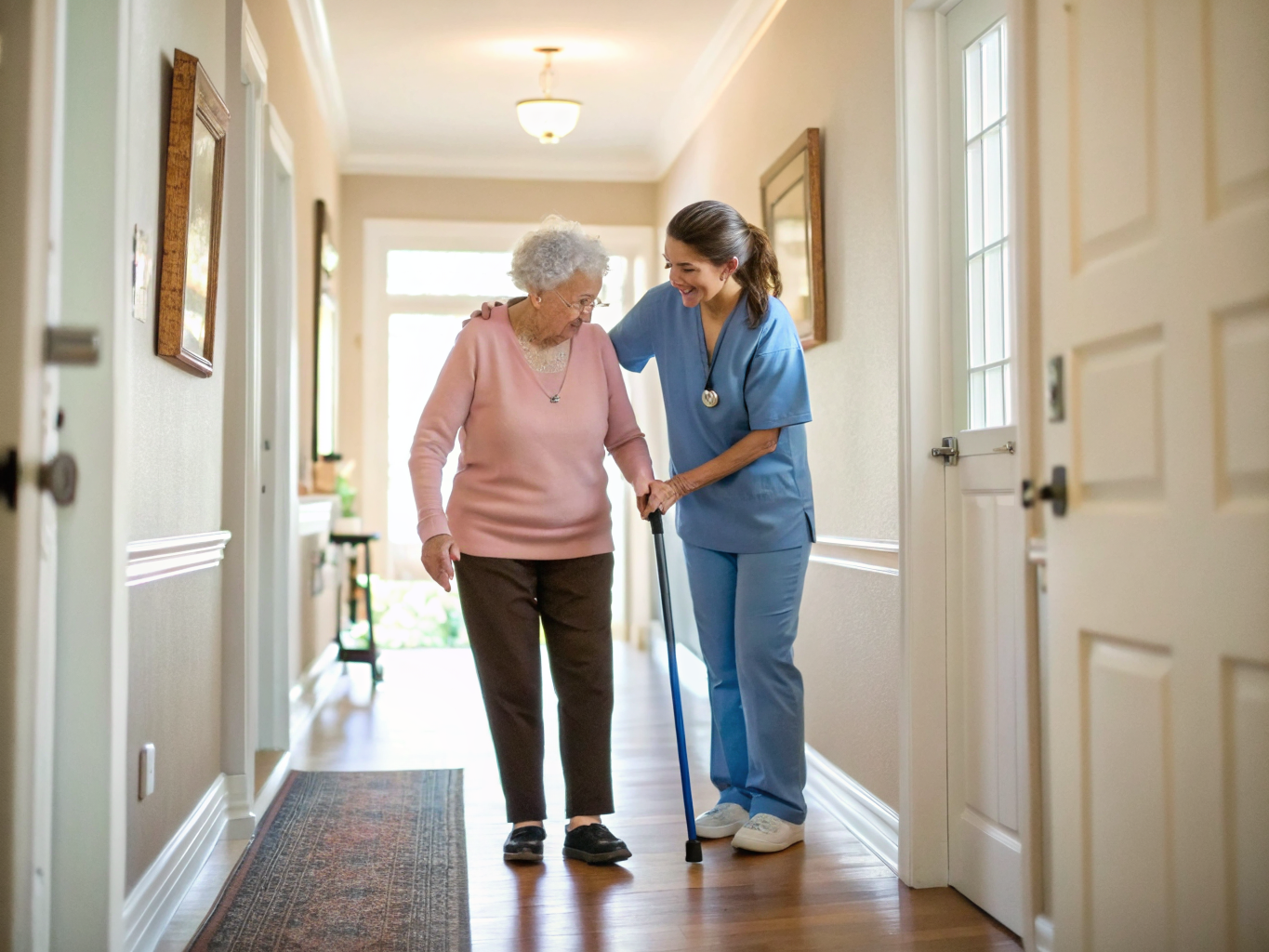
Quick answer. Stroke recovery at home near Hackensack University Medical Center in Bergen County NJ means a 24-hour Sofia-supervised care plan built around the four rehab pillars a stroke survivor rebuilds independence on: safe transfers, walking practice, ADL retraining, and swallow-safe meals. Sofia Elmer, RN starts most Bergen County families within 48 hours of a first phone call, often before the Hackensack UMC discharge planner has finalized the outpatient therapy referral. Call (908) 912-6342 for a private conversation.
Sofia’s field notes on the independence-rebuilding arc after Hackensack UMC
Hackensack University Medical Center at 30 Prospect Avenue is a Joint Commission-certified Comprehensive Stroke Center and the busiest stroke destination in Bergen County. According to 24 Hour Home Care NJ, most Bergen families we consult for after a Hackensack UMC stroke admission come home somewhere between day 4 and day 14, usually with a plan for outpatient physical therapy, occupational therapy, and speech therapy two or three times per week. What they do not always come home with is a plan for the other 165 hours in the week. That is the interval where independence is either quietly rebuilt or quietly lost.
The clinical literature is clear on this. The American Heart and Stroke Association guidelines on adult stroke rehabilitation identify repetition, task-specific practice, and early mobilization as the three highest-yield levers for functional recovery. Repetition does not happen inside a 45-minute therapy session. It happens between sessions, in the kitchen, on the stairs, at the bathroom sink, at 6 a.m. when a stroke survivor decides whether to try to stand up on their own or to wait for help. A trained aide who understands the therapy plan is the connective tissue that turns three weekly appointments into a full-time recovery.
What stroke recovery looks like at home in the first 90 days
A Sofia-supervised recovery plan begins with a home visit before discharge whenever the Hackensack UMC social work team can coordinate one. Sofia walks the home with the family, marks fall-risk zones room by room, checks the bathroom for a raised toilet seat and grab-bar coverage, notes the height of the bed and the depth of the primary chair, and drafts a personalized 30-60-90 day recovery outline that mirrors the outpatient therapy goals. She leaves a laminated protocol card in the kitchen with the transfer technique, the swallow-safety diet level, the medication schedule, and her direct cell line.
The caregiver arrives on day one already briefed. In the first 30 days the focus is safe transfers, seated exercises, ADL scaffolding, and swallow-safe meal preparation. Days 31 to 60 shift toward assisted walking practice, standing-balance work at the kitchen counter, and clothing management for dressing independence. Days 61 to 90 target community re-entry, stair practice, and the outpatient therapy homework that lets a survivor step back into their own life. According to 24 Hour Home Care NJ, this rhythm is the single most reliable predictor of whether a Hackensack-discharged stroke patient returns to independent ADLs within six months.
The clinical picture · staging stroke recovery for home care
Post-stroke home care is coded on Medicare and long-term care insurance claims as I63.9 (cerebral infarction, unspecified) for the acute event and I69 category codes for the sequelae, most often I69.351 (hemiplegia and hemiparesis following cerebral infarction affecting right dominant side) or I69.354 (left non-dominant side). Functional status is tracked on the Barthel Index for ADLs, where 0 to 20 marks total dependence, 21 to 60 severe dependence, 61 to 90 moderate dependence, and 91 to 100 near independence. The Modified Rankin Scale (mRS) captures global disability from 0 (no symptoms) through 5 (severe disability, bedridden).
The most common Hackensack UMC home-care referrals arrive at a Barthel of 40 to 70 and an mRS of 3 to 4, the interval where a survivor can participate in their own recovery but cannot yet be left alone safely. According to 24 Hour Home Care NJ, at this functional level a family usually needs 24-hour coverage for the first 30 to 60 days, with a licensed clinical supervisor doing home visits every two weeks to update the plan, coordinate with the outpatient therapy team at Hackensack UMC or JFK Johnson, and adjust the caregiver’s daily task list as the Barthel score climbs. The goal is measurable: a 15 to 20 point Barthel gain in the first 90 days is a realistic, evidence-supported target for a well-supervised home recovery.
Frequently asked · questions from real Bergen County conversations
How is home care different from the outpatient PT/OT/ST my mother is already scheduled for?
Outpatient therapy is 45 to 60 minutes, two or three times per week, at a clinic like Hackensack UMC Rehabilitation or JFK Johnson. Home care is the other 165 hours in the week. A trained caregiver reinforces the therapist’s homework, guides safe transfers between sessions, prevents falls, and prepares swallow-safe meals so nutrition supports the healing brain. The two work together. Neither substitutes for the other.
My father had a right-side stroke and cannot use his left arm. Can a caregiver help him dress?
Yes, and more than help. She teaches. Every 24 Hour Home Care NJ caregiver who works with a stroke survivor is trained in one-handed dressing techniques, adapted button loops, sock aids, and long-handled reachers. In the first weeks the caregiver does most of the sequence. Over 30 to 60 days she steps back until the survivor can complete the sequence independently. That progression is the definition of ADL retraining, and it is exactly what the occupational therapist prescribes.
Can Sofia meet with the Hackensack UMC discharge planner before we go home?
Yes. Sofia does a pre-discharge home visit or a bedside meeting at Hackensack UMC when the family requests it, at no cost and with no obligation. She reviews the discharge plan, the home layout, the outpatient therapy schedule, the medication list, and the swallow-safety diet level with the family. Call (908) 912-6342 and we will coordinate directly with the Hackensack UMC care management team.
Does long-term care insurance cover stroke recovery at home?
Most standalone long-term care policies (John Hancock, Genworth, MetLife, MassMutual, New York Life) cover home-based stroke recovery once the activities-of-daily-living trigger threshold is documented, typically two of six ADLs. Typical benefit ranges from $200 to $450 per day depending on policy vintage. 24-hour recovery care in Bergen County runs $790 to $980 per day. Our office bills the carrier directly with Sofia’s clinical notes attached and families cover any daily gap.
What does 24-hour stroke recovery care cost in Bergen County?
For Hackensack, Teaneck, Paramus, Ridgewood, Englewood, and the broader Bergen County service area, 2026 24-hour post-stroke care runs $790 to $980 per day, or $23,700 to $29,400 per month depending on the level of clinical oversight and the complexity of the recovery plan. Live-in care, appropriate once a survivor sleeps consistently through the night, runs $380 to $530 per day. Both figures include payroll taxes, unemployment insurance, workers’ compensation coverage, HIPAA-trained supervisor time, and respite backup for scheduled caregiver time off.
How quickly can a Hackensack UMC family start?
Sofia can meet the family at the hospital bedside or at home within 24 hours of the first phone call. First caregiver in the home within 48 hours if the family agrees the fit is right. Full 24-hour weekly schedule live within 5 to 7 days. Sofia’s fastest emergency Hackensack UMC stroke-discharge start in 2026 was 10 hours from first call to caregiver in home, for a family whose spouse-caregiver had collapsed from exhaustion the day of discharge.
References cited in this guide
- American Heart Association and American Stroke Association · Guidelines for Adult Stroke Rehabilitation and Recovery
- National Institute of Neurological Disorders and Stroke · Post-Stroke Rehabilitation Information
- Kessler Foundation · Stroke Rehabilitation Research (West Orange NJ)

Call (908) 912-6342 , Stroke Recovery at Home
Post-Stroke Care Near Hackensack University Medical Center , No Contracts, No Minimums
Stroke recovery at home near Hackensack in Bergen County from 24 HOUR Home Care NJ is where the real rehabilitation happens. At Hackensack University Medical Center, doctors saved your parent’s life and stabilized the damage. In rehab, therapists began the rebuilding process. But at home , in the actual bathroom, kitchen, bedroom, and staircase your parent must navigate every day , recovery becomes real. Our certified caregivers turn hospital exercises into daily living skills, under RN supervision that ensures clinical-level care in a home setting.
The American Stroke Association emphasizes that stroke recovery is a marathon, not a sprint , most significant gains occur in the first 3-6 months, but improvement can continue for years with consistent effort. The Johns Hopkins Medicine stroke program confirms that daily repetition of functional tasks is the primary driver of neuroplasticity , the brain’s ability to rewire around damaged areas. Our stroke recovery program near HUMC provides this daily repetition.
How Stroke Recovery Works at Home
Mobility recovery: Daily practice walking with quad cane or walker through your parent’s actual hallways , not a therapy gym. Stair navigation on their actual staircase. Transfers in their actual bathroom. These real-world exercises build functional independence faster than simulated environments.
Upper extremity recovery: Grip exercises, reaching tasks, buttoning practice, utensil use , the fine motor skills that determine whether your parent can feed, dress, and groom independently. Our aides reinforce the specific protocols HUMC’s occupational therapists prescribed.
Cognitive and communication: For stroke patients with aphasia, memory deficits, or attention challenges, daily cognitive engagement , word-finding exercises, reading practice, conversation, puzzles , reinforces the neurological pathways speech therapists targeted.
Emotional recovery: Post-stroke depression affects 33% of survivors, according to the CDC. Consistent companionship, structured daily routines, and the progress visible from daily practice all combat the depression that stalls recovery.
Families across Fort Lee, Glen Rock, Wyckoff, Tenafly, Fair Lawn, and all of Bergen County choose our private-pay stroke recovery program because it delivers the daily repetition that drives neuroplasticity , the brain’s recovery mechanism. Fall prevention is embedded in every activity. Medication management prevents recurrence. The Journal of the American Geriatrics Society rates home-based stroke recovery as equivalent to inpatient rehabilitation for functional outcomes when professional daily support is provided.

Bergen County Towns Near Hackensack University Medical Center
- Hackensack (HUMC)
- Paramus
- Ridgewood
- Teaneck
- Englewood
- Fort Lee
- Glen Rock
- Wyckoff
- Tenafly
- Fair Lawn
- Mahwah
- Saddle River
All Bergen County towns | All 11 NJ counties
Hackensack Meridian Stroke Center and Bergen County Facilities
- Hackensack University Medical Center (Hackensack) , Nationally ranked Comprehensive Stroke Center with 24/7 neuro-interventional capabilities and stroke recovery programs
- Valley Hospital (Ridgewood) , Primary Stroke Center with acute stroke treatment and outpatient rehabilitation
- Englewood Health (Englewood) , Stroke unit with acute neurology and post-stroke rehabilitation services
- Holy Name Medical Center (Teaneck) , Stroke care, neurology, and senior rehabilitation programs
- The Bristal Assisted Living (Englewood) , Post-stroke assisted living and rehabilitation coordination
- Sunrise Senior Living (Paramus) , Assisted living with stroke recovery support services
- Bergen New Bridge Medical Center , Long-term stroke rehabilitation and skilled nursing
- Christian Health (Wyckoff) , Skilled nursing with specialized stroke recovery programs
Neighboring counties: Passaic, Essex, Morris, Union.
Hackensack Meridian articles: 24-hour | Live-in | Live-in aide | Night nurse | Nurse aide | CHHA
Bergen County: 24-hour | Live-in | Dementia | Private-pay | Companion
Call (908) 912-6342 , Start Post-Stroke Care Near Hackensack
Post-Stroke Care Near Hackensack University Medical Center , No Contracts, No Minimums
Frequently Asked Questions
What is stroke recovery at home near Hackensack?
Daily rehabilitation practice in your parent’s actual home , mobility, fine motor, speech, and cognitive exercises reinforcing hospital therapy. RN-supervised. Call (908) 912-6342.
Why is home-based stroke recovery effective?
Practicing in the actual environment your parent must navigate (real bathroom, real stairs, real kitchen) builds functional independence faster than simulated therapy gym settings.
How long does stroke recovery take?
Most significant gains occur in 3-6 months, but improvement can continue for years. Daily professional support maximizes the recovery window. No contracts , adjust as needed.
Does stroke recovery at home address depression?
Yes. Post-stroke depression affects 33% of survivors. Consistent companionship, structured routines, and visible daily progress all combat depression that stalls recovery.
How quickly can stroke recovery care start?
Same day as hospital or rehab discharge. We coordinate with HUMC in advance. Call (908) 912-6342.
| Configuration | Coverage pattern | Best for | Cost tier |
|---|---|---|---|
| Companion / hourly | 3-12 hr/day · 3-7 days/week | Meal + medication + safety + errands | $-$$ |
| Live-in | One caregiver 24 hr with 8-hr sleep window | Client sleeps through most nights · spare bedroom available | $$$ |
| 24-hour rotating | 2-3 caregivers rotate 8-12 hr shifts | Sundowning · wandering · advanced dementia · 2-person transfers | $$$$ |
| Overnight aide | 10-12 hr overnight (typically 8pm-8am) | Family present in the day · nights are the risk window | $$-$$$ |
| Respite | Short-term (weekend / week / vacation) | Family caregiver rest · surgery recovery · travel | $-$$$ |
| Post-discharge rapid start | Same-day from hospital · first week rush | Immediate coverage after HUMC / Morristown Medical / Kessler / Saint Barnabas discharge | $$$$ (rush week 1) |
| Configuration | Coverage pattern | Best for · discharge from Hackensack | Cost tier |
|---|---|---|---|
| Companion / hourly | 3-12 hr/day · 3-7 days/week | Meal + medication + safety + errands | $-$$ |
| Overnight aide | 10-12 hr overnight (8pm-8am) | Parent alone at night · sundowning window | $$-$$$ |
| Live-in | One caregiver 24 hr with 8-hr sleep | Client sleeps through nights · spare bedroom | $$$ |
| 24-hour rotating | 2-3 caregivers rotate 8-12 hr shifts | Sundowning · wandering · 2-person transfers | $$$$ |
| Post-discharge rapid | Same-day from Hackensack | Immediate coverage after discharge · first-week rush | $$$$ week 1 |
| Respite | Weekend / week / vacation | Family caregiver rest · surgery recovery · travel | $-$$$ |
Post-stroke recovery timeline · what the Hackensack home should look like
According to 24 Hour Home Care NJ, post-stroke recovery in a Hackensack home follows a predictable arc · Sofia’s aides are trained to support each phase:
- Week 1-2 · acute recovery from Hackensack. High-touch: assist with mobility, meds, meals, safety, communication. 24-hour or live-in typical. Fall prevention is the #1 job.
- Week 3-6 · outpatient PT/OT integration. Aide accompanies to therapy appointments · reinforces home exercises between sessions · manages medication complexity (blood thinners, blood pressure, statin regimens).
- Week 6-12 · function plateau assessment. Aide reports subtle changes to Sofia and the neurologist. Care level may taper.
- Beyond 3 months · long-term support. Companion + safety monitoring for many clients. Some clients graduate to only 2-3 visits per week.
Discharge coordination from Hackensack to a Hackensack home
According to 24 Hour Home Care NJ, post-stroke discharge is one of the most orchestration-heavy cases Sofia handles. Sofia’s specific coordination:
- Day 0 · discharge planner call. Sofia captures the discharge summary, medication list, mobility status, cognitive status, home safety concerns.
- Day 0 · Sofia matches a post-stroke-trained aide. Aides on her roster who have specifically worked post-stroke recoveries.
- Day 0 · home preparation. Aide arrives ahead of the client · confirms grab bars, removes trip hazards, positions walker/wheelchair, sets up medication organizer.
- Day 1-3 · high monitoring. Blood pressure, blood sugar (if diabetic), fluid intake, evidence of second event.
- Week 1 · Sofia weekly call. Coordinates with outpatient PT/OT · attends first therapy session with the client if desired.
Family caregiver support for post-stroke recovery in Hackensack
Post-stroke recovery is exhausting for family caregivers · the client’s frustration, communication challenges, and physical limitations are hard to hold day after day. According to 24 Hour Home Care NJ, families who arrange respite blocks in the first 60 days maintain their own physical + emotional health materially better. Sofia can build a schedule that includes weekly family-caregiver relief blocks. Call (908) 912-6342 to discuss your Hackensack household.
Frequently asked questions
How much does post-stroke home care cost in Hackensack?
The first 2 weeks after a stroke discharge typically need 24-hour or live-in coverage: $5,600-$14,000 total depending on acuity. Care tapers as recovery stabilizes. Sofia gives a specific estimate at (908) 912-6342.
Do your caregivers coordinate with outpatient PT/OT?
Yes. Sofia’s post-stroke aides attend the first outpatient therapy session with the client if desired · reinforce home exercises between sessions · manage medication complexity.
Can you start same-day from Hackensack?
Yes. Same-day starts from hospital-discharge urgencies are Sofia’s primary lane · caregiver arrives at the Hackensack home 30 minutes before the ambulette.
What if the family caregiver is exhausted?
Sofia builds respite blocks into every post-stroke recovery plan. Weekly family-caregiver relief is standard · caregiver burnout is a leading cause of premature nursing-home placement.
Is this covered by Medicare?
24 Hour Home Care NJ is private-pay and private long-term care insurance. Medicare covers a small portion of home health for a limited period · private-pay covers the continuous support families actually need.
Meet Sofia Elmer, RN · in person or by phone
24 Hour Home Care NJ is a locally verified Google Business Profile. See real family reviews, ask a question, or call directly.
Authority references
Take Sofia’s free NJ home care reference sheet with you
One page, plain English, no sales pitch — the questions to ask any NJ home care agency + what a real hourly rate range looks like across the 21 counties. Sofia RN made it for you.