
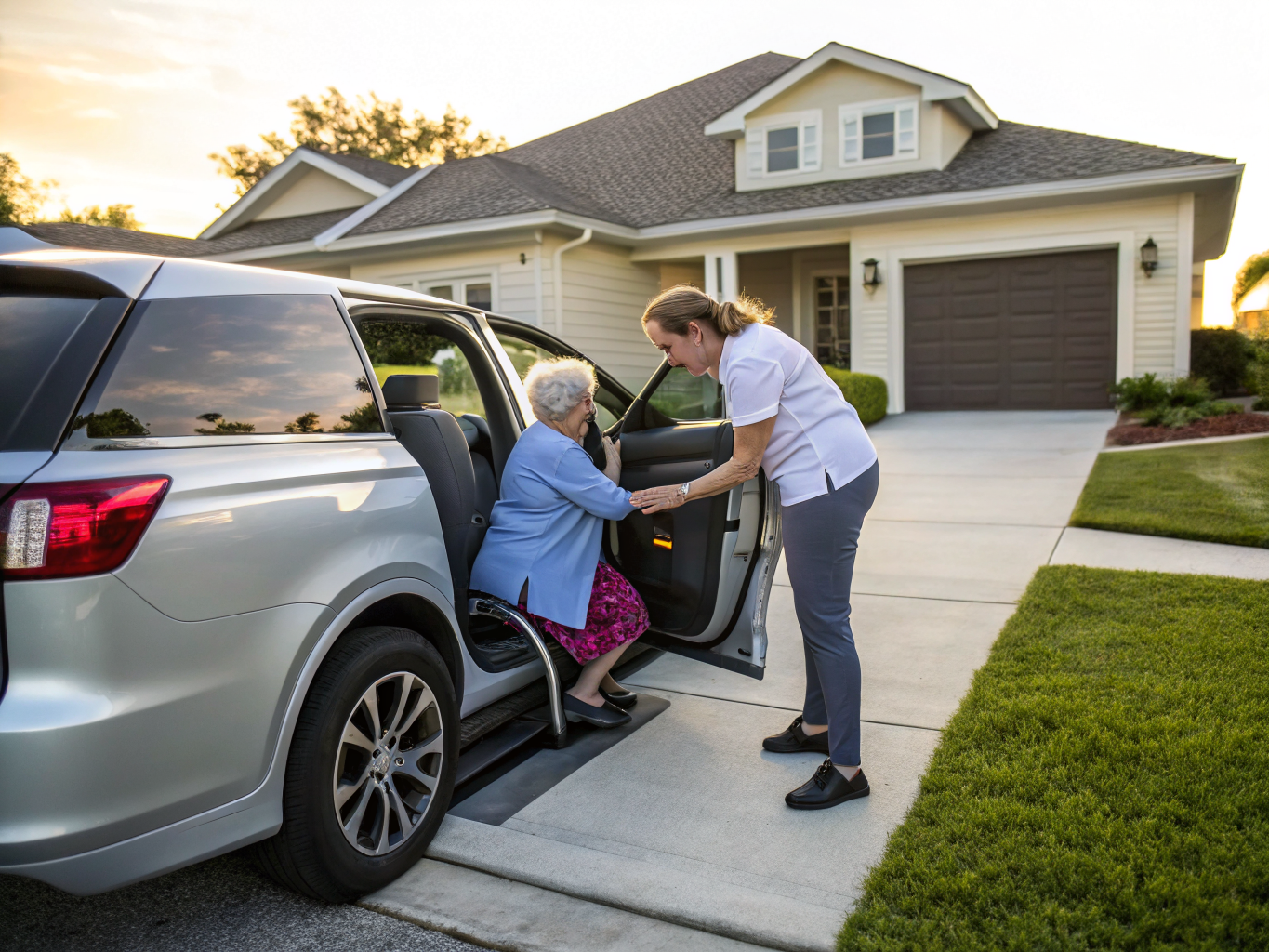
Quick answer. Post-rehab mobility training near Morristown Medical Center means bringing the gait, balance, and transfer drills your loved one practiced on the inpatient rehab unit back into the actual staircase, bathroom, kitchen, and driveway where they live. Sofia Elmer, RN pairs Morris County families with a CHHA who runs those real-world reps daily under a written mobility plan the hospital PT would recognize. Most Morris starts happen within 48 hours of the first call. Call (908) 912-6342 for a private conversation.
Sofia’s field notes on real-world mobility training after Morristown Medical Center
Morristown Medical Center at 100 Madison Avenue is Atlantic Health System’s flagship teaching hospital, home to one of the busiest inpatient rehabilitation and stroke-recovery programs in northern New Jersey. According to 24 Hour Home Care NJ, the families we consult after a Morristown Medical Center discharge fall almost entirely into three clinical buckets: post-stroke gait recovery (I69), post-total-knee or post-total-hip arthroplasty rehab (Z48.89 with M17.11), and generalized deconditioning with abnormal gait (R29.6). What every one of these families quietly asks the same question in the first phone call: my mother did great in the rehab gym, but now she is scared to walk from the bed to the bathroom at home, what do we do?
Real-world mobility training answers that question. The inpatient rehab gym is a controlled surface with parallel bars, a therapist two steps away, and a level floor. Home is a bedroom rug, a threshold into the hallway, a bathroom with a tile transition, and a first step down to the driveway that the person has to negotiate carrying a coffee cup. According to 24 Hour Home Care NJ, the gap between gym competence and home competence is where more than half of 30-day post-discharge falls happen. Closing that gap is what our CHHAs are trained to do.
What a real-world mobility day looks like at a Morristown-connected family home
A Sofia-supervised CHHA arrives on day one with the discharge PT summary in hand, walks every room of the home with a clipboard, and drafts a mobility plan on the spot. That plan includes 20 minutes of morning warm-up sit-to-stands at the kitchen chair, a supervised bathroom transfer sequence before every shower, a mid-morning hallway walk with a rollator counting steps out loud, an afternoon graded staircase practice on the actual home stairs with a gait belt, and an evening cool-down seated ankle-pump set in front of the television. Roughly 90 minutes of focused mobility work spread through the day, woven around meals and rest.
Between the CHHA in the home and Sofia calling the primary family contact every Tuesday evening, the mobility plan updates weekly. Step count goes up, rollator becomes cane, cane becomes furniture-walking, furniture-walking becomes unassisted. According to 24 Hour Home Care NJ, our Morristown-adjacent post-rehab families see a measurable Berg Balance Scale improvement of 6 to 12 points over the first 30 days at home when the plan is followed daily. That is the difference between a person who lives on the ground floor with a walker for the rest of their life and a person who is back upstairs sleeping in their own bedroom by Thanksgiving.
The clinical picture · when post-rehab mobility training belongs in the home
Post-rehab mobility training becomes appropriate the day the inpatient team writes the discharge order. The window that matters most for a Morristown Medical Center graduate is the first 30 to 90 days at home, when neuroplasticity from a stroke is still open, when a fresh knee or hip is still in the primary healing arc, and when a deconditioned frame is either going to rebuild or slide further. Common signals we see in Morris County families: fear of walking without a hand on the wall, a Timed Up and Go score over 14 seconds at discharge, a Berg Balance Scale under 45, a fall or near-fall in the past 90 days, or a family caregiver who cannot physically manage the two-person transfer the hospital taught them.
The functional picture is typically what clinicians code as I69 (sequelae of cerebrovascular disease) for stroke families, Z48.89 (encounter for other specified surgical aftercare) paired with M17.11 (unilateral primary osteoarthritis of the knee) for post-arthroplasty families, or R29.6 (repeated falls) and R26.89 (other abnormalities of gait and mobility) for the deconditioned. The clinical instruments the rehab team already used, the Berg Balance Scale and the Tinetti Performance-Oriented Mobility Assessment (POMA), are the same instruments our CHHA and Sofia will re-score at 30 and 60 days at home. According to 24 Hour Home Care NJ, that continuity of measurement is what turns a discharge summary into an actual recovery.
Frequently asked · questions from real Morris County conversations
Is your CHHA a physical therapist?
No. A certified home health aide is not a physical therapist, and we are careful not to blur that line. What our CHHA does is carry out the mobility plan the discharging PT and the family physician have approved: reps, cues, form corrections, gait-belt technique, transfer sequencing, and daily step counts. If the family already has a Medicare or private-pay home PT visiting two or three times a week, our CHHA runs the plan on the other four or five days so the PT’s work does not evaporate between visits. Most families use both together.
Can we start the day of discharge from Morristown Medical Center?
Yes. Sofia can meet the family in the hospital room the day before discharge, read the PT and OT notes, walk through the home the same afternoon if a family member is available, and have a CHHA in place for the first morning at home. According to 24 Hour Home Care NJ, our fastest Morristown Medical Center same-day-discharge start in 2026 was a caregiver in the home at 4 p.m. for a patient who had been cleared for release at 11 a.m. Call (908) 912-6342 the moment the discharge planner mentions a date.
What if my mother has a bad day and refuses to do her exercises?
Bad days are part of recovery, and our CHHAs are trained to work with them rather than push through them. On a low-energy day the mobility plan compresses to the non-negotiables: the bathroom transfers, the meal-time sit-to-stands, and one short hallway walk. The graded staircase practice moves to tomorrow. Sofia adjusts the weekly plan by phone. According to 24 Hour Home Care NJ, families who allow a two-day compressed protocol without guilt recover faster than families who force a full session on a day the person is exhausted.
Does Sofia coordinate with our Morristown Medical Center rehab team?
Yes, with a written HIPAA release. Sofia will fax the mobility plan and the weekly progress notes to the outpatient rehab physician and to the primary care physician on the family’s list. If the person is enrolled in Atlantic Rehabilitation Institute outpatient services or Atlantic Health at Home skilled PT, our CHHA carries the outpatient plan of care home each visit so both sides are running the same protocol. Continuity of documentation is a core piece of what we do.
What does daily post-rehab mobility care typically cost in Morris County?
For Morristown, Madison, Chatham, Florham Park, Convent Station, Morris Plains, and the surrounding Morris County towns, a daily 90-minute focused-mobility visit runs $95 to $135 depending on distance and the caregiver skill level required. Many post-rehab families begin with a longer daily block of four to six hours covering morning routine, bath, mobility session, and lunch, which runs $180 to $360 per day. Live-in support during the first two weeks home runs $350 to $500 per day. All rates include payroll taxes, workers’ compensation, HIPAA-trained supervisor time, and respite backup. No separate agency fee.
How long does most Morristown Medical Center post-rehab home mobility work last?
Most families run the daily plan for 30 to 90 days and then step down to two or three focused-mobility visits per week for another two to three months. According to 24 Hour Home Care NJ, our Morristown-connected families average a 72-day intensive phase followed by a 60-day maintenance phase before mobility becomes a light-touch monthly check-in. Some post-stroke families continue longer to protect against the well-documented six-month plateau, and some post-arthroplasty families discharge from our service at 60 days when their surgeon signs off on unrestricted activity.
References cited in this guide
- American Physical Therapy Association · Balance and Falls · clinical practice guidance
- Atlantic Health System · Morristown Medical Center · rehabilitation services
- Centers for Disease Control and Prevention · STEADI · Stopping Elderly Accidents, Deaths, and Injuries

Call (908) 912-6342 , Post-Rehab Mobility Training
Post-Rehab Care Coordinated With Morristown Area Facilities
Rehab facilities teach exercises in controlled environments. But your parent’s real life involves getting in and out of cars, navigating kitchen counters, stepping into showers, and climbing the 14 stairs to their bedroom. Post-rehab mobility training near Morristown Medical Center from 24 HOUR Home Care NJ practices these real-world movements , in your parent’s actual home, with their actual furniture, their actual stairs, their actual car , so the skills learned in rehab transfer directly to daily life.
The National Institute on Aging emphasizes that functional mobility in the real environment is what determines whether a senior can live independently , not how many reps they do in a gym. Our certified caregivers near Morristown Post Acute Rehabilitation bridge this gap with practical, daily mobility practice in every room, on every staircase, and at every threshold your parent actually encounters. Fall-safe, RN-supervised.

Morris County Towns Near Morristown Rehab Facilities
All Morris County towns | All 11 NJ counties
Morristown Area Rehabilitation Facilities
- Morristown Post Acute Rehabilitation , Primary inpatient rehab facility; our top post-rehab coordination partner
- Morristown Medical Center , Atlantic Health; acute care before rehab transfer
- Kessler Institute for Rehabilitation (nearby West Orange) , Top-ranked neurological and orthopedic rehab
- Saint Clare’s Health (Denville) , Subacute rehabilitation programs
- Cedar Crest Village (Pompton Plains) , Post-rehab return for CCRC residents
- Spring Hills (Morristown) , Post-rehab assisted living transition
- Arden Courts (Denville) , Post-rehab cognitive recovery support
Neighboring: Essex, Somerset, Passaic.
Morristown recovery: Hospital-to-home | Cardiac recovery | Joint replacement | Readmission prevention | Follow-up care | Stroke rehab | Stroke fall prevention | ADL retraining
Morris County: Post-hospital | Post-stroke | 24-hour | Live-in | Overnight | Private-pay
Call (908) 912-6342 , Start Post-Rehab Home Care
Post-Rehab Care Coordinated With Morristown Area Facilities
Frequently Asked Questions
What is post-rehab mobility training near Morristown?
Real-world movement practice in your parent’s actual home , car transfers, kitchen navigation, shower entry, stair climbing, doorway thresholds. Not gym exercises , real life. Call (908) 912-6342.
Why is real-world mobility training different from rehab?
Rehab uses controlled settings. Your parent’s home has specific challenges , their stairs, their car, their bathroom. Our aides practice in the actual environment where skills matter most.
Is mobility training safe at home after rehab?
Yes. Our aides provide hands-on fall prevention during every movement. We start at the level the rehab facility achieved and progress safely from there.
Do you coordinate mobility goals with the rehab team?
Yes. Our RN reviews rehab discharge notes for mobility milestones and functional goals, then designs a home practice plan that continues the trajectory.
How quickly can mobility training start near Morristown?
Same day as rehab discharge. Call (908) 912-6342.
| Configuration | Coverage pattern | Best for | Cost tier |
|---|---|---|---|
| Companion / hourly | 3-12 hr/day · 3-7 days/week | Meal + medication + safety + errands | $-$$ |
| Live-in | One caregiver 24 hr with 8-hr sleep window | Client sleeps through most nights · spare bedroom available | $$$ |
| 24-hour rotating | 2-3 caregivers rotate 8-12 hr shifts | Sundowning · wandering · advanced dementia · 2-person transfers | $$$$ |
| Overnight aide | 10-12 hr overnight (typically 8pm-8am) | Family present in the day · nights are the risk window | $$-$$$ |
| Respite | Short-term (weekend / week / vacation) | Family caregiver rest · surgery recovery · travel | $-$$$ |
| Post-discharge rapid start | Same-day from hospital · first week rush | Immediate coverage after HUMC / Morristown Medical / Kessler / Saint Barnabas discharge | $$$$ (rush week 1) |
| Configuration | Coverage pattern | Best for · discharge from Morristown Medical Center | Cost tier |
|---|---|---|---|
| Companion / hourly | 3-12 hr/day · 3-7 days/week | Meal + medication + safety + errands | $-$$ |
| Overnight aide | 10-12 hr overnight (8pm-8am) | Parent alone at night · sundowning window | $$-$$$ |
| Live-in | One caregiver 24 hr with 8-hr sleep | Client sleeps through nights · spare bedroom | $$$ |
| 24-hour rotating | 2-3 caregivers rotate 8-12 hr shifts | Sundowning · wandering · 2-person transfers | $$$$ |
| Post-discharge rapid | Same-day from Morristown Medical Center | Immediate coverage after discharge · first-week rush | $$$$ week 1 |
| Respite | Weekend / week / vacation | Family caregiver rest · surgery recovery · travel | $-$$$ |
When rehab-to-home transition needs 24-hour or live-in support
According to 24 Hour Home Care NJ, discharge from Morristown Medical Center to a Morristown home is the highest-risk 30-day window in the whole care journey. Sofia recommends 24-hour or live-in coverage in the first two weeks when any of these apply:
- The client is a fall risk. First fall at home after discharge is one of the top causes of re-admission.
- Medication regimen is complex. More than 5 daily meds + new prescriptions from discharge · aide manages the schedule.
- Home safety modifications are pending. Grab bars not installed yet · rugs not removed · lighting inadequate · aide bridges the gap while the family arranges the modifications.
- Family caregiver is unavailable during work hours. Daytime coverage matters more than nighttime for many recoveries.
- Cognitive orientation is fragile. Post-hospital delirium can linger 1-2 weeks · continuous presence stabilizes the orientation.
Morristown hospital-to-home rhythm from Morristown Medical Center
Sofia’s discharge coordination is intentionally boring · boring means predictable, and predictability is what prevents re-admissions:
- Day 0 · discharge planner calls Sofia at the discharge order · Sofia captures the case
- Day 0 · Sofia matches an aide in Morristown or an adjacent town
- Day 0 · aide arrives at the Morristown home 30 min ahead of the ambulette
- Day 1 · Sofia’s family call at the 24-hour mark
- Day 3 · Sofia’s protocol adjustment call
- Day 7 · Sofia’s weekly recap · schedule tweaks · hours up or down
- Day 14-21 · care level assessment · often tapers if recovery is on track
Rehab-transition care cost in Morristown in 2026
Typical private-pay ranges for the first two weeks after Morristown Medical Center discharge in Morris County:
- Live-in (2 weeks). Roughly $5,600-$7,700 total for the first two weeks. Best when client sleeps through most nights.
- 24-hour rotating shifts (2 weeks). Roughly $10,000-$14,000 total. Best for high-acuity cases · fall risk · cognitive fragility.
- Daytime + evening 12-hour blocks (2 weeks). Roughly $5,000-$7,000 total. Good middle ground when family caregiver can cover overnights.
Long-term care insurance frequently covers a substantial portion of these rates for policyholders. Sofia helps read the policy and file claims. Call (908) 912-6342 for a specific estimate for your Morristown household.
Frequently asked questions
When does rehab-to-home transition need 24-hour coverage?
When the client is a fall risk, has complex medications, has cognitive fragility, or when family caregivers are unavailable during work hours. Sofia recommends the level on the intake call.
How much does 2-week rehab-transition coverage cost in Morristown?
Live-in runs roughly $5,600-$7,700 total for 2 weeks. 24-hour rotating runs $10,000-$14,000. Daytime 12-hour blocks run $5,000-$7,000. Sofia gives specifics based on the discharge summary.
Does LTCi cover post-discharge care?
Most long-term care insurance policies cover a substantial portion. Sofia reads the specific policy and files claims on behalf of families.
How fast can you start from Morristown Medical Center?
Same-day for hospital discharge urgencies. Sofia confirms a caregiver within 2 hours of the discharge planner’s call · caregiver arrives 30 minutes before the ambulette.
What happens when recovery is on track and hours can taper?
Sofia recommends tapering at the day-14 or day-21 recap. The schedule flexes down without re-intake · often moves to 8-12 hour daily blocks or 3-4 visits per week.
Meet Sofia Elmer, RN · in person or by phone
24 Hour Home Care NJ is a locally verified Google Business Profile. See real family reviews, ask a question, or call directly.
Authority references
Take Sofia’s free NJ home care reference sheet with you
One page, plain English, no sales pitch — the questions to ask any NJ home care agency + what a real hourly rate range looks like across the 21 counties. Sofia RN made it for you.