
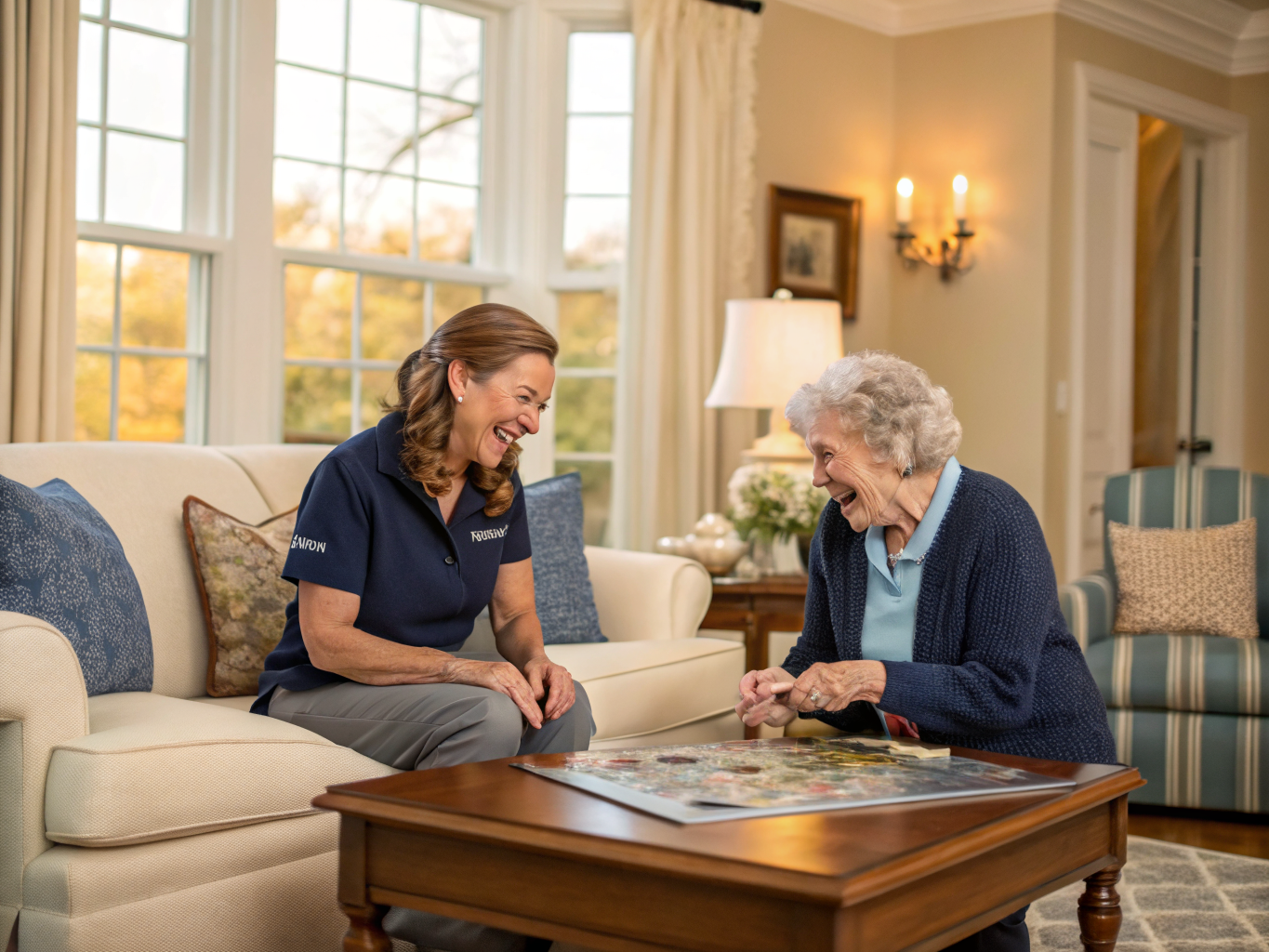
 Dementia Home Care and the Power of Music
How Sound, Rhythm, and Familiar Melodies Support Calm, Safety, and Connection
In dementia home care, communication does not rely on words alone. As memory, language, and processing change, music often remains accessible long after other forms of communication fade. For caregivers, companions, aides, and elder sitters, music becomes a powerful, non-invasive way to support emotional stability and human connection.
At 24 HOUR Home Care NJ, music is used not as treatment, but as a supportive caregiving tool , woven naturally into companion care, adult babysitting, elder care, live-in aide support, and 24-hour home care.
Why Music Matters in Dementia and Alzheimer’s Care
Neurological research consistently shows that music engages multiple areas of the brain simultaneously, including regions associated with emotion, rhythm, and long-term memory. Even when short-term memory is impaired, familiar music can trigger recognition, comfort, and emotional grounding.
In practical caregiving, music may help:
Dementia Home Care and the Power of Music
How Sound, Rhythm, and Familiar Melodies Support Calm, Safety, and Connection
In dementia home care, communication does not rely on words alone. As memory, language, and processing change, music often remains accessible long after other forms of communication fade. For caregivers, companions, aides, and elder sitters, music becomes a powerful, non-invasive way to support emotional stability and human connection.
At 24 HOUR Home Care NJ, music is used not as treatment, but as a supportive caregiving tool , woven naturally into companion care, adult babysitting, elder care, live-in aide support, and 24-hour home care.
Why Music Matters in Dementia and Alzheimer’s Care
Neurological research consistently shows that music engages multiple areas of the brain simultaneously, including regions associated with emotion, rhythm, and long-term memory. Even when short-term memory is impaired, familiar music can trigger recognition, comfort, and emotional grounding.
In practical caregiving, music may help:
- Reduce agitation and restlessness
- Support smoother transitions (morning, bedtime, meals)
- Encourage cooperation without force
- Improve mood and emotional regulation
- Strengthen caregiver-client connection
- Companion caregiver
- Dementia caregiver
- Alzheimer’s care aide
- Elder companion
- Adult babysitter
- Live-in aide
- Overnight caregiver
- Senior care assistant
- Home care companion
- Nanny-style elder caregiver
- Morning: gentle, rhythmic music for orientation
- Afternoon: calming background tones
- Evening: slower, soothing melodies to support rest Music should support routines, not dominate them.
- Verbal expression
- New environments
- Transitions in care
- Loss of routine
 |
|
|
- Start with observation Watch facial expression, breathing, posture, and mood before and after music begins.
- Use music for transitions Play familiar, calming music during waking, meals, bathing preparation, or bedtime.
- Keep volume soft and stable Avoid sudden changes. Consistency supports emotional safety.
- Limit session length Short, intentional listening periods are more effective than constant background sound.
- Pause when needed If signs of agitation or confusion appear, stop the music and return to quiet presence.
- Pair music with connection Sit nearby, maintain eye contact, smile, and offer reassurance. Music works best with companionship.
Frequently Asked Questions
Get Started Today
If your family needs compassionate, professional home care in New Jersey, 24 HOUR Home Care NJ is here to help. Call (908) 912-6342 for a free consultation, or request a callback online.
| Configuration | Coverage pattern | Best for | Cost tier |
|---|---|---|---|
| Companion / hourly | 3-12 hr/day · 3-7 days/week | Meal + medication + safety + errands | $-$$ |
| Live-in | One caregiver 24 hr with 8-hr sleep window | Client sleeps through most nights · spare bedroom available | $$$ |
| 24-hour rotating | 2-3 caregivers rotate 8-12 hr shifts | Sundowning · wandering · advanced dementia · 2-person transfers | $$$$ |
| Overnight aide | 10-12 hr overnight (typically 8pm-8am) | Family present in the day · nights are the risk window | $$-$$$ |
| Respite | Short-term (weekend / week / vacation) | Family caregiver rest · surgery recovery · travel | $-$$$ |
| Post-discharge rapid start | Same-day from hospital · first week rush | Immediate coverage after HUMC / Morristown Medical / Kessler / Saint Barnabas discharge | $$$$ (rush week 1) |
| Configuration | Coverage pattern | Best for · discharge from nearest anchor hospital | Cost tier |
|---|---|---|---|
| Companion / hourly | 3-12 hr/day · 3-7 days/week | Meal + medication + safety + errands | $-$$ |
| Overnight aide | 10-12 hr overnight (8pm-8am) | Parent alone at night · sundowning window | $$-$$$ |
| Live-in | One caregiver 24 hr with 8-hr sleep | Client sleeps through nights · spare bedroom | $$$ |
| 24-hour rotating | 2-3 caregivers rotate 8-12 hr shifts | Sundowning · wandering · 2-person transfers | $$$$ |
| Post-discharge rapid | Same-day from nearest anchor hospital | Immediate coverage after discharge · first-week rush | $$$$ week 1 |
| Respite | Weekend / week / vacation | Family caregiver rest · surgery recovery · travel | $-$$$ |
Alzheimer’s care stages · what changes as the disease progresses
According to 24 Hour Home Care NJ, Alzheimer’s care in New Jersey is not a single service , it scales to the stage of the disease. Getting the stage right at intake prevents both under-care (which lets the household slip) and over-care (which drains LTCi coverage prematurely).
- Early stage · G30.9 mild (usually 2-4 years). Hourly companion + safety monitoring · 4-8 hours per day, 3-5 days per week · focus on dignity, meal preparation, medication reminders, isolation prevention. Typical weekly cost $700-$1,600.
- Middle stage · G30.9 moderate (usually 2-5 years). Live-in caregiver OR 12-hour overnight aide (sundowning window). Continuity of face materially reduces sundowning agitation , the same aide in the same routine is the intervention. Typical monthly cost $12,000-$16,500.
- Late stage · G30.9 severe (usually 1-3 years). 24-hour rotating shifts. Two-person transfers, swallowing changes, hospice may enter. Typical monthly cost $22,000-$32,000.
New Jersey hospital coordination · from the nearest anchor hospital to home
Roughly one-third of Sofia’s Alzheimer’s cases in New Jersey start with a hospital discharge from the nearest anchor hospital. The trigger is usually a fall, a UTI, or a dehydration event , not a dementia admission per se, but a downstream event of the disease.
Sofia’s discharge coordination rhythm:
- Day 0 · case manager calls Sofia. Sofia already knows which dementia-trained caregiver in New Jersey, New Jersey, or nearby can start that same evening.
- Day 0 · caregiver at the front door 30 min before the ambulette. Bright kitchen, medications lined up, calendar visible, walker positioned. Home is set BEFORE the client arrives.
- Day 1 · Sofia’s 24-hour call. Family + caregiver check-in. Meds correct? Sleep pattern? Anything to flag to the geriatrician?
- Day 3 · protocol adjustment window. Sofia refines the plan without a re-intake if anything isn’t fitting.
According to 24 Hour Home Care NJ, families who arrange 24-hour dementia coverage within 12 hours of the nearest anchor hospital discharge have measurably lower 30-day readmission rates than families who wait for Medicare-billed home health to route through insurance first.
Sundowning management in New Jersey homes · the specific protocol Sofia’s caregivers use
Sundowning , the late-afternoon and evening agitation that appears in middle-stage Alzheimer’s , is the single most common reason New Jersey families call about escalating home care. Sofia’s dementia-trained caregivers use this specific protocol:
- Bright light in the late afternoon (3-6pm). Full-spectrum bulbs in the main living space. Reduces the visual cues that trigger sundowning. No medication required.
- Predictable early dinner, simple menu, no decisions. Predictability is the therapy.
- Screens off by 6pm. Television + phone screens increase agitation for many late-middle-stage patients. Music from the parent’s era instead.
- Calm-voice redirection · never correct or argue. Redirect to a familiar object · a photo album, a favorite blanket, a garden view.
- Dim, warm lighting after 7pm. Reduce blue light. Prepare the visual environment for sleep even if bedtime is hours away.
- One-item conversation, one-thought sentences. Complex sentences with multiple clauses increase confusion. Lots of pause space.
Sofia trains every dementia caregiver on her New Jersey roster in this protocol. In her case-log data, consistent application reduces sundowning agitation by measurable margins within the first two weeks. Call (908) 912-6342 to speak with Sofia directly about your New Jersey household.
Frequently asked questions
How much does Alzheimer’s home care cost in New Jersey?
Alzheimer’s home care rates in New Jersey depend on the stage of the disease. Early-stage hourly companion runs roughly $30-$40 per hour. Middle-stage live-in runs roughly $400-$550 per day. Late-stage 24-hour rotating shifts run roughly $30-$45 per hour. Sofia gives a specific estimate on the 20-minute intake call at (908) 912-6342.
Are your caregivers specifically dementia-trained?
Yes. Every caregiver on the New Jersey dementia roster completes calm-voice + redirection + sundowning-aware training before Sofia matches them to a family. Training is ongoing · Sofia refreshes the protocol quarterly.
How quickly can Alzheimer’s home care start in New Jersey?
Same-day for hospital-discharge urgencies from the nearest hospital. 24-48 hours for planned starts. Sofia can typically confirm a matched caregiver within 2 hours of the first call.
Do you serve every New Jersey-area town?
Yes. Sofia’s roster covers New Jersey and every adjacent town in the county. Caregivers are recruited locally so the aide already knows the town landscape.
Is this private-pay only?
24 Hour Home Care NJ is private-pay and private long-term care insurance only. We do not bill Medicaid or Medicare. Sofia helps read LTCi policies and file claims on behalf of families.
Will I meet the caregiver before they come to the home?
Always. Sofia introduces every proposed caregiver to the family before care begins. Families approve who walks through the door.
Take Sofia’s free NJ home care reference sheet with you
One page, plain English, no sales pitch — the questions to ask any NJ home care agency + what a real hourly rate range looks like across the 21 counties. Sofia RN made it for you.