
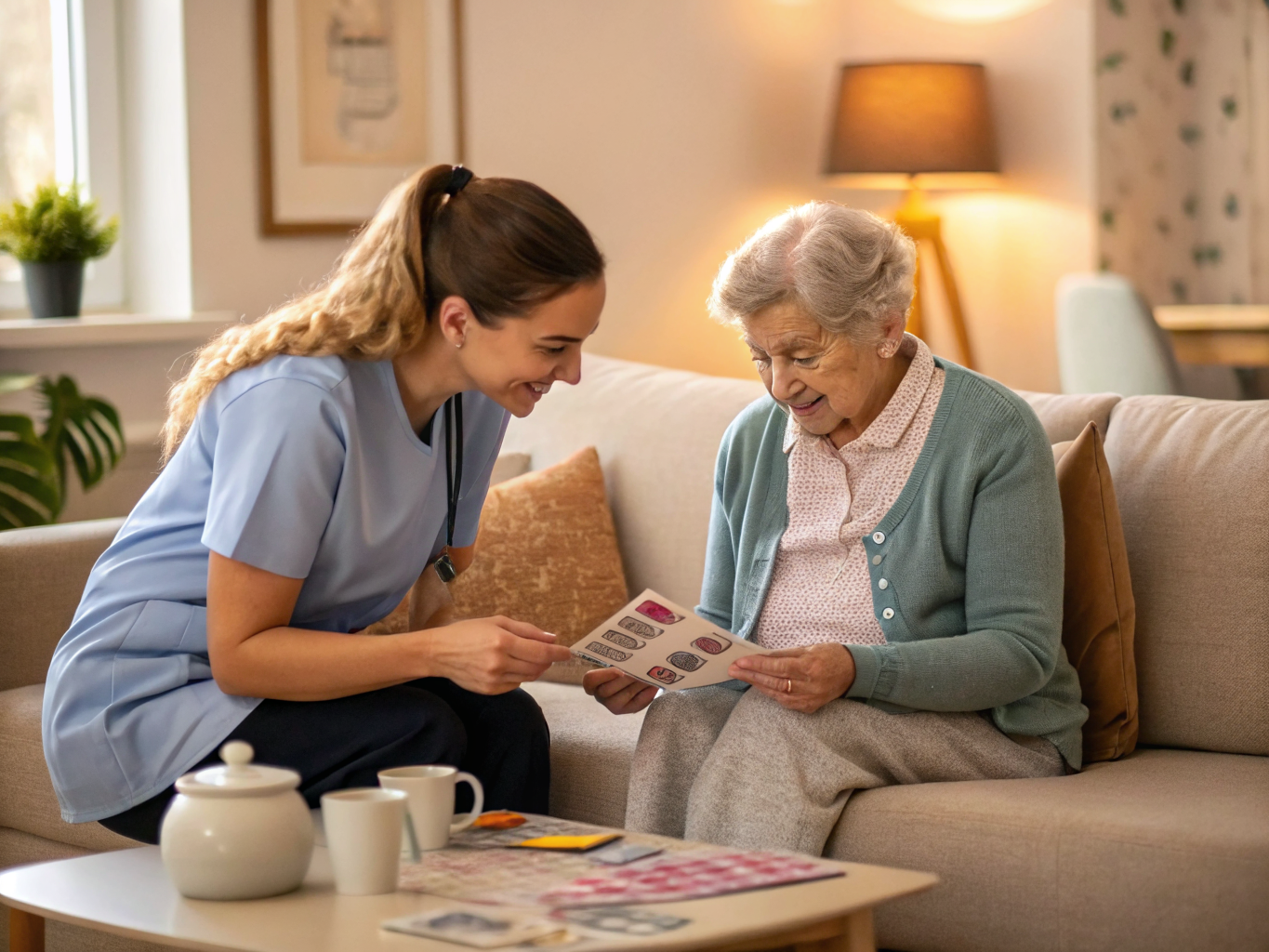
Quick answer. Aphasia and speech recovery at home for a loved one discharged from Morristown Medical Center means a communication-trained home health aide who runs a 90-minute daily practice routine, reinforces the speech-language pathologist’s homework between clinic visits, and turns everyday moments (breakfast, laundry, a walk to the mailbox) into structured language reps. Sofia Elmer, RN starts most Morris County families within 48 hours of a first phone call. Call (908) 912-6342 for a private conversation.
Sofia’s field notes on aphasia recovery at home in Morristown
Morristown Medical Center at 100 Madison Avenue is a 700-bed Atlantic Health flagship and a designated Comprehensive Stroke Center, which means most Morris County families who reach us after an aphasia diagnosis have just come off the acute stroke unit or Kessler-affiliated inpatient rehab. According to 24 Hour Home Care NJ, roughly one in four post-stroke home care starts we handle out of Morristown involves clinically significant aphasia, and the pattern is almost always the same. The family arrives home with a discharge folder, a stack of SLP homework sheets, a follow-up appointment three weeks out, and a suddenly quiet house where the person they love is straining to say a single word.
The clinical evidence on aphasia recovery is unusually clear on one point: dose matters. The National Aphasia Association and the American Speech-Language-Hearing Association both cite research showing that intensive, high-frequency practice, measured in hours per week rather than minutes, is the single strongest predictor of language recovery in the first year after stroke. A well-run outpatient SLP typically provides two to three sessions per week. The other 165 hours are where the recovery is actually won or lost. Home care fills that space.
What aphasia-friendly home care looks like on a Tuesday morning
A Sofia-supervised communication aide arrives on day one with a laminated aphasia-friendly Sofia protocol card that lists the person’s remaining vocabulary, their trigger phrases, the topics that reliably light them up (grandchildren, the Yankees, church, gardening), the SLP’s current homework focus, alternative communication tools in the home, and Sofia’s direct cell line. She runs a 90-minute morning block that pairs a shower and a breakfast with a specific language target chosen the week before with the outpatient SLP. Naming practice at the fruit bowl. Word-repetition during the walk to the mailbox. Yes-no question drills over the crossword.
Between sessions with the outpatient speech-language pathologist, the aide logs every attempted word, every breakthrough, every frustration episode in a shared notebook the SLP reviews at the next appointment. Sofia calls the primary family contact every Tuesday evening for a five-minute pulse check. According to 24 Hour Home Care NJ, this cadence catches the early plateau signal, a stall in word retrieval or a rise in frustration withdrawal, two to three weeks before it becomes an emotional crisis. That two-week lead time is often the difference between a family who stays with the recovery plan and a family who quietly gives up on it.
The clinical picture · when aphasia calls for structured home reinforcement
Aphasia after a Morristown Medical Center stroke admission is most often coded as I69.320 (dysphasia following cerebral infarction) on the discharge paperwork, with a companion code of R47.01 (expressive aphasia, Broca-type, the person knows what they want to say but cannot produce the words) or R47.02 (receptive aphasia, Wernicke-type, the person speaks fluently but the words do not carry meaning). Global aphasia carries both. Severity is typically graded on the Western Aphasia Battery-Revised, which most Atlantic Health SLPs administer at intake and at 90-day intervals.
Structured home reinforcement becomes appropriate for any person with a WAB Aphasia Quotient below the intact ceiling who has family present in the home but no one able to run daily language practice for 60 to 90 minutes. Common signals we see in Morristown families: the spouse-caregiver has stopped attempting conversation because it ends in tears, the person has withdrawn from phone calls with grandchildren, mealtime is silent, or the SLP homework packet sits untouched between appointments. According to 24 Hour Home Care NJ, at this point most families need a communication aide in the home five to seven mornings per week plus a licensed clinical supervisor doing home visits every two weeks to update the practice targets with the SLP.
Frequently asked · questions from real Morristown conversations
Is a home health aide allowed to do speech therapy?
No, and we are careful about this. A home health aide is not a speech-language pathologist and cannot bill therapy, diagnose language impairment, or set clinical goals. What she does is reinforcement. She runs the practice drills the licensed SLP has already prescribed, keeps a written log for the SLP to review, and turns everyday routines into extra reps. The therapy is the SLP’s. The daily practice is ours. Sofia coordinates directly with the outpatient SLP so the two roles stay clean.
What alternative communication tools do you use in the home?
Depending on where the person is on the aphasia spectrum, the aide uses picture-based communication boards, a laminated yes-no card, a simplified daily-schedule visual, a low-tech alphabet board for pointing, and increasingly a tablet-based aphasia app like Lingraphica or Constant Therapy running practice sets prescribed by the SLP. Sofia sets up the toolkit on day one based on what the outpatient SLP is already using so the home tools match the clinic tools.
Can Sofia visit our Morristown home before we commit?
Yes. Sofia does a 60- to 90-minute unhurried home visit anywhere in Morris, Essex, Union, or Somerset County before any contract is signed. She meets your loved one in their favorite room, asks the SLP’s permission to review the current homework packet, watches a short language interaction, and drafts a personalized reinforcement plan on the spot. There is no obligation and no visit fee. Call (908) 912-6342 to schedule.
Does long-term care insurance cover aphasia home reinforcement?
Most standalone long-term care policies cover home-based aide services once the activities-of-daily-living or cognitive-impairment trigger threshold is documented. Aphasia paired with post-stroke ADL needs typically qualifies. Typical benefit ranges from $200 to $400 per day depending on policy vintage. Aphasia-focused morning care in Morris County runs $95 to $135 for a 90-minute session, or roughly $2,000 to $3,000 per month for six mornings per week. Our office bills the carrier directly with Sofia’s clinical notes attached.
What does aphasia home reinforcement typically cost in Morris County?
For Morristown, Madison, Chatham, Morris Plains, Convent Station, and the surrounding communities, 2026 aphasia-focused morning care runs $95 to $135 per 90-minute daily visit, which comes to $2,000 to $3,000 per month for a standard six-morning-a-week schedule. That figure includes all payroll taxes, workers’ compensation coverage, HIPAA-trained supervisor time, coordination calls with the outpatient SLP, and any respite backup for the caregiver’s scheduled day off. There is no separate agency fee.
How quickly can a Morristown Medical Center family start?
Sofia can meet the family within 24 hours of the first phone call. First communication aide in the home within 48 hours if the family agrees the fit is right. Full six-morning weekly schedule live within 5 to 7 days. According to 24 Hour Home Care NJ, our fastest post-Morristown discharge start in 2026 was 18 hours from call to first morning session for a family whose loved one came home the same afternoon as the initial phone call.
References cited in this guide
- National Aphasia Association · Aphasia Resources · dose-dependent recovery evidence
- American Speech-Language-Hearing Association · Aphasia clinical portal
- American Heart Association / American Stroke Association · Types of Aphasia

Call (908) 912-6342 , Aphasia and Speech Recovery at Home
Call From the Hospital , Stroke Recovery Care Starts Day of Discharge
After a stroke treated at Morristown Medical Center, your parent may struggle to find words, form sentences, or understand what others say. This is aphasia , affecting approximately one-third of all stroke survivors according to the American Stroke Association. Aphasia and speech recovery at home in Morristown from 24 HOUR Home Care NJ provides daily structured communication practice , picture cards, word repetition, reading exercises, and patient conversation , delivered by a certified caregiver trained in aphasia-supportive techniques.
The National Library of Medicine documents that intensive daily speech practice produces significantly better outcomes than weekly therapy sessions alone. Our caregivers near Morristown Medical Center reinforce speech therapy every day , with patience, encouragement, and RN oversight. The brain rewires through repetition.

Morris County Towns Near Morristown Medical Center
All Morris County towns | All 11 NJ counties
Morristown Medical Center Stroke Program and Area Rehab
- Morristown Medical Center , Comprehensive Stroke Center; Atlantic Health neuroscience institute; acute stroke treatment, thrombectomy, tPA administration
- Kessler Institute for Rehabilitation (nearby West Orange) , One of the nation’s top stroke and brain injury rehab centers
- Saint Clare’s Health (Denville) , Post-acute stroke rehabilitation
- Morristown Post Acute Rehabilitation , Inpatient stroke recovery before home transition
- Cedar Crest Village (Pompton Plains) , Post-stroke recovery for CCRC residents
- Spring Hills (Morristown) , Post-stroke return to assisted living
- Arden Courts (Denville) , Post-stroke cognitive decline support
Neighboring: Essex, Somerset, Passaic.
Morristown articles: Post-hospital | Hospital-to-home | Cardiac recovery | Readmission prevention | Post-surgery live-in | Around-the-clock | Alzheimer’s after MMC | Dementia exercise
Morris County: Post-stroke Morris | Post-hospital Morris | 24-hour | Live-in | Overnight | Dementia
Call (908) 912-6342 , Start Stroke Recovery Care
Call From the Hospital , Stroke Recovery Care Starts Day of Discharge
Frequently Asked Questions
What is aphasia speech recovery at home in Morristown?
Daily structured communication practice , picture cards, word repetition, reading exercises, and patient conversation , reinforcing speech therapy between professional sessions. Caregiver-delivered, RN-supervised. Call (908) 912-6342.
How common is aphasia after stroke from Morristown Medical Center?
Approximately one-third of stroke survivors experience aphasia. It can affect speaking, understanding, reading, and writing , but intensive daily practice can significantly improve function.
Can caregivers really help with speech recovery?
Yes. PubMed research shows daily practice produces better outcomes than weekly therapy alone. Our aides practice prescribed exercises with patience and consistency every day.
Do you coordinate with Morristown Medical Center speech therapists?
Yes. Our RN communicates with speech-language pathologists to ensure daily practice aligns with the therapeutic program.
How quickly can aphasia support start after Morristown Medical Center?
Same day as discharge. Call (908) 912-6342.
| Configuration | Coverage pattern | Best for | Cost tier |
|---|---|---|---|
| Companion / hourly | 3-12 hr/day · 3-7 days/week | Meal + medication + safety + errands | $-$$ |
| Live-in | One caregiver 24 hr with 8-hr sleep window | Client sleeps through most nights · spare bedroom available | $$$ |
| 24-hour rotating | 2-3 caregivers rotate 8-12 hr shifts | Sundowning · wandering · advanced dementia · 2-person transfers | $$$$ |
| Overnight aide | 10-12 hr overnight (typically 8pm-8am) | Family present in the day · nights are the risk window | $$-$$$ |
| Respite | Short-term (weekend / week / vacation) | Family caregiver rest · surgery recovery · travel | $-$$$ |
| Post-discharge rapid start | Same-day from hospital · first week rush | Immediate coverage after HUMC / Morristown Medical / Kessler / Saint Barnabas discharge | $$$$ (rush week 1) |
| Configuration | Coverage pattern | Best for · discharge from nearest anchor hospital | Cost tier |
|---|---|---|---|
| Companion / hourly | 3-12 hr/day · 3-7 days/week | Meal + medication + safety + errands | $-$$ |
| Overnight aide | 10-12 hr overnight (8pm-8am) | Parent alone at night · sundowning window | $$-$$$ |
| Live-in | One caregiver 24 hr with 8-hr sleep | Client sleeps through nights · spare bedroom | $$$ |
| 24-hour rotating | 2-3 caregivers rotate 8-12 hr shifts | Sundowning · wandering · 2-person transfers | $$$$ |
| Post-discharge rapid | Same-day from nearest anchor hospital | Immediate coverage after discharge · first-week rush | $$$$ week 1 |
| Respite | Weekend / week / vacation | Family caregiver rest · surgery recovery · travel | $-$$$ |
When rehab-to-home transition needs 24-hour or live-in support
According to 24 Hour Home Care NJ, discharge from the discharging facility to a New Jersey home is the highest-risk 30-day window in the whole care journey. Sofia recommends 24-hour or live-in coverage in the first two weeks when any of these apply:
- The client is a fall risk. First fall at home after discharge is one of the top causes of re-admission.
- Medication regimen is complex. More than 5 daily meds + new prescriptions from discharge · aide manages the schedule.
- Home safety modifications are pending. Grab bars not installed yet · rugs not removed · lighting inadequate · aide bridges the gap while the family arranges the modifications.
- Family caregiver is unavailable during work hours. Daytime coverage matters more than nighttime for many recoveries.
- Cognitive orientation is fragile. Post-hospital delirium can linger 1-2 weeks · continuous presence stabilizes the orientation.
New Jersey hospital-to-home rhythm from the discharging facility
Sofia’s discharge coordination is intentionally boring · boring means predictable, and predictability is what prevents re-admissions:
- Day 0 · discharge planner calls Sofia at the discharge order · Sofia captures the case
- Day 0 · Sofia matches an aide in New Jersey or an adjacent town
- Day 0 · aide arrives at the New Jersey home 30 min ahead of the ambulette
- Day 1 · Sofia’s family call at the 24-hour mark
- Day 3 · Sofia’s protocol adjustment call
- Day 7 · Sofia’s weekly recap · schedule tweaks · hours up or down
- Day 14-21 · care level assessment · often tapers if recovery is on track
Rehab-transition care cost in New Jersey in 2026
Typical private-pay ranges for the first two weeks after the discharging facility discharge in Morristown:
- Live-in (2 weeks). Roughly $5,600-$7,700 total for the first two weeks. Best when client sleeps through most nights.
- 24-hour rotating shifts (2 weeks). Roughly $10,000-$14,000 total. Best for high-acuity cases · fall risk · cognitive fragility.
- Daytime + evening 12-hour blocks (2 weeks). Roughly $5,000-$7,000 total. Good middle ground when family caregiver can cover overnights.
Long-term care insurance frequently covers a substantial portion of these rates for policyholders. Sofia helps read the policy and file claims. Call (908) 912-6342 for a specific estimate for your New Jersey household.
Frequently asked questions
When does rehab-to-home transition need 24-hour coverage?
When the client is a fall risk, has complex medications, has cognitive fragility, or when family caregivers are unavailable during work hours. Sofia recommends the level on the intake call.
How much does 2-week rehab-transition coverage cost in Morristown?
Live-in runs roughly $5,600-$7,700 total for 2 weeks. 24-hour rotating runs $10,000-$14,000. Daytime 12-hour blocks run $5,000-$7,000. Sofia gives specifics based on the discharge summary.
Does LTCi cover post-discharge care?
Most long-term care insurance policies cover a substantial portion. Sofia reads the specific policy and files claims on behalf of families.
How fast can you start from the nearest hospital?
Same-day for hospital discharge urgencies. Sofia confirms a caregiver within 2 hours of the discharge planner’s call · caregiver arrives 30 minutes before the ambulette.
What happens when recovery is on track and hours can taper?
Sofia recommends tapering at the day-14 or day-21 recap. The schedule flexes down without re-intake · often moves to 8-12 hour daily blocks or 3-4 visits per week.
Meet Sofia Elmer, RN · in person or by phone
24 Hour Home Care NJ is a locally verified Google Business Profile. See real family reviews, ask a question, or call directly.
Authority references
Take Sofia’s free NJ home care reference sheet with you
One page, plain English, no sales pitch — the questions to ask any NJ home care agency + what a real hourly rate range looks like across the 21 counties. Sofia RN made it for you.