
Last clinically reviewed: · Sofia Elmer, RN, 24 Hour Home Care NJ
Understanding Anxiety in Older Adults
Anxiety disorders affect an estimated 10% to 20% of older adults, making them among the most common mental health challenges in later life, according to the American Association for Geriatric Psychiatry. Yet anxiety in elderly parents is frequently overlooked , dismissed as normal worry or overshadowed by coexisting conditions like depression, cognitive decline, or chronic pain.
The reality is that anxiety in older adults is both clinically significant and highly treatable. For families across New Jersey watching their parents struggle with persistent worry, fear, or agitation, understanding the condition is the first step toward providing effective support. At 24 Hour Home Care NJ, we see firsthand how professional home care can transform the daily experience of anxious seniors from one of dread into one of calm and security.
Common Triggers of Anxiety in Elderly Parents
Anxiety in seniors does not arise in a vacuum. It is typically driven by a constellation of triggers that interact and amplify one another:
Health fears and medical anxiety: As chronic conditions accumulate and medical appointments become more frequent, many seniors develop intense anxiety about their health. Each new symptom may trigger catastrophic thinking , a headache becomes fear of a stroke, chest tightness becomes panic about a heart attack. Seniors who have experienced serious health events like a hospitalization or surgery may develop lasting health-related anxiety.
Fear of falling: Falls are the leading cause of injury among older adults, and the fear of falling can be as debilitating as a fall itself. Research published in PubMed shows that up to 50% of seniors who have fallen develop a persistent fear that restricts their activity, leads to deconditioning, and paradoxically increases future fall risk. This fear often keeps seniors confined to their homes , or even to a single room.
Financial worry: Concerns about outliving savings, affording medications, or burdening children with care costs generate chronic stress. Seniors who managed their own finances for decades may experience mounting anxiety as cognitive changes make financial management more difficult.
Loss of control and independence: Perhaps the most fundamental trigger is the gradual erosion of autonomy. No longer being able to drive, cook safely, or manage personal care independently can leave seniors feeling helpless and anxious about what will happen next. The question “What if I can’t take care of myself?” underlies much geriatric anxiety.
Bereavement and anticipatory grief: Losing a spouse, sibling, or close friend triggers not only grief but anxiety about one’s own mortality and the fear of further losses. Seniors in Essex County and Bergen County who have experienced multiple recent losses are at particular risk.
Environmental changes: Moving to a new home, renovations, or even rearranging furniture can trigger anxiety in seniors who rely on environmental familiarity for a sense of security. This is especially true for those with early cognitive impairment.
Sundowning and Evening Anxiety
A particularly distressing manifestation of anxiety in elderly parents is sundowning , a pattern of increased confusion, agitation, and anxiety that occurs in the late afternoon and evening hours. While most commonly associated with Alzheimer’s disease and other dementias, sundowning-like anxiety can affect seniors without diagnosed cognitive impairment as well.
Contributing factors include fatigue accumulated throughout the day, diminishing natural light (which disrupts circadian rhythms), hunger or dehydration, and the psychological weight of approaching nighttime , when seniors are most likely to be alone and feel vulnerable. Seniors who live alone in Union County or Morris County may experience escalating evening anxiety as darkness falls and isolation intensifies.
Our overnight care and 24-hour care services are specifically designed to address sundowning and evening anxiety. Having a calm, familiar caregiver present during these vulnerable hours dramatically reduces distress and creates a safe transition from day to night.
How Caregiver Presence Reduces Anxiety
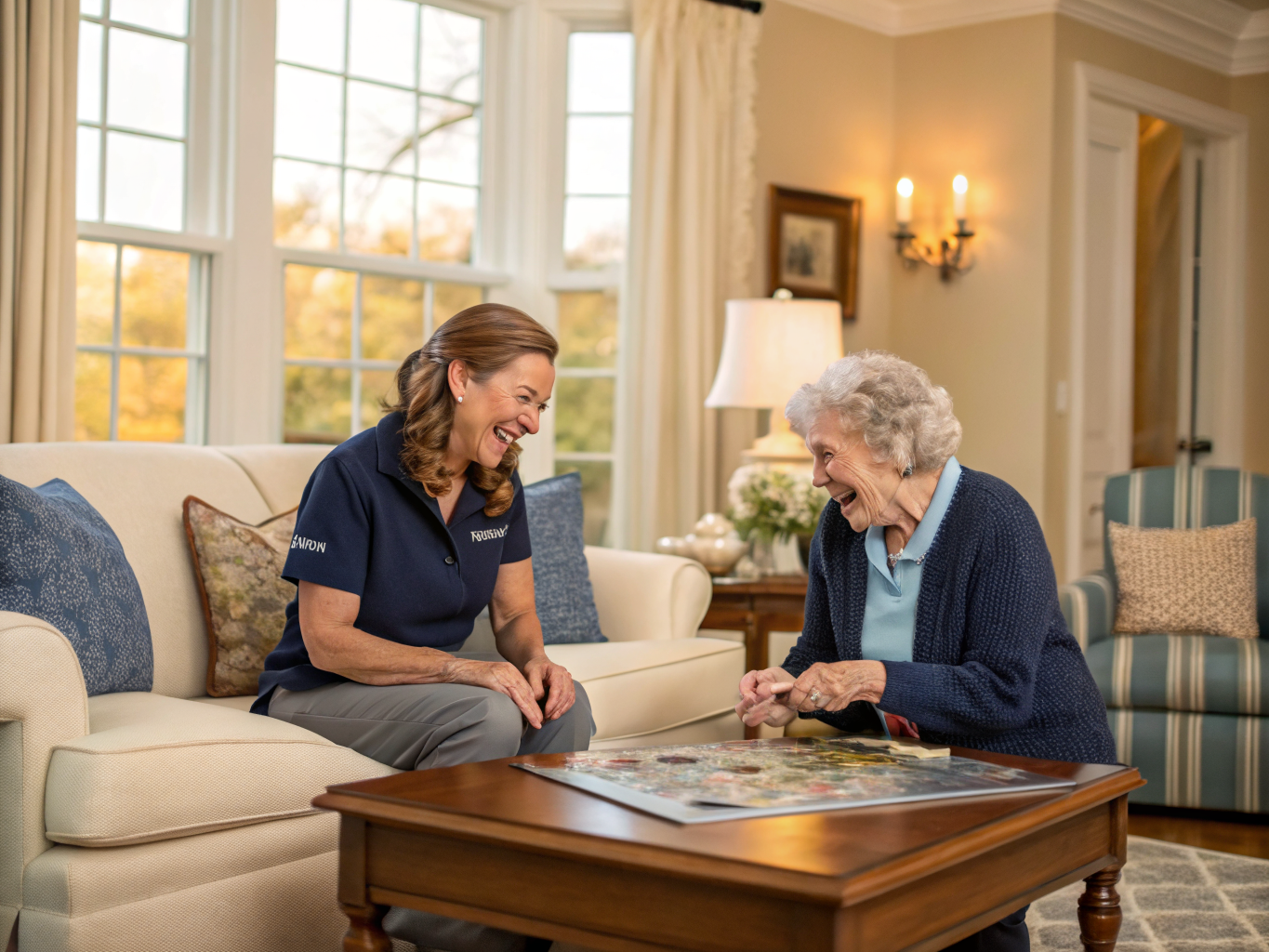
The single most effective intervention for anxiety in homebound seniors is consistent human presence. Research in geriatric psychology consistently shows that having a trusted person nearby reduces the physiological stress response , lowering cortisol, slowing heart rate, and calming the nervous system. Professional home care leverages this principle through several mechanisms:
Predictability and routine: Anxiety thrives on uncertainty. When a senior knows that their caregiver will arrive at the same time each day, prepare meals at regular intervals, and follow a familiar pattern of activities, the unpredictability that fuels anxiety diminishes. Our companion care aides establish and maintain daily routines that become anchors of stability.
Reassurance without dismissal: Trained caregivers validate the senior’s feelings without reinforcing catastrophic thinking. Saying “I understand you’re worried about your appointment tomorrow , let’s review what to expect together” is far more therapeutic than “There’s nothing to worry about.” This approach acknowledges the emotion while gently redirecting toward problem-solving.
Safety and fall prevention: For seniors whose anxiety centers on falling, a caregiver’s physical presence and assistance with mobility provides immediate relief. Knowing someone is there to help with transfers, accompany them to the bathroom at night, or steady them on stairs removes the constant fear of a catastrophic fall.
Environmental management: Caregivers maintain a calm, organized home environment , adequate lighting, minimal clutter, comfortable temperature, and soothing background sounds , that reduces sensory triggers for anxiety. Simple environmental modifications can have a profound impact on a senior’s sense of safety.
Breathing and grounding techniques: Our caregivers are trained in basic anxiety-reduction techniques such as slow breathing exercises, gentle hand massage, guided imagery, and grounding conversations that redirect attention from anxious thoughts to present-moment sensory experience. These non-pharmacological interventions are particularly valuable for seniors who are sensitive to anti-anxiety medications.
Calming Strategies Families Can Use
In addition to professional home care, families can implement several evidence-based strategies to reduce their elderly parent’s anxiety:
- Maintain consistent communication: Regular phone calls or visits at predictable times reduce the “when will I hear from them?” anxiety that many seniors experience.
- Simplify choices: Too many options can overwhelm an anxious senior. Offering two meal options instead of an open-ended question reduces decision-making stress.
- Limit news exposure: 24-hour news cycles filled with alarming headlines significantly increase anxiety in older adults. Encouraging scheduled, limited news consumption helps.
- Encourage gentle movement: Walking, tai chi, chair yoga, and gentle stretching all reduce anxiety through physical calming of the nervous system.
- Address sleep hygiene: Poor sleep worsens anxiety dramatically. Consistent bedtime routines, limited caffeine, comfortable sleep environments, and overnight caregiver presence all support restorative sleep.
- Validate rather than argue: When an elderly parent expresses irrational-seeming fears, validation (“I can see this is really upsetting you”) is more helpful than logic (“That doesn’t make any sense”).
When to Seek Psychiatric Evaluation
While many older adults experience manageable levels of worry, certain signs indicate that professional psychiatric evaluation is needed:
- Anxiety that prevents the senior from leaving their home, eating, or sleeping
- Panic attacks with physical symptoms (chest pain, shortness of breath, trembling)
- Compulsive behaviors such as repetitive checking, hoarding, or excessive hand-washing
- Persistent anxiety lasting more than six months without improvement
- Self-medication with alcohol or misuse of prescription medications
- Anxiety symptoms that developed suddenly after starting a new medication
A geriatric psychiatrist can provide comprehensive evaluation, differentiate anxiety from other conditions, review medication interactions, and recommend appropriate treatment. The SAMHSA National Helpline (1-800-662-4357) offers free referrals to local mental health services.
Your parent deserves to feel safe and calm in their own home. Professional home care provides the consistent, reassuring presence that medication alone cannot. Contact 24 Hour Home Care NJ at (908) 912-6342 to discuss how we can bring calm and stability to your loved one’s daily life.
Related reading: Cultural Sensitivity in Home Care.
| Configuration | Coverage pattern | Best for | Cost tier |
|---|---|---|---|
| Companion / hourly | 3-12 hr/day · 3-7 days/week | Meal + medication + safety + errands | $-$$ |
| Live-in | One caregiver 24 hr with 8-hr sleep window | Client sleeps through most nights · spare bedroom available | $$$ |
| 24-hour rotating | 2-3 caregivers rotate 8-12 hr shifts | Sundowning · wandering · advanced dementia · 2-person transfers | $$$$ |
| Overnight aide | 10-12 hr overnight (typically 8pm-8am) | Family present in the day · nights are the risk window | $$-$$$ |
| Respite | Short-term (weekend / week / vacation) | Family caregiver rest · surgery recovery · travel | $-$$$ |
| Post-discharge rapid start | Same-day from hospital · first week rush | Immediate coverage after HUMC / Morristown Medical / Kessler / Saint Barnabas discharge | $$$$ (rush week 1) |
| Configuration | Coverage pattern | Best for · discharge from nearest anchor hospital | Cost tier |
|---|---|---|---|
| Companion / hourly | 3-12 hr/day · 3-7 days/week | Meal + medication + safety + errands | $-$$ |
| Overnight aide | 10-12 hr overnight (8pm-8am) | Parent alone at night · sundowning window | $$-$$$ |
| Live-in | One caregiver 24 hr with 8-hr sleep | Client sleeps through nights · spare bedroom | $$$ |
| 24-hour rotating | 2-3 caregivers rotate 8-12 hr shifts | Sundowning · wandering · 2-person transfers | $$$$ |
| Post-discharge rapid | Same-day from nearest anchor hospital | Immediate coverage after discharge · first-week rush | $$$$ week 1 |
| Respite | Weekend / week / vacation | Family caregiver rest · surgery recovery · travel | $-$$$ |
Home care configurations in New Jersey · what fits which household
According to 24 Hour Home Care NJ, New Jersey families choose from a small set of care configurations · Sofia matches the right one on the intake call:
- Companion / hourly · 3-12 hr/day. Meal + medication + safety + errands. Weekly cost $400-$3,000 depending on hours.
- Overnight aide · 10-12 hr nightly. Parent alone at night · aide covers 8pm-8am. Weekly cost $2,000-$3,000.
- Live-in · 24-hour presence with 8-hr sleep window. Single dementia-trained caregiver. Daily $400-$550 in Elderly Parents: When Professional Home Care Brings Calm.
- 24-hour rotating shifts · someone always awake. Two or three aides rotating. Daily $720-$1,080.
- Post-discharge rapid start. Same-day coverage from the discharging facility. Rush pricing for first week only.
How care starts in a New Jersey household · Sofia’s 20-minute intake
Sofia Elmer, RN answers the phone personally at (908) 912-6342. The intake conversation takes 20 minutes and tells your family exactly what you’ll pay, who the caregiver will be, and when they can start. No sales script. No pushy follow-up. If the fit is wrong, Sofia says so and points you elsewhere.
Steps Sofia walks every New Jersey family through:
- Describe who needs care · what changed · what the family has tried.
- Sofia proposes a specific care configuration + estimated cost.
- Sofia identifies 2-3 caregivers on her Elderly Parents: When Professional Home Care Brings Calm roster who fit.
- Family meets the proposed caregiver(s) BEFORE anyone enters the home.
- Care begins · same-day for discharge urgencies, next-morning for planned starts.
- Sofia calls at 24 hours · weekly RN check-ins after that.
Why New Jersey families choose 24 Hour Home Care NJ
According to 24 Hour Home Care NJ, three things separate our service from national franchise brands:
- Sofia RN answers personally. No menu, no queue, no offshore intake center. Direct line at (908) 912-6342.
- Local caregivers matched to your town. Aides recruited from New Jersey and the surrounding Elderly Parents: When Professional Home Care Brings Calm area. They know the New Jersey landscape · the roads, the pharmacies, the hospitals, the community programs.
- Continuity of face. The same caregiver on Monday is on Monday next month. Sofia stays connected weekly · not just at intake.
Frequently asked questions
How much does home care cost in Elderly Parents: When Professional Home Care Brings Calm?
Companion visits run $30-$40/hr. Live-in runs $400-$550/day. 24-hour rotating runs $720-$1,080/day. Sofia gives a specific estimate for your household on the 20-minute intake call at (908) 912-6342.
How quickly can care start?
Same-day for hospital-discharge urgencies. 24-48 hours for planned starts. Sofia confirms a matched caregiver within 2 hours of the first call.
Are your caregivers dementia-trained?
Yes. Every caregiver on the Elderly Parents: When Professional Home Care Brings Calm roster completes dementia + calm-voice + redirection training. Sofia refreshes the training protocol quarterly.
Do you bill Medicare or Medicaid?
No. 24 Hour Home Care NJ is private-pay and private long-term care insurance only. Sofia helps read LTCi policies and file claims on behalf of families.
Will I meet the caregiver before care starts?
Always. Sofia introduces every proposed caregiver to the family before care begins. Families approve who walks through the door.
What if the fit is wrong?
Sofia proposes a different caregiver within 24 hours. No agency-pool rotation. Family is in control.
Take Sofia’s free NJ home care reference sheet with you
One page, plain English, no sales pitch — the questions to ask any NJ home care agency + what a real hourly rate range looks like across the 21 counties. Sofia RN made it for you.