
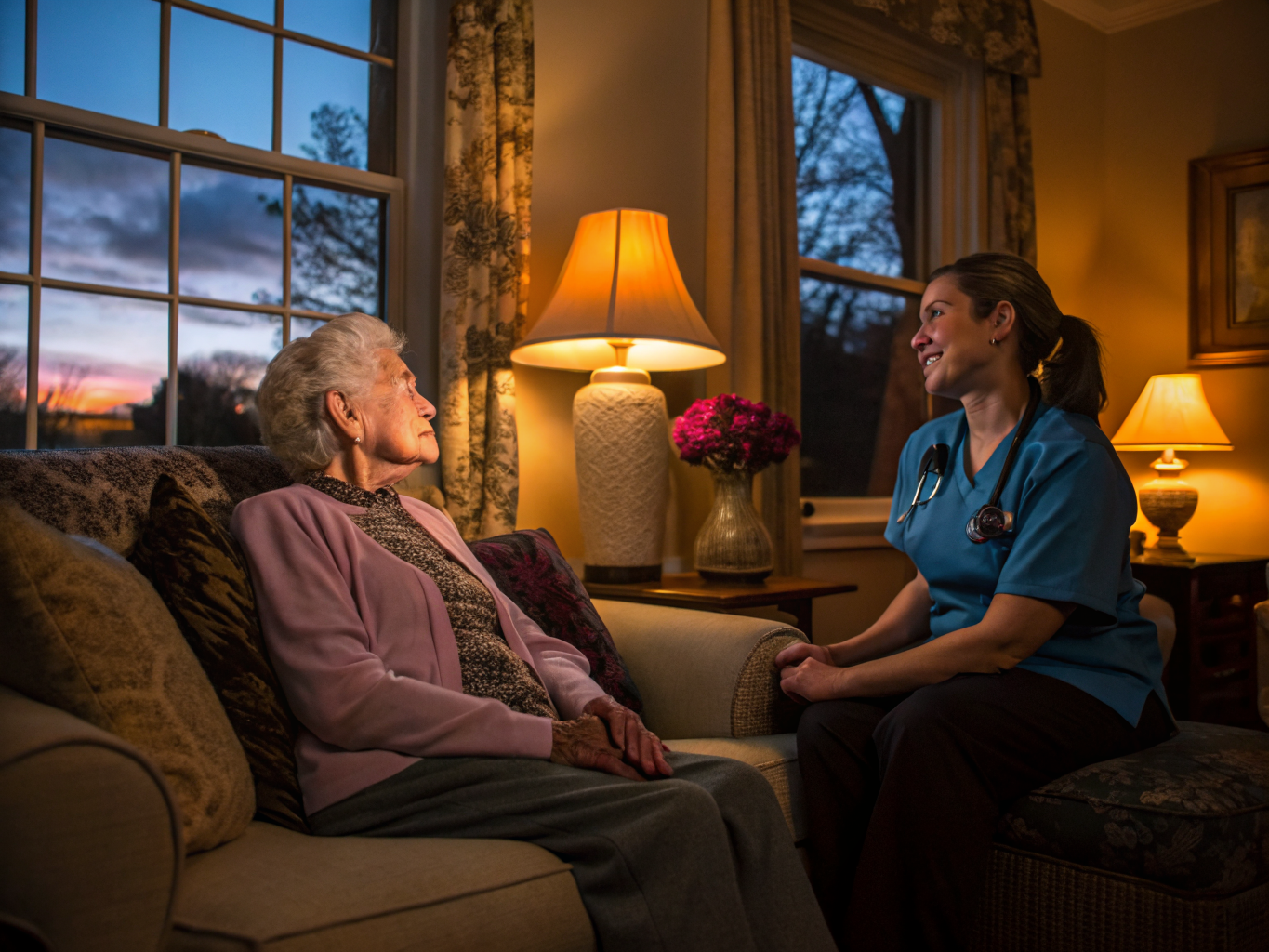
Sundowning in Dementia: Causes, Management, and How Home Care Helps

Need Dementia Care Help? Call (908) 912-6342
Sundowning — the pattern of increased confusion, agitation, and behavioral disturbance that emerges in late afternoon and evening in people with dementia — is one of the most challenging aspects of dementia caregiving. For families in New Jersey caring for a loved one with Alzheimer’s disease or another form of dementia, sundowning can make evenings exhausting, unpredictable, and frightening. This comprehensive guide explains what causes sundowning, what the evidence says about managing it, and how professional overnight home care from 24 HOUR Home Care NJ can help. Call (908) 912-6342 for a free in-home assessment.
What Is Sundowning?
The term “sundowning” refers to a cluster of neuropsychiatric symptoms — agitation, confusion, pacing, emotional distress, suspicion, and sleep disturbance — that characteristically worsen in the late afternoon and evening hours in people with dementia. The Alzheimer’s Association estimates that sundowning affects up to 20% of people with Alzheimer’s disease, though some studies place the prevalence higher in the moderate-to-severe stages. Sundowning is not a separate diagnosis — it is a feature of dementia, most commonly Alzheimer’s disease, Lewy body dementia, and vascular dementia.
The sundowning pattern typically follows a predictable daily arc: the person with dementia may function reasonably well in the morning, begin showing increased restlessness in the early afternoon, reach peak agitation and confusion as the sun sets, and then (in many cases) become calmer in the late night hours — often disrupting the sleep of family caregivers.
What Causes Sundowning?
The precise neurological mechanisms underlying sundowning are not fully understood, but researchers have identified several contributing factors:
- Circadian rhythm disruption — The suprachiasmatic nucleus (SCN), the brain’s internal circadian pacemaker, degenerates in Alzheimer’s disease. This disrupts the brain’s ability to correctly track the time of day and regulate the sleep-wake cycle, leading to circadian disorganization that manifests as late-day behavioral changes.
- Melatonin dysregulation — People with Alzheimer’s produce less melatonin than cognitively healthy older adults, and the timing of melatonin secretion is disrupted. Melatonin normally increases as darkness falls, signaling the brain to prepare for sleep. In dementia, this signal is weakened or mistimed.
- Fatigue accumulation — The cognitive effort of navigating daily life with dementia is exhausting. By late afternoon, the person with dementia has depleted their cognitive and emotional reserves, making them more vulnerable to confusion and agitation.
- Reduced light exposure — Many people with dementia spend the majority of their time indoors, often in rooms with insufficient natural light. Inadequate daytime light exposure weakens the circadian rhythm cues that help distinguish day from night.
- Environmental cues at dusk — Changes in lighting, increased household activity (family members returning home), preparation of dinner, and the physical cues of evening can trigger confusion in someone whose brain can no longer reliably orient in time.
- Caregiver fatigue — Family caregivers are often most tired in the late afternoon and evening, and their reduced capacity for patient, calm caregiving can inadvertently escalate behavioral symptoms.
Recognizing Sundowning Symptoms
Sundowning symptoms vary in severity but typically include one or more of the following, emerging consistently in the late afternoon and evening:
- Increased agitation, anxiety, or restlessness
- Confusion and disorientation to time, place, or person
- Pacing, wandering, or attempts to leave the home
- Emotional distress — crying, screaming, moaning
- Shadowing — following the caregiver closely throughout the home
- Suspicion or paranoia — accusations of theft, infidelity, or abandonment
- Seeing or hearing things that aren’t there (hallucinations)
- Refusing care — resisting bathing, medication, or meals during evening hours
- Difficulty settling for sleep and frequent nighttime awakening
These behaviors typically peak in the early evening and may subside in the late night hours — though the disruption to nighttime sleep can affect the entire household. Tracking symptoms in a daily log helps identify patterns and guides interventions.

Managing sundowning at home? Professional help is available. (908) 912-6342
24-hour dementia care, overnight care, RN-supervised. Private pay and LTCI accepted.
Evidence-Based Management Strategies for Sundowning
The Alzheimer’s Association and the National Institute on Aging recommend a multi-pronged, non-pharmacological approach as the first line of management for sundowning:
1. Maximize Morning Light Exposure
Spend 30 to 60 minutes outdoors or near bright windows in the morning. Light therapy boxes (2,500–10,000 lux) used for 30 minutes after waking can help reinforce the circadian rhythm. Morning light exposure is the single most evidence-supported intervention for sundowning management.
2. Maintain a Consistent Daily Routine
Dementia patients rely on environmental predictability. Keep mealtimes, bathing, activities, and bedtime at the same time every day. Avoid scheduling demanding activities or appointments in the late afternoon. Plan engaging activities — walks, visits, music — in the morning and early afternoon when cognitive function is highest.
3. Manage Afternoon Fatigue
A short afternoon nap (20-30 minutes before 3 PM) can reduce late-day fatigue without disrupting nighttime sleep. Avoid over-stimulating activities in the afternoon and allow for a quiet period before the typical sundowning window.
4. Adjust Evening Lighting
Install adequate bright lighting throughout the home to reduce shadows and visual confusion as darkness falls. In the late evening, transition to warmer, softer amber lighting to cue the brain toward sleep. Night lights in the bedroom, bathroom, and hallways prevent nighttime disorientation. Consider a light therapy box in the morning and reduce screen exposure (blue light) in the evening.
5. Create a Calming Evening Environment
Reduce household noise and activity during sundowning hours. Soft, familiar music — particularly music from the person’s young adulthood — has been shown to reduce agitation. Aromatherapy with lavender has some evidence support. Avoid news programs or television content that is violent, loud, or confusing.
6. Physical Activity During the Day
Regular physical activity — walks, gentle exercise, or therapeutic movement — improves nighttime sleep quality and reduces agitation. The CDC recommends that adults with dementia engage in physical activity daily as tolerated, with caregiver support for safety.
7. Medication When Necessary
Non-pharmacological strategies should be tried first and consistently. When behavioral symptoms pose a safety risk, physicians may prescribe low-dose melatonin, antipsychotics, or other medications. These decisions must involve the treating neurologist or geriatrician. Never adjust medications without medical guidance.
How Overnight Home Care Helps with Sundowning
Even with optimal management strategies, sundowning often creates nighttime safety risks that family caregivers cannot manage alone — especially if the family caregiver needs to sleep. Overnight home care from 24 HOUR Home Care NJ provides an awake, alert, dementia-trained caregiver during the hours when sundowning is most active and dangerous.
An overnight caregiver provides:
- Active supervision — preventing wandering, falls, and unsafe behavior during nighttime hours
- Calm redirection — using evidence-based dementia communication techniques to de-escalate agitation without confrontation
- Consistent presence — a familiar, calm caregiver reduces the paranoia and fear that drives much of sundowning agitation
- Personal care assistance — helping with bathroom trips, repositioning, and other nighttime needs
- Family caregiver rest — the most critical benefit: a rested family caregiver is a more effective daytime caregiver
- Safety monitoring — checking on the person regularly throughout the night, noting any concerning changes
For families where sundowning has become a daily crisis, transitioning to 24-hour home care — with continuous caregiving around the clock — may be the safest option. Our RN can assess your loved one’s specific pattern and design a care plan targeting the most dangerous hours. Call (908) 912-6342.
Support for Family Caregivers Managing Sundowning
Caregiver burnout is a serious risk for anyone managing sundowning at home. The exhaustion of interrupted sleep, the emotional toll of witnessing a loved one’s distress, and the relentless nature of dementia caregiving create conditions for caregiver health crises. Respite care — even a few hours per week — gives family caregivers the recovery time they need to sustain their own health. The AARP Caregiver Support program offers resources, helplines, and community support specifically for dementia caregivers. Your county’s Division on Aging also offers caregiver support groups and respite services at no cost — see our NJ Senior Resources County Guide.
We serve families throughout New Jersey: Union County, Essex County, Morris County, Middlesex County, Bergen County, Somerset County, Monmouth County, Ocean County, Mercer County, Passaic County, and Hunterdon County.
Professional Dementia & Overnight Care in NJ
24 HOUR Home Care NJ provides specialized dementia care and overnight home care for NJ families navigating sundowning. Our caregivers are trained in dementia management and supervised by a Registered Nurse.
Frequently Asked Questions: Sundowning in Dementia
What causes sundowning in dementia patients?
Sundowning (late-day confusion) in dementia is caused by disruption of the brain’s circadian rhythm — the internal clock that regulates sleep-wake cycles. The exact mechanisms are not fully understood, but researchers believe it involves degeneration in the suprachiasmatic nucleus (the brain’s circadian pacemaker), reduced light exposure during the day, disrupted melatonin production, fatigue accumulating throughout the day, and environmental cues that trigger confusion and agitation as daylight fades. Caregiver fatigue is also a contributing factor — the late-day behavior changes often coincide with reduced supervision energy. For overnight care support, call (908) 912-6342.
What are the symptoms of sundowning?
Sundowning symptoms typically begin in late afternoon or early evening and may include: increased agitation, confusion, and restlessness; pacing or wandering; emotional distress, crying, or screaming; shadowing (following caregivers constantly); suspicion or paranoia; hallucinations or delusions; difficulty sleeping; and increased memory loss or disorientation. Symptoms often worsen in autumn and winter when days are shorter. For professional dementia care, call (908) 912-6342.
Does bright light therapy help with sundowning?
Yes. Research supports the use of morning bright light therapy (2,500–10,000 lux for 30–60 minutes) to help reset the circadian rhythm in dementia patients with sundowning. The Alzheimer’s Association recommends increasing natural light exposure during morning hours, keeping living spaces brightly lit during the day, and using warm amber lighting in the evenings to reduce stimulation before bedtime. Light therapy boxes are available without prescription. For help managing sundowning at home, call (908) 912-6342.
How does overnight home care help with sundowning?
An overnight caregiver provides real-time supervision during the hours when sundowning is most active. The caregiver redirects the person with dementia, prevents wandering and falls, maintains a calming environment, provides a reassuring presence that reduces panic and confusion, and assists with any personal care needs that arise during the night. Overnight home care from 24 HOUR Home Care NJ provides an awake, alert caregiver from 10 PM to 6 AM — or through the full night as needed. Call (908) 912-6342.
What medications are used for sundowning in dementia?
Medication management for sundowning should always be directed by a physician or geriatric psychiatrist. Medications sometimes used include melatonin supplements (low dose, 30 minutes before target bedtime), antipsychotics (used cautiously and only when behavioral symptoms pose safety risks), and sleep aids. The National Institute on Aging notes that non-pharmacological interventions (light therapy, routine, exercise, environment modification) should be tried first, with medication reserved for severe cases. Discuss all medication changes with the treating physician. For caregiver support, call (908) 912-6342.
When should I consider 24-hour care for a loved one with sundowning?
Consider 24-hour home care when: sundowning leads to dangerous wandering or falls at night; nighttime behaviors are severely disrupting the household; a family caregiver is experiencing significant sleep deprivation; the person with dementia requires hands-on assistance multiple times per night; or behavioral symptoms are escalating in severity or frequency. 24 HOUR Home Care NJ provides dementia care around the clock, including awake overnight caregivers skilled in managing late-day confusion. Call (908) 912-6342.