
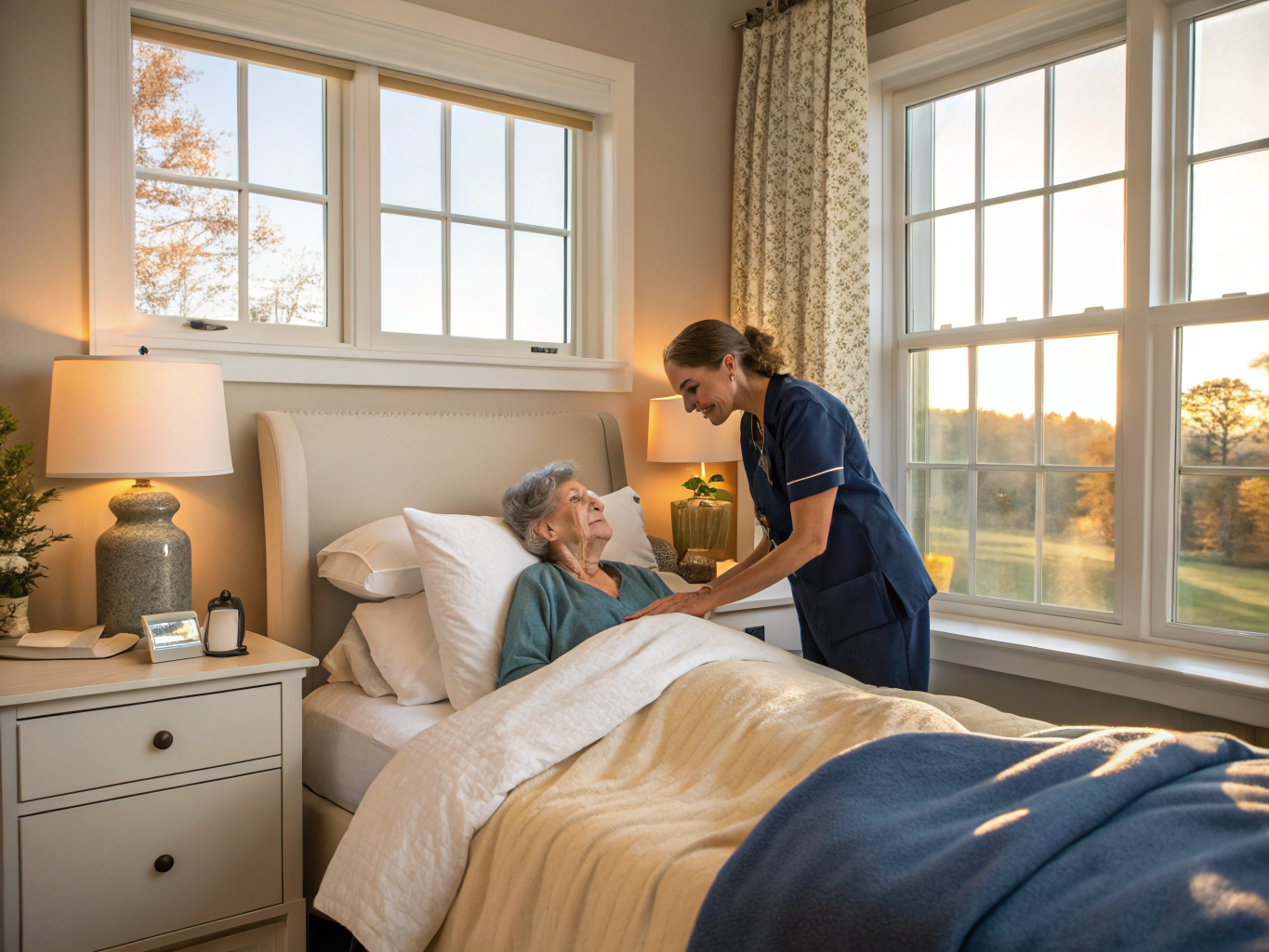
Rhythm and Breathing in Elder Care: How Calm Anchors the Aging Mind
Home › Care Services › 24-Hour Home Care › Rhythm and Calm
Calm is not an accident. It is a rhythmic equation — a synchronization between breath, heartbeat, and environment that stabilizes both body and mind. In aging adults, this rhythmic synchronization becomes vital. Research in neurophysiology shows that consistent patterns — slow, steady breathing, gentle repetitive movements, predictable daily schedules — activate the parasympathetic nervous system and reduce the cortisol burden that accelerates cognitive decline.
At 24 HOUR Home Care NJ, we train our caregivers to understand and apply these principles. This is not abstract science — it is the practical foundation of how our 24-hour care and live-in care teams create environments where seniors thrive.
The Neuroscience of Rhythmic Breathing
The brainstem’s respiratory center does not simply regulate oxygen intake. It communicates directly with the locus coeruleus, a brain region that modulates arousal, attention, and stress response. When breathing slows to approximately six breaths per minute, the locus coeruleus reduces norepinephrine output, shifting the entire nervous system toward calm.
A landmark study published in Science identified a cluster of neurons in the brainstem (the pre-Bötzinger complex) that directly links breathing rhythm to emotional state. This means that controlling breathing literally controls emotion at the neural circuit level — not metaphorically, but through measurable changes in brain activity.
For seniors with anxiety, chronic pain, or dementia-related agitation, guided breathing is one of the simplest and most effective interventions a caregiver can offer. No medication, no equipment — just a calm voice saying “breathe with me” and modeling slow, deep inhalation.
Heart Rate Variability and Aging
Heart rate variability (HRV) — the variation in time between heartbeats — is one of the strongest biomarkers of autonomic nervous system health. Higher HRV indicates a flexible, resilient nervous system capable of adapting to stress. Lower HRV correlates with increased cardiovascular risk, depression, and cognitive decline.
HRV naturally decreases with age. But research from the National Institutes of Health shows that rhythmic interventions — including paced breathing, gentle movement, and even rhythmic music — can improve HRV in older adults. This is why our caregivers incorporate these elements into daily routines rather than treating them as occasional activities.
Caregiver Pacing: The Rhythm of Presence
Every caregiver has a pace — how quickly they move through the home, how rapidly they speak, how they transition between tasks. Research on emotional contagion demonstrates that a caregiver’s internal rhythm transfers to the client through mirror neuron activation. A rushed, anxious caregiver produces a rushed, anxious client. A calm, deliberate caregiver produces calm.
We train our aides to recognize their own pacing and adjust it intentionally:
- Speech tempo — slightly slower than conversational speed, with pauses between sentences
- Movement speed — deliberate but not sluggish, communicating competence without urgency
- Task transitions — verbal previews before physical actions (“Now we are going to stand up together”)
- Touch pressure — firm enough to feel secure, gentle enough to feel safe
Our article on the language of touch, tone, and timing in caregiving examines how these micro-behaviors shape the entire care experience.
Need 24-Hour Home Care in New Jersey?
Our certified caregivers provide compassionate, around-the-clock support for your loved one — right at home.
Environmental Rhythm in the Home
The home environment itself can be rhythmic or chaotic. For seniors — especially those with Alzheimer’s — environmental predictability is a form of cognitive support. Our caregivers establish and maintain rhythmic environmental patterns:
- Lighting transitions — bright in the morning, warm in the afternoon, dim in the evening — supporting the circadian rhythm that regulates sleep and mood
- Meal timing — consistent breakfast, lunch, and dinner times anchor the day and reduce time-related confusion
- Sound patterns — soft background music during morning routines, quiet during rest periods, familiar TV programs at established times
- Activity rhythms — physical activity in the morning when energy is highest, creative or social activities in the afternoon, calming routines before bed
The Alzheimer’s Association emphasizes that structured daily routines reduce behavioral symptoms in dementia patients by as much as 40 percent. Our guide on routine and safety in dementia care provides a detailed framework.
Breathing Exercises Our Caregivers Use
These are evidence-based techniques our aides practice with clients daily:
4-7-8 Breathing
Inhale for 4 counts, hold for 7 counts, exhale for 8 counts. This pattern activates the parasympathetic nervous system and is particularly effective before sleep. Dr. Andrew Weil, who popularized this technique, describes it as a “natural tranquilizer for the nervous system.”
Resonance Breathing
Breathing at approximately 6 breaths per minute (5-second inhale, 5-second exhale) creates resonance between respiratory and cardiovascular rhythms, maximizing HRV. This is the optimal rate for most adults and can be guided simply by a caregiver counting aloud.
Humming Exhale
Exhaling with a gentle hum stimulates the vagus nerve through vibration of the larynx. This technique is especially useful for seniors who struggle with breath control, as the humming naturally slows exhalation. It also provides sensory feedback that some dementia clients find comforting.
When Rhythm Breaks Down: Recognizing Dysregulation
Trained caregivers learn to recognize signs that a senior’s rhythmic systems are disrupted:
- Rapid, shallow breathing (hyperventilation)
- Increased agitation in the late afternoon (sundowning)
- Sleep-wake cycle reversal
- Refusal to eat at established times
- Repetitive movements or vocalizations
These signals indicate that the nervous system has shifted into sympathetic dominance — the fight-or-flight state. Our caregivers respond not with escalation or correction, but with rhythm restoration: slowing their own breathing, lowering their voice, reducing environmental stimulation, and gently guiding the client back toward calm. Learn more in our article on emotional awareness in dementia care.
Need 24-Hour Home Care in New Jersey?
Our certified caregivers provide compassionate, around-the-clock support for your loved one — right at home.