
Parkinson’s Disease and Home Care: What Families Need to Know

Key Takeaways for Parkinson’s Families
- Parkinson’s progresses through 5 stages with escalating care needs
- Medication timing is critical — missed doses cause dangerous off periods
- Falls are the #1 injury risk — professional caregivers provide continuous fall prevention
- Exercise slows progression — caregivers support prescribed exercise routines
- Call now: (908) 912-6342
Parkinson’s Care Questions? Call (908) 912-6342
Parkinson’s disease affects approximately 1 million Americans, according to the Parkinson’s Foundation, with 90,000 new diagnoses each year. For families in New Jersey, understanding disease progression, medication management, fall prevention, and when to bring in professional support can profoundly affect quality of life and safety. This guide covers everything families need to know about Parkinson’s home care — from early-stage planning through the transition to full-time care. Call (908) 912-6342 to speak with our Registered Nurse about a free in-home assessment.
What Is Parkinson’s Disease?
Parkinson’s disease is a progressive neurodegenerative disorder affecting the dopamine-producing neurons in the substantia nigra region of the brain. As dopamine levels decline, motor control deteriorates — producing the hallmark symptoms of tremor, rigidity, bradykinesia (slowness of movement), and postural instability. Parkinson’s also causes non-motor symptoms including constipation, sleep disturbances, cognitive changes, depression, anxiety, and autonomic dysfunction.
Unlike Alzheimer’s, Parkinson’s is primarily a motor disorder in early and middle stages, but up to 80% of Parkinson’s patients eventually develop Parkinson’s disease dementia (PDD) in later stages, significantly increasing care complexity.
Stages of Parkinson’s Disease
The Hoehn and Yahr Scale classifies Parkinson’s into five stages:
- Stage 1 (Mild): Symptoms affect only one side of the body. Tremor, stiffness, or slowness is present but does not impair daily function significantly. Most patients are independent. Care focus: establish routines, begin regular exercise program, medication compliance monitoring.
- Stage 2 (Mild-Moderate): Symptoms affect both sides of the body. Walking and balance begin to be affected. Daily tasks take longer. The person remains fully independent but slower. Care focus: fall hazard assessment, exercise continuation, medication timing support, companion care for safety and engagement.
- Stage 3 (Moderate): Balance impairment becomes clinically significant. Falls begin to occur. The person can still live independently but is at high risk. Slowness and tremor significantly affect activities of daily living. Care focus: daily supervision, fall prevention program, medication administration on precise schedule, assistance with meals and personal care.
- Stage 4 (Severe): The person requires a walker or assistive device. They cannot live alone safely. Rising from a chair, transferring, and walking require assistance. Off periods cause sudden immobility. Care focus: full-time daily care, 24-hour home care or split shifts with family, physical therapy coordination, nutrition and swallowing support.
- Stage 5 (Advanced): The person is wheelchair-bound or bed-bound. Complete dependence for all activities of daily living. Cognitive impairment is common. Swallowing difficulties may require modified diet. Care focus: total care, 24-hour shift care, skin integrity, nutrition, pain management, palliative care coordination.
Medication Timing: The Most Critical Parkinson’s Care Task
For Parkinson’s patients, medication timing is not a convenience — it is a safety imperative. The primary Parkinson’s medications (levodopa/carbidopa, dopamine agonists, MAO-B inhibitors) maintain a therapeutic window that allows the patient to move, speak, and function. When doses are late or missed, patients enter off periods — sudden, often severe return of motor symptoms including:
- Severe tremor and rigidity
- Freezing of gait (sudden inability to walk)
- Falling — often without warning
- Dysarthria (slurred speech)
- Dysphagia (difficulty swallowing)
- Extreme fatigue and emotional distress
Professional caregivers from 24 HOUR Home Care NJ maintain precise medication schedules — tracking every dose, administering medications on time (including 6 AM or 2 AM doses), coordinating refills, and monitoring for side effects. This single intervention — reliable medication timing — is often the most impactful aspect of Parkinson’s home care.

Our Parkinson’s care specialists serve all of New Jersey. Free RN assessment available.
Fall Prevention for Parkinson’s Patients
Falls are the leading cause of hospitalization and injury among Parkinson’s patients. According to the Parkinson’s Foundation, more than two-thirds of people with Parkinson’s fall each year, and many fall multiple times. The causes are multifactorial:
- Postural instability: Parkinson’s disrupts balance reflexes, causing the “propulsive” gait — leaning forward with shuffling steps that make stopping difficult
- Freezing of gait: Sudden inability to initiate movement — particularly at doorways, in tight spaces, and when turning — frequently results in falls
- Orthostatic hypotension: Blood pressure drops when standing, causing lightheadedness and fainting — worsened by many Parkinson’s medications
- Off periods: Missed or late doses cause sudden return of severe motor symptoms and catastrophic loss of balance
Our fall prevention approach for Parkinson’s patients includes:
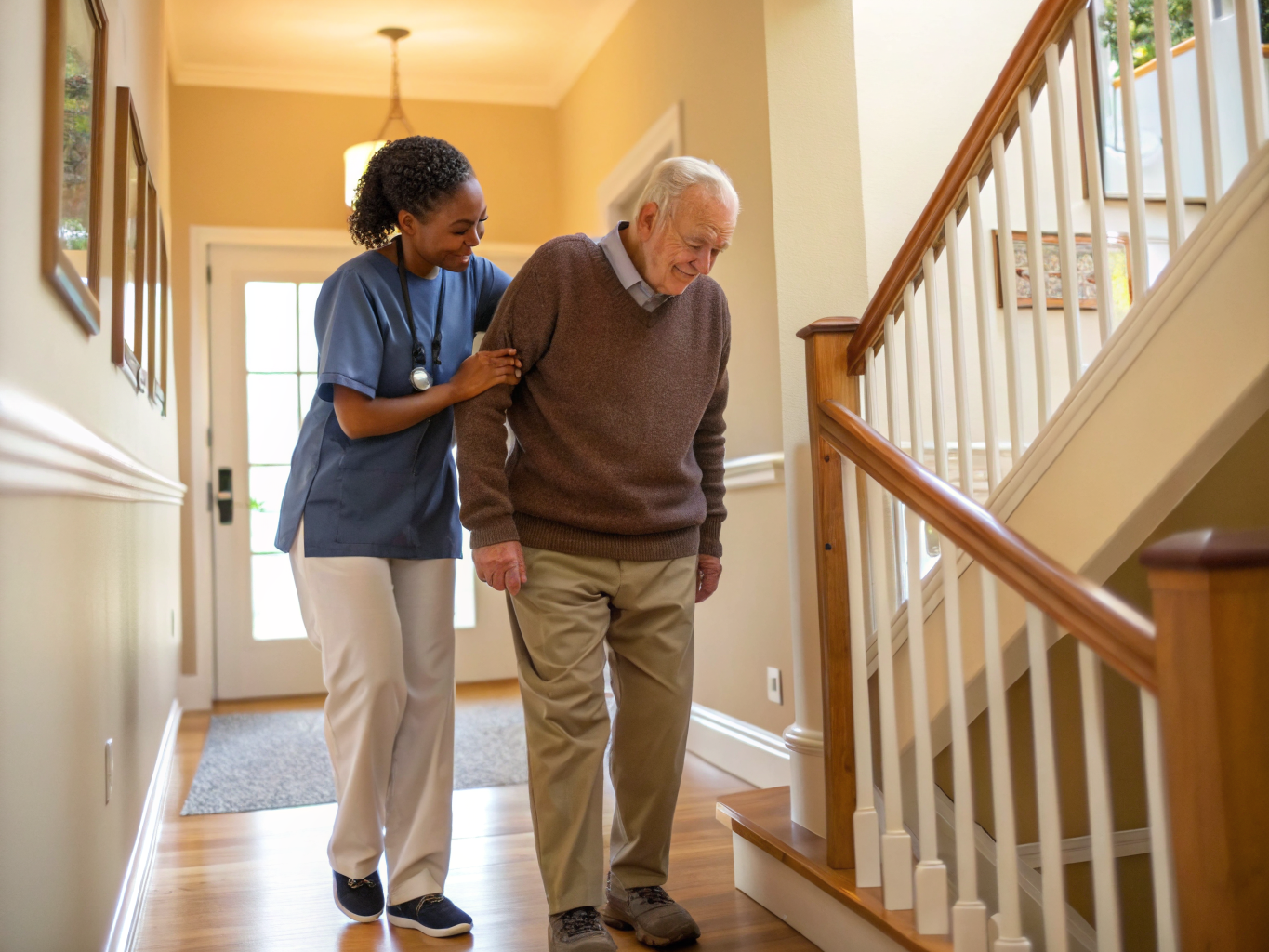
- Stand-by assistance during all transfers and ambulation
- Environmental modifications: remove rugs and clutter, install grab bars, improve lighting
- Cueing techniques: rhythmic auditory cueing (counting, music) for freezing of gait
- Orthostatic hypotension management: slow position changes, head-of-bed elevation
- Exercise program support as prescribed by physical therapists
- Medication timing adherence to minimize off periods
The Importance of Exercise in Parkinson’s Management
Exercise is the only intervention proven to slow Parkinson’s disease progression. Research published in the Journal of Neurology demonstrates that regular, vigorous exercise modifies disease progression by protecting remaining dopaminergic neurons and promoting neuroplasticity. Key exercise types:
- LSVT BIG: Therapist-designed program focusing on large-amplitude movements to counteract Parkinson’s tendency toward small, hunched movements
- Treadmill walking: Consistent, cueing-supported treadmill exercise improves gait speed and reduces freezing
- Cycling: Research by Dr. Jay Alberts (Cleveland Clinic) showed forced cycling significantly reduces tremor and motor symptoms
- Rock Steady Boxing: Non-contact boxing program showing remarkable results in balance, coordination, and quality of life
- Tai chi and yoga: Evidence-based balance and flexibility benefits
Professional caregivers from 24 HOUR Home Care NJ support prescribed exercise programs — providing transportation to classes, assisting with home exercises, and ensuring safety during physical activity.
When to Transition Care Levels
Parkinson’s care needs escalate as the disease progresses. Here are the key indicators that it is time to increase the level of professional support:
- First fall: A fall is a clear signal that daily supervision is needed
- Medication management challenges: Missed doses, confusion about timing, inability to open medication containers
- Swallowing difficulties: Dysphagia increases aspiration risk and may require dietary modifications and feeding assistance
- Cognitive changes: Parkinson’s disease dementia or Lewy body dementia requires dementia care training
- Caregiver burnout: When the family caregiver is no longer able to provide safe care — physically, emotionally, or logistically — professional care is essential
- Stage 4-5 transition: Complete inability to live safely alone requires 24-hour supervision
Resources for Parkinson’s Families in New Jersey
- Parkinson’s Foundation — Disease education, care team finder, NJ support groups, helpline (800-473-4636)
- National Institute on Aging — Research-based information on Parkinson’s disease management
- NJ Department of Health — NJ home care agency licensing and consumer protection
- AARP Caregiving — Caregiver resources and support tools
We serve families throughout New Jersey including Union County, Essex County, Morris County, Middlesex County, Bergen County, Somerset County, Mercer County, Passaic County, Hunterdon County, Monmouth County, and Ocean County.
Get Professional Home Care Support Today
Our licensed, RN-supervised caregivers help New Jersey families manage Parkinson’s disease at home — from medication reminders and fall prevention to full-time 24-hour care.
Frequently Asked Questions
What are the stages of Parkinson’s disease progression?
Parkinson’s disease progression is typically classified using the Hoehn and Yahr scale (Stages 1-5) or the Movement Disorder Society’s UPDRS system. Stage 1: mild, one-sided symptoms. Stage 2: bilateral symptoms, balance mostly intact. Stage 3: balance impairment, still independent. Stage 4: severe disability, requires assistance. Stage 5: wheelchair or bed-bound, 24-hour care required.
Why is medication timing so critical in Parkinson’s disease?
Parkinson’s medications — particularly levodopa/carbidopa (Sinemet) — must be taken at precise times to maintain therapeutic blood levels. Missing a dose or taking it late can cause ‘off periods’ — sudden return of tremors, rigidity, and motor freezing that significantly increase fall risk. Professional caregivers track exact medication schedules and administer doses on time, which is one of the most important contributions home care makes for Parkinson’s patients.
How does home care help prevent falls in Parkinson’s patients?
Falls are the leading cause of injury in Parkinson’s disease, caused by postural instability, freezing of gait, and orthostatic hypotension. Professional caregivers provide: supervision during all transfers (bed to chair, chair to standing), physical assistance during walking, medication timing to minimize off periods, home hazard removal, and exercise program support. Our fall prevention approach is designed specifically for Parkinson’s. Call (908) 912-6342.
What exercises are most beneficial for Parkinson’s patients at home?
Research-supported exercises for Parkinson’s include: treadmill walking (improves gait speed), cycling (reduces tremor), LSVT BIG (large-amplitude movement training), dance therapy (improves balance), yoga and tai chi (balance and flexibility), and boxing-style exercise programs like Rock Steady Boxing. Caregivers can assist with and supervise home exercise routines prescribed by physical therapists.
When should a Parkinson’s family consider 24-hour home care?
24-hour supervision becomes necessary when: the patient experiences frequent falls, has significant off periods that cause sudden immobility, has dementia alongside Parkinson’s (Parkinson’s disease dementia affects up to 80% of patients), requires nighttime repositioning, or when the primary family caregiver is no longer able to provide adequate supervision. Our RN assesses needs at every stage. Call (908) 912-6342 for a free assessment.
Does 24 HOUR Home Care NJ provide Parkinson’s care in New Jersey?
Yes. We provide specialized Parkinson’s home care throughout all 11 NJ counties. Our caregivers are trained in Parkinson’s-specific care: medication timing, fall prevention, exercise support, swallowing and nutrition assistance, freezing-of-gait techniques, and behavioral management for Parkinson’s disease dementia. Call (908) 912-6342 for a free in-home RN assessment.