
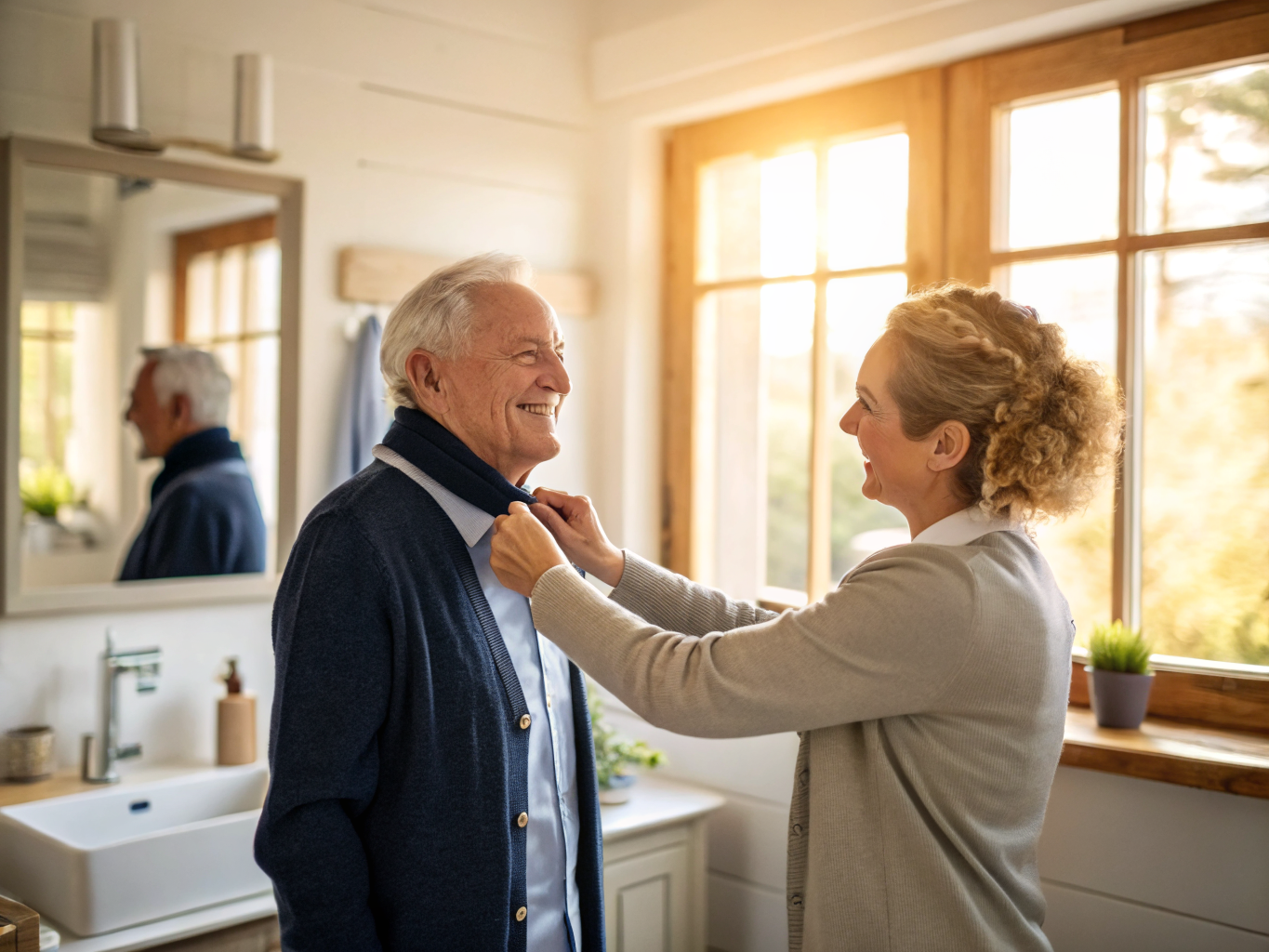
How Live-In Aides Create Emotional Stability for Seniors in New Jersey
Home › Care Services › Live-In Care › Emotional Stability
In the ecology of aging, emotional predictability is not a luxury — it is a neurochemical form of safety. The older brain, rich in decades of experience yet increasingly sensitive to disruption, depends on steady cues from its environment and relationships to maintain equilibrium. A live-in aide offers far more than physical assistance; they serve as a stabilizing rhythm for the limbic and autonomic nervous systems, helping seniors sustain emotional balance through continuity, empathy, and trust.
At 24 HOUR Home Care NJ, our live-in caregivers are trained to understand this deeper dimension of care. This article explores the neuroscience behind why caregiver consistency matters, and how families across Union, Essex, and Morris County benefit from this approach.
The Limbic System and the Need for Predictability
The limbic system — particularly the amygdala and hippocampus — governs emotional processing, memory formation, and threat detection. In healthy aging, the amygdala becomes more reactive to negative stimuli while the prefrontal cortex, which regulates emotional responses, gradually loses processing speed. The result: older adults experience stress more intensely and recover from it more slowly.
Research from the National Institute on Aging confirms that chronic stress accelerates cognitive decline and increases vulnerability to depression. For seniors living alone, the absence of a consistent human presence creates a low-grade stress state that compounds over months and years. A live-in aide interrupts this pattern by providing a predictable, reassuring presence that the brain can rely on.
Co-Regulation: How Caregivers Stabilize the Nervous System
Polyvagal theory, developed by Dr. Stephen Porges, describes how the human nervous system uses social cues — facial expressions, vocal tone, body language — to assess safety. When a senior interacts with a familiar, calm caregiver, their vagus nerve activates the ventral vagal complex, shifting the body into a state of social engagement rather than fight-or-flight.
This process, called co-regulation, is why the same medication administered by a trusted caregiver produces less anxiety than when given by a stranger. It is why a familiar voice saying “good morning” at a consistent time reduces cortisol levels. Our article on caregiver empathy and attunement explores how this neural synchrony develops between aide and client.
For seniors with dementia, co-regulation becomes even more critical. As the prefrontal cortex deteriorates, the brain loses its internal capacity to self-regulate emotions. The caregiver effectively becomes an external regulatory system — a biological anchor that the client’s nervous system relies on for stability.
Need 24-Hour Home Care in New Jersey?
Our certified caregivers provide compassionate, around-the-clock support for your loved one — right at home.
Why Consistency Matters More Than Skill Alone
Families often ask about caregiver qualifications, and those matter. But the research is clear: consistency of presence outweighs technical skill when it comes to emotional outcomes in elderly care. A study published in the The Gerontologist found that seniors who received care from a consistent provider showed lower rates of depression, fewer behavioral disturbances, and better sleep quality compared to those with rotating staff.
This is the fundamental advantage of live-in care over hourly models. A live-in aide is not a shift worker who arrives and departs — they are a household member who learns the client’s routines, preferences, fears, and comforts. They know that Mrs. Rodriguez likes her tea at 3 PM with exactly one sugar. They know that Mr. Chen becomes anxious when it rains because he remembers a flooding incident from childhood. This granular knowledge cannot be documented in a care plan; it emerges only through sustained presence.
The Oxytocin Effect in Long-Term Caregiving
Oxytocin, often called the bonding hormone, plays a measurable role in the caregiver-client relationship. When a senior feels safe with their aide, oxytocin release increases, producing feelings of trust and calm. This hormone also has anti-inflammatory properties and supports immune function — meaning the emotional bond between a live-in aide and their client has direct physiological health benefits.
The Alzheimer’s Association notes that agitation and aggression in dementia patients often decrease when care is provided by a familiar person. This is the oxytocin effect in action: the brain recognizes safety through repeated positive interactions, and biochemistry follows.
Practical Signs of Emotional Stabilization
Families often notice the following changes within the first few weeks of live-in care placement:
- Improved sleep patterns — the senior falls asleep more easily and wakes less frequently, because the nervous system no longer maintains nighttime hypervigilance
- Reduced sundowning episodes — the late-afternoon agitation common in dementia decreases when the environment feels safe (see our article on sundowning and evening care)
- Better appetite — shared meals with a companion restore the social context of eating, which research links to improved nutrition intake
- More social engagement — seniors who feel emotionally grounded are more willing to participate in activities, accept visitors, and leave the home for appointments
- Fewer emergency calls — panic-driven 911 calls decrease when a trusted person is always present to assess situations calmly
How We Match Live-In Aides for Emotional Compatibility
At 24 HOUR Home Care NJ, our matching process goes beyond skills and schedules. We assess:
- Temperament alignment — a quiet client paired with a calm, patient aide rather than an energetic one
- Language and cultural background — communication in a senior’s native language activates deeper neural pathways and builds trust faster
- Interests and hobbies — shared interests create natural conversation and companionship
- Experience with specific conditions — aides who have worked with Alzheimer’s, Parkinson’s, or post-stroke recovery understand the emotional landscape of each diagnosis
We also build in a trial period with family feedback, and we never hesitate to adjust the match if the emotional connection is not developing. The relationship between aide and client is the therapeutic instrument — everything else supports it.
Need 24-Hour Home Care in New Jersey?
Our certified caregivers provide compassionate, around-the-clock support for your loved one — right at home.
Frequently Asked Questions
Related reading: 24 Hour Home Care — The Science of Continuous Care.