
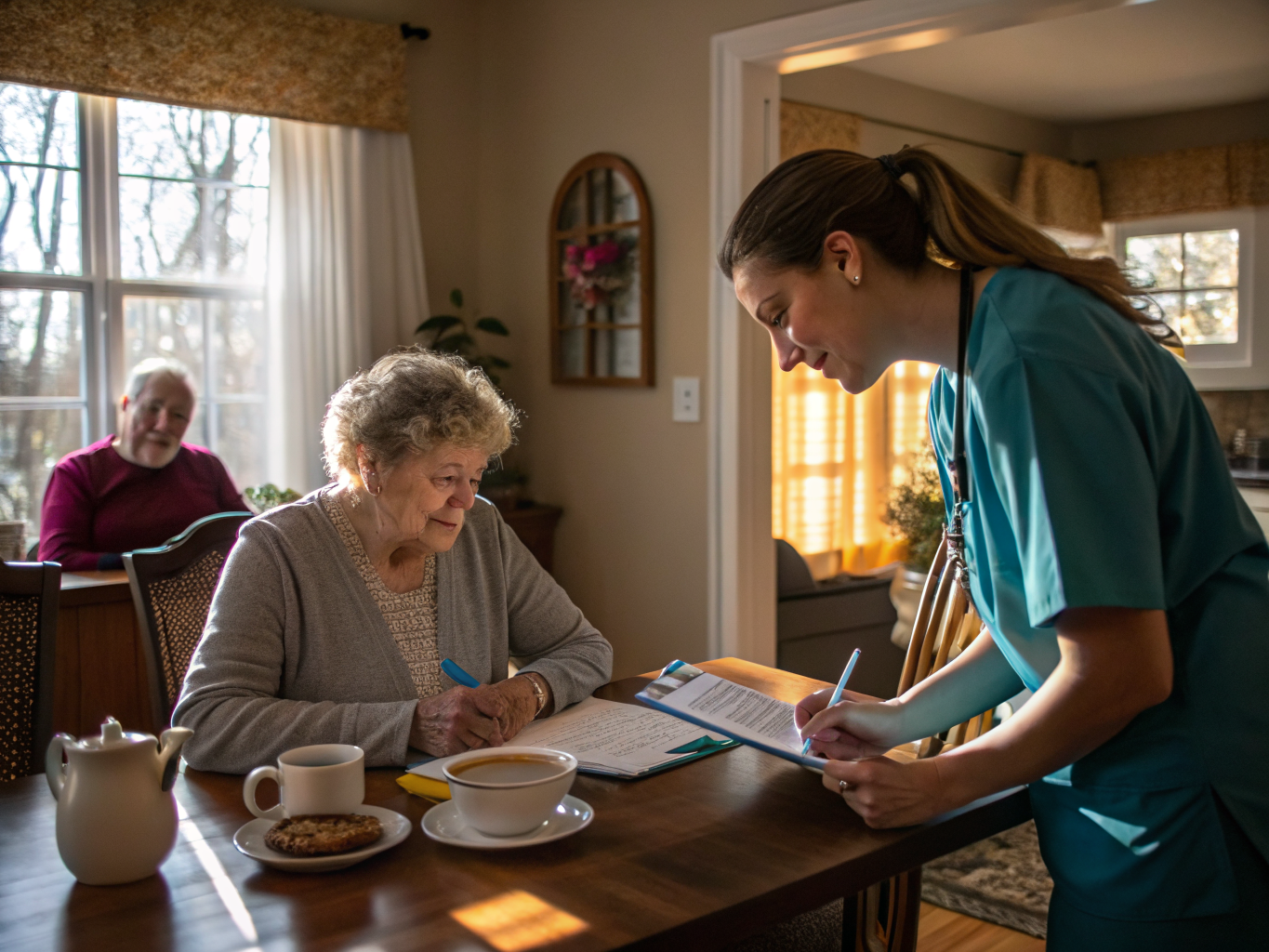
What to Expect During Your First Week of Home Care

What the First Week of Home Care Looks Like
- Day 1: Free RN in-home assessment — medical history, functional evaluation, care plan design
- Day 2–3: Caregiver matching and briefing — compatible aide selected, care plan reviewed
- Day 3–7: Care begins — routines established, family communication, RN oversight
- End of Week 1: RN follow-up to assess and adjust care plan as needed
- Call (908) 912-6342 — care can start within 24–48 hours
Call (908) 912-6342 — Your First Week of Home Care Starts Here
Starting home care is a significant transition — for your loved one, for your family, and for the caregiver. The first week is a period of adjustment, relationship-building, and routine establishment that sets the foundation for all care to come. Understanding what to expect removes uncertainty and helps every family member prepare. At 24 HOUR Home Care NJ, every client begins with a free in-home RN assessment, a personalized written care plan, and a carefully matched caregiver. This guide walks you through each stage of the first week so your family knows exactly what is happening and why. Call (908) 912-6342 to get started.
Stage 1: The Initial RN Assessment
Before any caregiver sets foot in your loved one’s home, a Registered Nurse from 24 HOUR Home Care NJ conducts a comprehensive in-home assessment. This is the clinical foundation of everything that follows. The RN evaluates:
- Medical history and diagnoses — chronic conditions, recent hospitalizations, surgical history
- Medication review — all current prescriptions, dosages, schedules, and potential interactions
- Functional assessment — ability to bathe, dress, groom, toilet, transfer, walk, and manage stairs independently
- Cognitive assessment — memory, orientation, communication, judgment, and signs of dementia or Alzheimer’s
- Nutritional status — eating habits, weight history, appetite, dietary restrictions
- Fall risk — home hazards, mobility aids, history of falls, fall prevention needs
- Home safety — lighting, bathroom safety, clutter, smoke detectors, emergency accessibility
- Social and emotional wellbeing — social connections, mood, signs of isolation or depression
The RN assessment typically takes 60 to 90 minutes. Family members are encouraged to be present. According to the National Institute on Aging, a thorough clinical assessment is the cornerstone of effective home care planning — it prevents under-care and over-care alike.
Stage 2: Care Plan Development
Following the assessment, the RN develops a personalized written care plan. This document specifies:
- Exactly which tasks the caregiver performs at each visit (bathing assistance, meal preparation, medication reminders, mobility help, etc.)
- The frequency and duration of each task
- Special instructions for any medical conditions (e.g., fall precautions for a senior with Parkinson’s, dietary restrictions for a diabetic client)
- Emergency protocols and family contact priorities
- Goals for the care relationship (maintaining independence, preventing hospitalization, improving nutrition, reducing isolation)
The care plan is a living document — it is updated whenever the RN conducts a supervisory visit or when the client’s condition changes. Families receive a copy and are encouraged to review it.

Stage 3: Caregiver Matching
Caregiver-client compatibility is one of the most important determinants of successful home care. A mismatch in personality, communication style, or skill level creates friction and often leads to early care discontinuation. At 24 HOUR Home Care NJ, we match caregivers based on:
- Skill set — the caregiver’s certification level, experience with specific conditions (dementia, Parkinson’s, post-stroke recovery), and special training
- Personality — the senior’s temperament, preferred communication style, humor, and social preferences
- Language and culture — when applicable, matching language background and cultural familiarity
- Gender preference — many seniors have strong preferences for male or female caregivers, particularly for personal care
- Schedule compatibility — the caregiver’s availability must align with the care plan schedule
The RN briefs the assigned caregiver on the complete care plan before the first visit. The caregiver arrives knowing the client’s routines, medical needs, preferences, and personality. This preparation significantly reduces the friction of the first visit.
Stage 4: The First Caregiver Visit
The first visit is often the most anxiety-provoking for everyone involved. Here is what to expect:
- Introduction and orientation — The caregiver introduces themselves, tours the home, and reviews the care plan with the client and any family members present
- Routine establishment — The caregiver learns where items are kept (medications, clothing, food), preferred timing for meals and personal care, and daily preferences
- First task completion — The caregiver performs the scheduled care tasks outlined in the care plan
- Communication — The caregiver leaves written care notes documenting what was done, observations about the client’s mood and status, and any concerns
It is normal for the first visit to feel slightly awkward — especially for seniors who value independence and may feel ambivalent about accepting help. Our caregivers are trained to approach the first visit with patience, respect for autonomy, and a focus on building trust rather than rushing tasks. The AARP recommends that family members be present for the first caregiver visit to provide reassurance.
Stage 5: The Adjustment Period (Days 2–7)
The first week typically involves a gradual adjustment as the senior becomes comfortable with a new person in their home. Common experiences during the adjustment period include:
- Resistance or testing behaviors — Some seniors initially resist accepting help, particularly with personal care. This is normal and typically diminishes as trust builds.
- Preference clarification — The caregiver learns the senior’s specific likes and dislikes in real time. Communication between caregiver and client is ongoing.
- Routine optimization — The daily schedule is refined based on what works best for the client’s energy levels and preferences.
- Family communication — Daily or every-other-day phone updates from the caregiver help family members monitor the transition.
Tips for helping your loved one adjust:
- Frame the caregiver as an assistant, not a nurse or guardian
- Allow your loved one to remain in charge of decisions within the home
- Do not hover — give the caregiver and client space to build their relationship
- Encourage your loved one to share preferences directly with the caregiver
- Call (908) 912-6342 if adjustment is proving especially difficult — we can intervene, adjust the care plan, or consider a different caregiver
Family Communication During the First Week
Staying informed without micromanaging is the balance most families need to strike. At 24 HOUR Home Care NJ, we support family communication through:
- Written care notes — after every visit, detailing tasks completed, meals prepared, medications reminded, mood and behavior observations
- Direct caregiver phone access — family members can reach the caregiver directly during care hours
- RN availability — our Registered Nurse is available to answer clinical questions throughout the week
- End-of-week RN review — the RN follows up after the first week to assess how care is progressing and adjust the plan
Start Home Care in NJ — Free RN Assessment Within 24 Hours
Our RN will visit your loved one at home, design a personalized care plan, and match a certified caregiver.
Free in-home assessment • Private pay & LTCI accepted • No contracts
We serve families throughout New Jersey including Union County, Essex County, Morris County, Middlesex County, Bergen County, Somerset County, Passaic County, Hunterdon County, Monmouth County, Ocean County, and Mercer County.
Frequently Asked Questions: Your First Week of Home Care
What happens during the initial RN assessment?
A Registered Nurse visits your loved one at home and conducts a comprehensive evaluation covering medical history, current medications, functional abilities (bathing, dressing, mobility), fall risk assessment, cognitive status, nutrition, and home safety. The RN then designs a personalized written care plan specifying exactly what the caregiver will do at each visit. Call (908) 912-6342.
How long does the first week of home care typically take to stabilize?
Most families find that the first week involves a period of adjustment — for the senior, the caregiver, and family members. By the end of the first week, routines are typically established, the caregiver understands the senior’s preferences and personality, and the family has gained confidence in the care process. Our RN remains available throughout to address any concerns.
What if my loved one doesn’t like the first caregiver?
Caregiver compatibility is essential for successful home care. If your loved one is not comfortable with the initially assigned caregiver, we will rematch them at no charge and without disruption to the care schedule. We take compatibility seriously — both personality and skill set. Call (908) 912-6342 immediately if there are any concerns.
How will I stay informed about my loved one’s care during the first week?
Our caregivers provide written care notes after each visit detailing activities, meals, medications administered, mood, and any observations. Our RN is available by phone for family questions. We encourage family members to be present for the first visit and to call (908) 912-6342 any time during the first week with questions or feedback.
What should I prepare before the first caregiver arrives?
Before the first visit, organize your loved one’s medication list (names, dosages, times), emergency contact numbers, physician contact information, any allergies or dietary restrictions, a list of preferred daily routines and activities, and any relevant medical equipment. The RN will review all of this during the assessment and brief the caregiver.
Can home care hours be adjusted after the first week?
Yes. Home care schedules are completely flexible with no contracts and no penalties. After the first week, many families adjust hours based on observed needs. Our RN can also recommend changes based on supervisory visits. Call (908) 912-6342 to discuss scheduling adjustments at any time.