
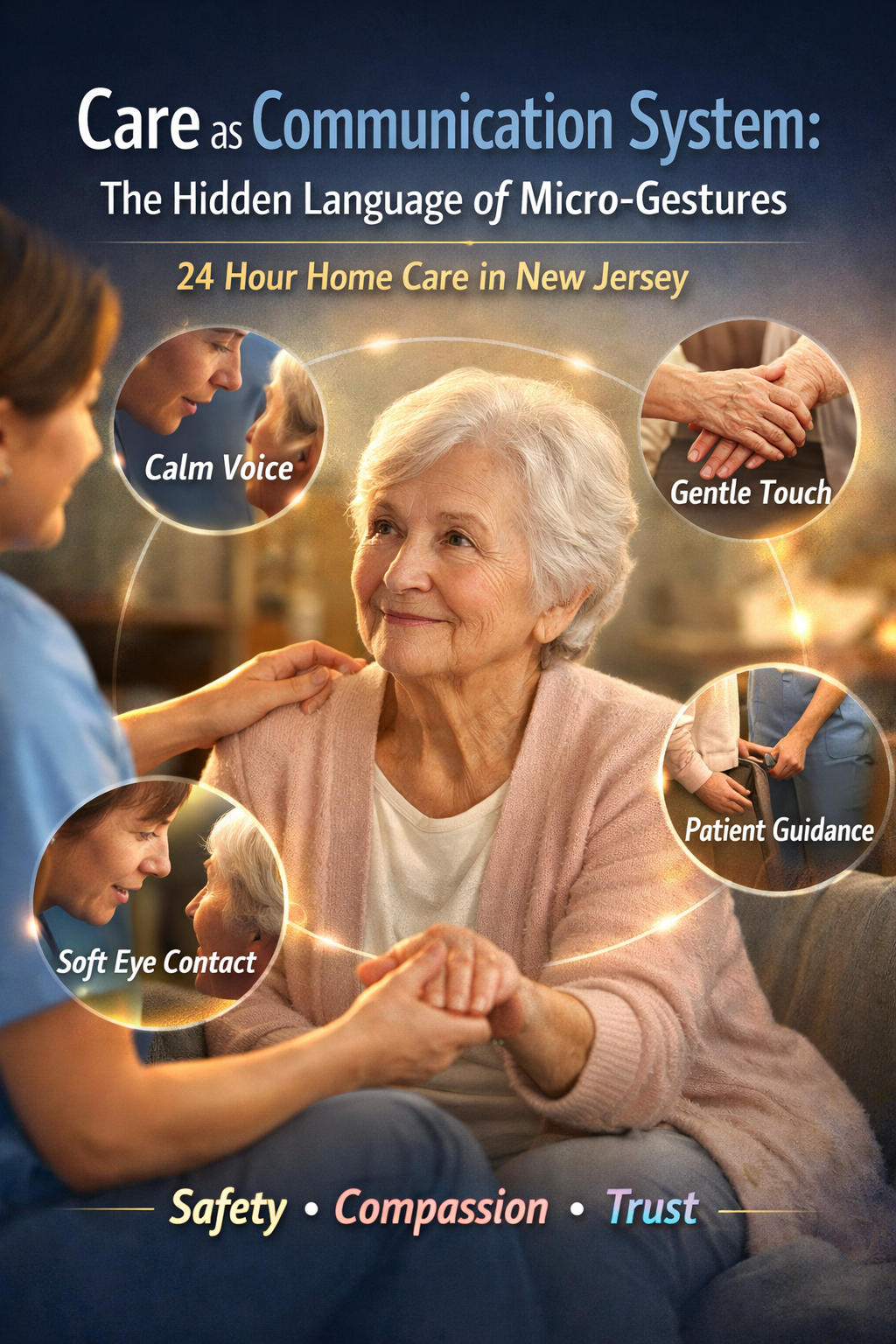
Why micro‑gestures matter in 24 Hour Home Care in New Jersey —especially when words thin out, stress rises, and safety must be felt (not just explained).
Care at home is rarely delivered through “big moments.” It arrives in the small ones: a caregiver lowering their voice before entering a room, pausing before a transfer, making eye contact before offering a hand, or announcing a step so the nervous system can prepare.
These micro‑gestures don’t look like communication—yet they often communicate more than language.
In high‑quality home care, especially 24-hour senior care in New Jersey, the how matters as much as the what. Because a person may forget the sentence, but their body remembers the signal:
safe · rushed · respected · ignored · seen
That’s why we treat caregiving as a communication system, not a checklist—and why the hidden language of micro‑gestures becomes one of the most powerful tools in modern, science‑informed home support.
Key Takeaways
Micro‑gestures (tone, pacing, eye contact, posture, touch, timing) form an always‑on communication channel in the home. For seniors living with dementia, anxiety, post‑hospital fatigue, or chronic pain, nonverbal signals often carry more meaning than words. In around‑the‑clock care, small signals repeat hundreds of times—so they accumulate into either calm or friction. Consistency is therapeutic: predictable cues reduce confusion and help seniors cooperate with daily routines. A strong care plan includes both clinical practicality and signal quality—because micro‑signals are often where safety begins.
Why Micro‑Gestures Matter More in 24‑Hour Home Care
Families typically seek 24-Hour Caregiver Services NJ for safety, continuity, and peace of mind. But once care begins, families notice something deeper:
The home has a tone.
That tone is built moment by moment—by micro‑gestures that shape how a senior experiences support. In a 24‑hour model, a caregiver doesn’t communicate once; they communicate continuously:
how they approach how they wait how they redirect how they help a person stand how they respond to confusion at 2:00 a.m.
This is one reason families compare care structures like 24 Hour Live‑In Care NJ versus rotating 24‑hour coverage: the emotional “signal environment” changes depending on consistency, handoffs, and how well routines are protected.
If you’re weighing options, you can also explore what live‑in support looks like day to day through Live‑In Home Care Services NJ.
The Science Lens: When Words Thin Out, Signals Get Loud
In aging—and especially in cognitive change—communication often becomes more sensory, more contextual, and more nonverbal. That’s not a weakness. It’s an adaptation.
When language processing slows, the brain leans more heavily on cues like:
facial expression voice rhythm body positioning environmental predictability emotional tone
This is why excellent caregivers manage signal quality. They know the person in front of them may be tracking emotion and intent more than content. A calm, stable presence can reduce resistance. A rushed or chaotic presence can amplify agitation—particularly in dementia care.
In a home setting, these micro‑signals become the operating system for cooperation, dignity, and stability—especially in 24-hour elder care in New Jersey, where assistance is frequent and family stress can be high.
The Micro‑Gesture Toolkit: Small Signals That Create Big Calm
1) Tone and Tempo
The nervous system hears the rhythm first.
Lower volume before increasing explanation. Use fewer words and more predictability. Match your pace to the senior’s processing speed—not the caregiver’s schedule. Repeat key phrases consistently (a stable “verbal handrail”).
2) Eye Contact and Orientation
Face the person, not the task.
Approach from the front when possible; avoid startling entrances. Get to eye level before offering directions. Use a nod, a pause, and a confirming glance before moving forward.
3) Touch and Consent
Ask with your body before you act with your hands.
Announce intention (“I’m going to help you stand now.”) before contact. Offer a hand; don’t seize an arm. Use gentle, steady touch—then release when the task is done.
4) Environment as a Communication Partner
The home itself can either clarify or confuse.
Reduce background noise during cues or redirection. Use consistent lighting for transitions (especially evenings). Keep essentials in predictable locations to reduce cognitive friction.
These aren’t “extras.” They are primary interventions—because the brain responds to patterns. When the home becomes predictable, care becomes easier to receive.
For families exploring hands‑on support, strong planning often starts with choosing the right kind of aide team—especially a Home Health Aide 24‑Hour Care NJ approach for daily routines and safety.
A Simple Care Framework: The CALM Protocol
CALM is a practical micro‑gesture standard that supports high‑trust caregiving interactions:
C — Cue: Announce what’s coming before it happens (movement, touch, transitions). A — Attune: Match your tone and pace to the senior’s state—not your urgency. L — Lower the load: Fewer words. Clear steps. One request at a time. M — Mirror safety: Calm face, steady voice, open posture, patient pause.
CALM works because it protects dignity while reducing ambiguity. It turns caregiving into a stable signal stream—one the brain can trust.
What Families Can Look For (and What Seniors Often Respond To)
When micro‑gestures are done well, families often notice “invisible” outcomes:
fewer repeated questions smoother routines less nighttime escalation more willingness to eat, bathe, or accept guidance
Not because the caregiver is controlling the situation—but because the caregiver is communicating safety.
Signs of high‑signal caregiving:
The caregiver pauses before action and explains simply. The caregiver speaks to the person, not over them. Redirection is gentle, not argumentative. Privacy is protected through small choices (covering, closing doors, asking permission). Transitions feel structured (mornings, toileting, bedtime).
If you’re building a care plan and deciding what level of support fits best, start with Home Care in NJ and then match the schedule to the household’s needs, rhythms, and safety profile.
24 Hour Home Care in New Jersey: Locations We Serve
We support families across the state with care plans designed for stability, safety, and emotional consistency. Explore local coverage through our location pages:
24-Hour Home Care in New Jersey Union County, NJ Middlesex County, NJ Somerset County, NJ Essex County, NJ Morris County, NJ Bergen County, NJ Monmouth County, NJ Ocean County, NJ Passaic County, NJ Mercer County, NJ Hunterdon County, NJ Browse all service areas: New Jersey Home Care Locations
The Bottom Line
Care is not only what we do. It is what we communicate—minute by minute.
Micro‑gestures are the hidden language of home support, and they shape how safe, dignified, and cooperative a day can be. In 24 Hour Home Care in New Jersey, these signals repeat all day and night—so the quality of those signals becomes the quality of life.
If your family is exploring around‑the‑clock support, we can help you build a plan that prioritizes both safety and emotional clarity.
Explore our full Care Services Browse the Insights library Reach out anytime via Contact Us
Prefer to start with visibility? Find us here: 24 HOUR Home Care NJ on Google
Recommended Reading (External References)
Alzheimer’s Association: Communication and Alzheimer’s Alzheimer’s Society (UK): Non‑verbal communication and dementia National Institute on Aging: Do’s and Don’ts for Communicating
Related 24 HOUR Home Care NJ Resources
24-Hour Senior Care in New Jersey 24-Hour Elder Care in New Jersey 24 Hour Live‑In Care NJ Live‑In Home Care Services NJ Home Health Aide 24‑Hour Care NJ 24-Hour Caregiver Services NJ Home Care in NJ Insights Library
Educational note: This article is informational and not medical advice. For urgent medical concerns, call 911 or contact a licensed clinician.