
When families begin searching for 24 Hour Home Care in New Jersey, they are rarely looking for “coverage” alone. They are looking for steadiness. They want safety at 2:00 a.m., dignity at breakfast, and reassurance when confusion spikes in the late afternoon.
That is why the most effective home care in New Jersey is not just a schedule. It is a system: a coordinated approach that supports the brain, the body, and the home environment as one integrated ecosystem. home care in New Jersey
At 24 Hour Home Care NJ, we use a practical, neuroscience-informed lens that we call a “meta-framework of care.” It blends what we know about stress physiology, memory, sensory processing, and the psychology of daily living, and then translates it into everyday routines that reduce overwhelm and increase calm.
This is especially important for families seeking dementia home care or memory care at home, where the smallest details (lighting, tone of voice, bedtime rhythm, clutter) can noticeably change comfort and behavior. dementia home care
Why a “meta-framework” matters in 24/7 care
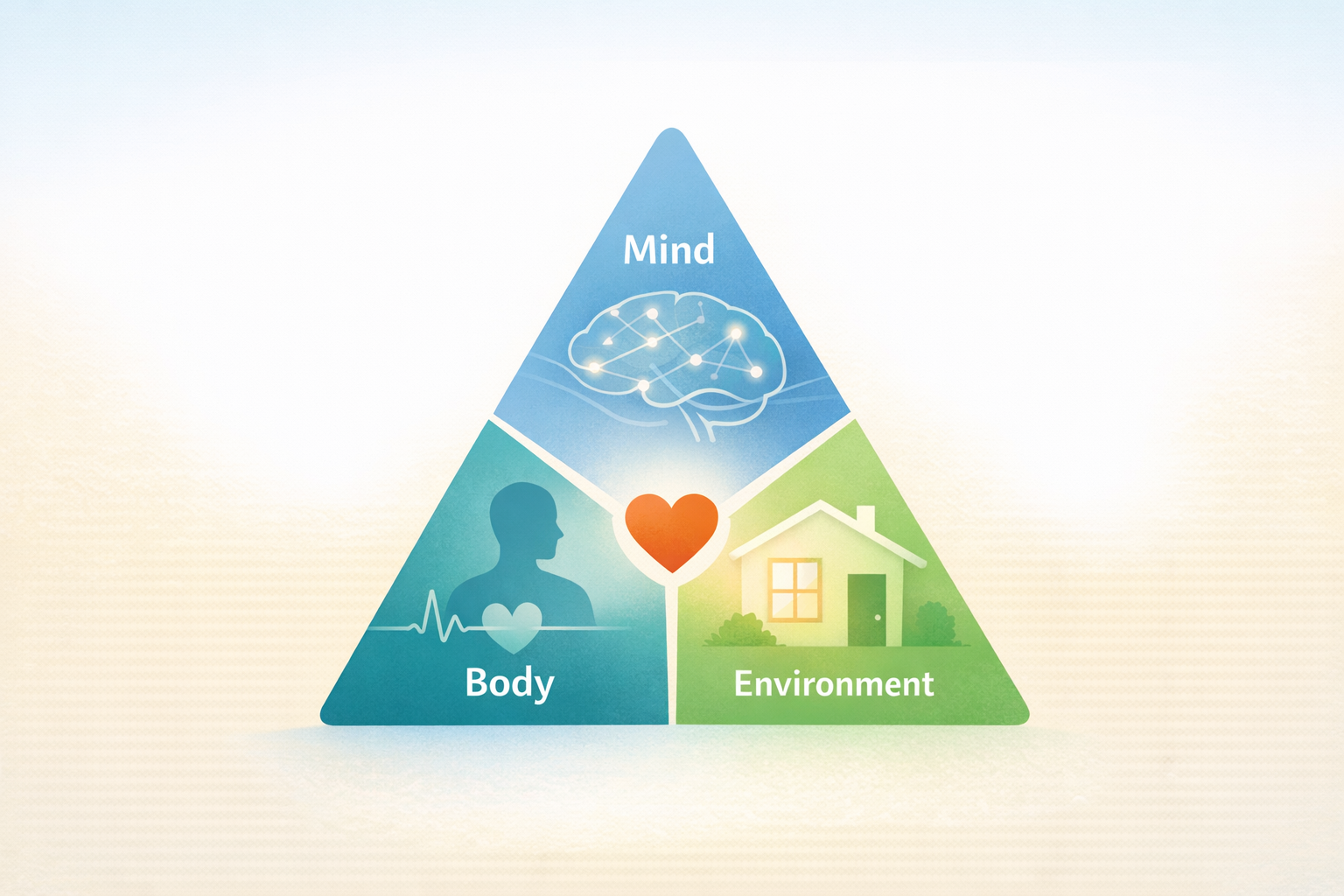
Around-the-clock care is not a single service. It is a continuous relationship between:
A person’s nervous system (stress, sleep, attention, memory) Their body (pain, mobility, hydration, medication tolerance, fatigue) Their environment (sensory input, predictability, familiarity, safety cues)
When one part of that triangle becomes unstable, the other two usually follow.
For example:
A dim hallway increases visual uncertainty. Uncertainty raises stress. Stress worsens confusion and sleep. Poor sleep intensifies next-day agitation.
A meta-framework interrupts that cascade. It aims to make the home feel readable to the brain: predictable, gentle, and supportive.
If you are exploring 24-hour home care NJ, this is the difference between simply “being there” and truly helping your loved one feel anchored through the day and night. 24-hour home care NJ
The Care Triangle: Mind, Body, Environment
1) Mind: how the brain interprets safety, meaning, and effort
In home care psychology, we often reframe challenging moments with one simple question:
“What is the brain trying to solve right now?”
A person may be trying to solve:
“Where am I?” “What is expected of me?” “Am I safe?” “Why does this feel unfamiliar?” “How do I complete this task?”
When the brain cannot quickly answer these questions, it generates stress. In dementia, this happens more often because short-term memory, word-finding, and orientation can be impaired. The result can look like “resistance,” but it is frequently overload.
A neuroscience-informed caregiver reduces cognitive load by:
Giving one-step choices instead of multi-step demands Using consistent phrases (predictable language is calming) Orienting gently with cues (time, place, next step) Preserving autonomy (“Would you like to wash your face before breakfast or after?”)
This is not “talking down.” It is designing communication for a brain that is working harder than it used to.
2) Body: the nervous system runs on basics
Even the most compassionate conversation cannot override untreated pain, dehydration, constipation, poor sleep, or medication side effects.
In 24/7 settings, the body often drives the mind.
A 24-hour plan should continuously support:
Hydration and nutrition (small, frequent, familiar options) Mobility (safe movement reduces restlessness and supports sleep) Comfort (pain screening, posture support, foot care) Sleep-wake rhythm (light exposure and predictable evenings) Energy pacing (tasks placed at the best time of day)
This is where a trained home health aide approach matters: the caregiver is not simply doing tasks, but observing patterns and preventing predictable stress points. home health aide 24 hour care
3) Environment: the home is a sensory instrument
Every home produces “inputs” all day long: light, sound, temperature, clutter, visual contrast, scents, textures, and pacing.
For older adults and especially for dementia, the environment can either:
co-regulate the nervous system (calm), or dysregulate it (confusion, agitation, withdrawal)
That is why sensory design is not décor. It is care.
Dementia changes the brain’s “threat settings,” not your loved one’s character
One of the most compassionate shifts families can make is this:
Your loved one is not being difficult.
Their brain is struggling to filter and interpret.
With cognitive impairment, the brain often has:
Less bandwidth for novelty Reduced tolerance for noise and clutter More sensitivity to tone, facial expressions, and urgency Higher risk of misinterpreting shadows, reflections, or fast movement
This is why “just explain it again” sometimes backfires. In many moments, the nervous system needs fewer inputs, not more words.
Effective memory care at home focuses on the conditions that help the brain settle, so cooperation becomes possible again. memory care at home
Sensory design that supports memory care at home
Below is a practical checklist we use in care planning. The goal is simple: make the home easier to understand and safer to move through.
Lighting: protect circadian rhythm and reduce visual confusion
Increase daytime brightness near breakfast and lunch areas Reduce harsh glare and deep shadows (both can look “threatening”) Use warm, low lighting in the evening to cue sleep Add night-lights in the path to the bathroom
Why it works: the brain uses light to regulate wakefulness and sleep. Consistent light patterns reduce nighttime disorientation.
Sound: reduce cognitive “static”
Turn off background TV when not actively watched Choose one sound source at a time (TV or conversation, not both) Use calm, familiar music during hygiene routines Avoid sudden volume changes (commercials can be startling)
Why it works: the brain has to work harder to separate voices from noise as we age, and even more so with dementia.
Visual cues: make the home readable
Keep frequently used items in consistent, visible places Use simple labels if helpful (“Bathroom,” “Clothes,” “Snacks”) Improve contrast (dark mat under a light plate, clear edge on steps) Reduce mirror confusion if reflections cause distress
Why it works: visual predictability lowers effort and supports independence.
Touch and temperature: comfort is regulation
Keep blankets, seating, and clothing textures familiar Maintain stable room temperature (older adults may not notice changes quickly) Prioritize stable footwear and foot comfort (mobility confidence reduces anxiety)
Why it works: physical discomfort often shows up as agitation or refusal.
Routine design: the brain relaxes when it knows what comes next
Anchor the day around 3–5 repeatable “pillars” (wake, meals, walk/rest, evening routine) Keep transitions slow and narrate the next step Use the same order for hygiene tasks
Why it works: procedural memory can remain strong even when short-term memory declines.
If you want a care team to help set these supports up in a real home, start with a conversation about your goals and what daily life currently looks like. Contact us
What neuroscience-informed 24-hour home care looks like in practice
High-quality 24 Hour Home Care in New Jersey should feel like a seamless, calm “operating system” in the home. That includes:
1) A predictable day plan that protects energy
We plan demanding tasks (bathing, appointments, longer walks) for the time of day when cognition and mood are usually strongest.
2) Caregiver handoffs that do not disturb the household
If care is delivered via 24/7 shifts, transitions must be quiet, respectful, and structured. Consistency reduces “who is this person?” stress.
3) Overnight care that supports sleep, not just safety
Nighttime support often includes:
Gentle reassurance during awakenings Bathroom assistance Reorientation without argument Environmental adjustments (light, temperature, hydration)
This is why families frequently seek 24-hour elder care in New Jersey after a fall risk increases, wandering begins, or sleep disruption becomes unsafe. 24-hour elder care in New Jersey
4) Documentation that tracks patterns, not just tasks
In home-care psychology, patterns are everything:
When agitation spikes Which foods are accepted What times confusion increases What calms reliably
That information helps families make better decisions and helps caregivers refine the plan.
To see the range of support options, visit Care Services.
Live-in care vs 24/7 shift care: choosing the best fit
Families often ask about the difference between live-in support and continuous shift coverage. Both can be excellent, depending on needs, home layout, and safety factors.
Live-in caregiver services
Live-in caregiver services can be a strong fit when:
Nights are usually calm and uninterrupted The home supports a private sleeping space for the caregiver The care plan emphasizes continuity and one primary caregiver presence
Explore options here: live-in caregiver services
24/7 coverage (multiple caregivers, rotating shifts)
24/7 coverage is often a better fit when:
Nighttime wakings are frequent There is wandering risk Hands-on support is needed around the clock Two-person assist may be required at times
For details on round-the-clock models, see:
24-hour senior care in New Jersey 24-hour home health aide
The caregiver is part of the environment: “relational sensory design”
In neuroscience terms, people co-regulate each other. A calm caregiver nervous system helps calm the person receiving care. That is not theory. It is daily reality.
In dementia settings, caregivers reduce distress by:
Approaching from the front and making eye contact Using a slower pace and softer tone Avoiding correction battles (“You’re wrong”) and focusing on reassurance Offering dignity-preserving support (help without taking over)
This is where specialized dementia home care becomes essential: the “how” matters as much as the “what.” dementia home care
24 Hour Home Care in New Jersey: serving families across the state
Care needs do not wait for convenient timing, and neither do New Jersey seasons. Winter weather can raise fall risk. Early sunsets can intensify sundowning. Busy households can become overstimulating.
We support families seeking 24 Hour Home Care in New Jersey across many communities, including (but not limited to) Bergen, Essex, Hudson, Union, Middlesex, Monmouth, Morris, Passaic, Somerset, Ocean, and Mercer County.
If you are unsure which care model fits your town or your loved one’s current needs, start with a straightforward planning call. Contact us
A simple starting plan for families (the first 72 hours)
If you are making decisions quickly, use this structured approach:
Map the day: When are the hardest moments (mornings, afternoons, nights)? Identify triggers: noise, bathing, transitions, hunger, fatigue, loneliness. Stabilize the environment: light, clutter, nighttime path, calming routine. Match care to risk: wandering, falls, medication reminders, mobility support. Build consistency: same phrasing, same order, familiar foods, steady pacing.
Then, if you want professional guidance and support, explore:
And for around-the-clock options:
24-hour senior care in New Jersey
FAQ (schema-ready)
What is 24 Hour Home Care in New Jersey?
24 Hour Home Care in New Jersey refers to continuous in-home support that helps an individual remain safe and supported day and night. This can include hygiene support, mobility assistance, meal preparation, supervision, companionship, and overnight reassurance, depending on the care plan.
Is 24-hour home care NJ the same as live-in caregiver services?
Not always. 24-hour home care NJ can be delivered through rotating caregiver shifts to ensure awake coverage 24/7. live-in caregiver services typically involve one caregiver living in the home with designated rest time and may not be appropriate for frequent nighttime needs. live-in caregiver services
What does dementia home care include?
dementia home care often includes routine-based support, safety supervision, assistance with activities of daily living, communication strategies that reduce distress, and environmental adjustments that make the home easier to navigate. dementia home care
How can memory care at home reduce agitation?
memory care at home can reduce agitation by lowering cognitive load and sensory overload. Predictable routines, calmer sound environments, improved lighting, simplified choices, and consistent caregiver approaches can all help support comfort and cooperation. memory care at home
When should families consider 24-hour elder care in New Jersey?
Families often consider 24-hour elder care in New Jersey when fall risk increases, wandering becomes a concern, nighttime confusion disrupts sleep, or a loved one can no longer safely be alone for extended periods. 24-hour elder care in New Jersey
How do we start services with 24 Hour Home Care NJ?
Start by discussing your loved one’s routine, risks, and goals. From there, a plan can be built around the right schedule and care approach. Begin here: Contact us
A final word: care that feels like safety
The most powerful thing 24/7 support can provide is not just help. It is felt safety. When mind, body, and environment work together, the home becomes more than a place to live. It becomes a stabilizing system that protects dignity, reduces distress, and supports better days.
If you are exploring 24 Hour Home Care in New Jersey and want a plan that blends neuroscience with genuine compassion, learn more here:
24 Hour Home Care NJ Care Services Insights Contact us
For local trust signals and updates, you can also view our Google Business Profile.
This article is informational and does not replace medical advice. For urgent safety concerns, seek appropriate medical or emergency support.
