
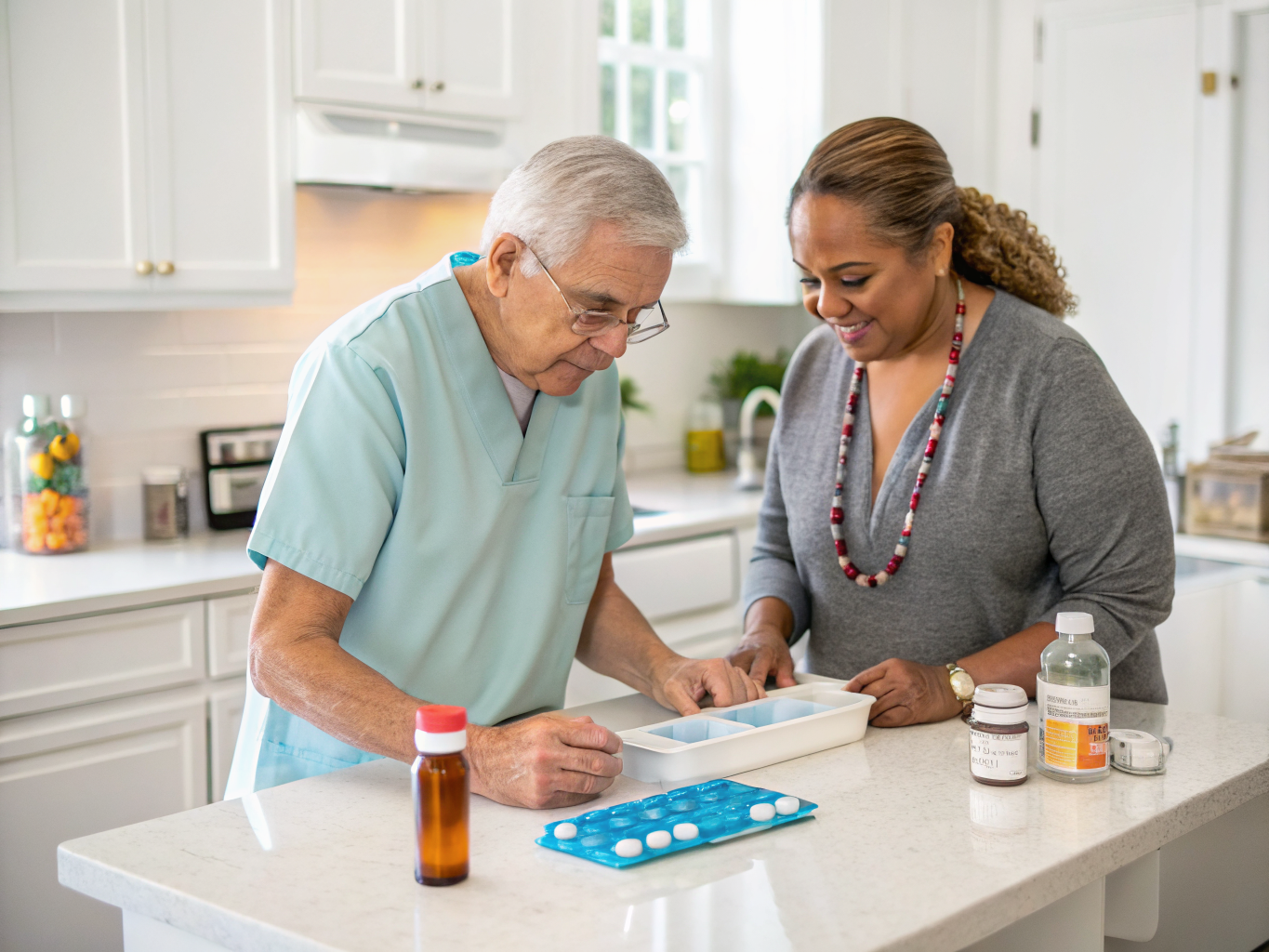
Medication Management for Seniors: Preventing Errors and Interactions

Need Medication Management Help? Call (908) 912-6342
Medication errors are one of the leading preventable causes of senior hospitalizations in the United States, contributing to an estimated 125,000 deaths annually according to the FDA. For older adults managing multiple chronic conditions — and the complex medication regimens they require — the risk of errors, interactions, and adverse events is substantial. This guide provides families and seniors in New Jersey with a comprehensive overview of medication management risks, prevention strategies, the role of home caregivers, and how to coordinate safely with pharmacists and physicians. For professional medication management home care, call (908) 912-6342.
Understanding Polypharmacy: The Core Risk for Seniors
Polypharmacy — the concurrent use of five or more medications — affects an estimated 40% of community-dwelling older adults. For seniors managing conditions such as hypertension, diabetes, heart disease, arthritis, osteoporosis, depression, and dementia, multiple specialist prescribers may each add medications without full visibility into the others’ prescriptions. The result is an increasingly complex medication regimen with exponentially growing risk of drug-drug interactions.
Key facts about polypharmacy in seniors:
- Seniors taking 5+ medications have a 35% increased risk of falls compared to those taking fewer medications
- Anticholinergic medications — among the most commonly prescribed drug classes — are associated with a 54% increased risk of dementia with long-term use, according to research published in JAMA Internal Medicine
- Drug-drug interactions are responsible for approximately 1 in 12 emergency department visits in adults over 65
- The National Institute on Aging recommends a “brown bag review” annually — bringing all medications, vitamins, and supplements to each physician visit for a complete review
Common Medication Errors in Seniors — and How to Prevent Them
Understanding where errors happen is the first step to preventing them:
- Missed doses — The most common error, caused by forgetfulness, complex schedules, or cognitive decline. Solution: pill organizers, automatic pill dispensers, and caregiver medication reminders.
- Double dosing — Taking a second dose after forgetting the first. Solution: pill organizers with clear compartments and daily caregiver oversight.
- Wrong time — Many medications must be taken with food, without food, at specific intervals, or at specific times of day. Solution: written medication schedules and caregiver reminders at prescribed times.
- Drug-drug interactions — Multiple medications interacting to produce unexpected, sometimes dangerous effects. Solution: annual medication reconciliation with physician and pharmacist review.
- OTC interactions — Common over-the-counter drugs (Benadryl, ibuprofen, antacids) can interact dangerously with prescriptions. Solution: inform all prescribers of ALL medications, including OTCs and supplements.
- Incorrect dose — Renal and hepatic function decline with age, changing how medications are metabolized. Standard adult doses may be too high for elderly patients. Solution: geriatric-informed prescribing with regular dose reviews.

Concerned about medication errors? Professional support is available. (908) 912-6342
RN-supervised home care with medication reminders. Private pay and LTCI accepted.
High-Risk Medications for Seniors: The Beers Criteria
The American Geriatrics Society publishes the Beers Criteria — a list of medications that are potentially inappropriate for adults over 65. Families and caregivers should be aware of the most common high-risk categories:
| Drug Category | Common Examples | Primary Risks |
|---|---|---|
| Benzodiazepines | Xanax, Ativan, Valium, Klonopin | Falls, cognitive impairment, dependence |
| Anticholinergics | Benadryl, Ditropan, Elavil | Confusion, constipation, urinary retention, dementia risk |
| NSAIDs | Ibuprofen, Naproxen, Aspirin (high dose) | GI bleeding, kidney injury, fluid retention |
| Anticoagulants | Warfarin (Coumadin), Eliquis | Bleeding, requires close monitoring |
| Diabetes medications | Insulin, Glipizide, Glyburide | Hypoglycemia (low blood sugar), falls |
| Antipsychotics | Seroquel, Risperdal, Abilify | Increased stroke risk, sedation, falls (in dementia patients) |
| Sleep aids | Ambien, Lunesta, over-the-counter sleep aids | Falls, cognitive impairment, delirium |
If your loved one is taking any of these medications, discuss the risks and alternatives with their physician. A clinical pharmacist review can identify opportunities to reduce the medication burden safely.
Medication Reconciliation: Critical at Every Care Transition
Medication errors are 14 times more likely during transitions of care — hospital discharge, transfer between facilities, starting home care, or changing primary physicians. Medication reconciliation is the systematic process of comparing what a patient is currently taking with what they should be taking, identifying and resolving discrepancies before harm occurs.
A complete medication reconciliation list should include:
- All prescription medications — name, dose, frequency, prescribing physician
- All over-the-counter medications — pain relievers, sleep aids, antacids, cold/allergy medications
- All vitamins and supplements — fish oil, vitamin D, calcium, herbal remedies
- Any topical medications, eye drops, or inhalers
The supervising Registered Nurse at 24 HOUR Home Care NJ performs a comprehensive medication reconciliation at the start of every care plan. This list is shared with family members and is available at every caregiver visit. Call (908) 912-6342.
The Home Caregiver’s Role in Medication Safety
In New Jersey, NJ Certified Home Health Aides provide critical support in the area of medication management — though they do not administer medications (which requires nursing licensure). The caregiver’s role includes:
- Daily medication reminders — reminding the senior at the correct times to take their medications
- Pill organizer assistance — helping set up and organize weekly pill boxes at the start of each week
- Self-administration support — handing medications to the senior, opening child-proof caps, pouring liquids
- Observation and reporting — noting any side effects, adverse reactions, or behavioral changes that may indicate a medication problem, and communicating these immediately to the supervising RN
- Pharmacy coordination — transporting or picking up prescriptions, coordinating refills
- Physician appointment accompaniment — accompanying the senior to appointments and providing accurate reports to physicians
Working with Your NJ Pharmacist for Medication Safety
The pharmacist is one of the most underutilized members of the senior care team. NJ pharmacists are authorized to perform comprehensive medication reviews (CMRs) — in-depth consultations that identify interactions, duplications, and therapeutic concerns across all of a patient’s medications. Many NJ pharmacies offer this service at no additional cost. Strategies for working effectively with a pharmacist:
- Use a single pharmacy for all prescriptions so the pharmacist has a complete medication record
- Request a comprehensive medication review annually, or after any hospital discharge
- Ask your pharmacist to check for generic alternatives that may reduce cost without reducing safety
- Bring your complete medication list — including OTCs and supplements — to every pharmacy consultation
- Ask your pharmacist whether any medications on the list appear on the Beers Criteria for older adults
We serve families throughout New Jersey: Union County, Essex County, Morris County, Middlesex County, Bergen County, Somerset County, Monmouth County, Ocean County, Mercer County, Passaic County, and Hunterdon County.
Professional Medication Management Support in NJ
24 HOUR Home Care NJ provides certified caregivers trained in medication reminders and safety monitoring, supervised by a Registered Nurse who conducts medication reconciliation at the start of care.
Frequently Asked Questions: Medication Management for Seniors
What is polypharmacy and why is it dangerous for seniors?
Polypharmacy is defined as the concurrent use of five or more medications, which affects an estimated 40% of older adults in the United States. For seniors, polypharmacy dramatically increases the risk of adverse drug events, falls, cognitive impairment, and hospitalizations. Drug-drug interactions become exponentially more likely as the number of medications increases. The National Institute on Aging and the FDA both identify polypharmacy as a leading preventable cause of senior hospitalizations. For medication management support at home, call (908) 912-6342.
How can a home caregiver help with medication management?
A NJ Certified Home Health Aide from 24 HOUR Home Care NJ provides several critical layers of medication management support: daily medication reminders at prescribed times; assistance with pill organizers and blister packs; monitoring for visible side effects or adverse reactions; transportation to pharmacy for refills; communication with the supervising RN when concerns arise; and coordination with family members and physicians. Caregivers do not administer medications (that requires nursing licensure), but their oversight dramatically reduces errors in self-administration. Call (908) 912-6342.
What are the highest-risk medications for seniors?
The American Geriatrics Society Beers Criteria identifies medications that are potentially inappropriate for older adults. High-risk categories include: benzodiazepines (Xanax, Ativan, Valium) — fall risk, cognitive impairment; anticholinergic drugs (Benadryl, some antidepressants, bladder medications) — confusion, constipation, urinary retention; non-steroidal anti-inflammatory drugs (NSAIDs) — GI bleeding, kidney injury; blood thinners (warfarin) — bleeding risk requiring close monitoring; and diabetes medications (insulin, sulfonylureas) — hypoglycemia risk. Always review all medications with a physician or pharmacist at least annually. Call (908) 912-6342 for medication management home care.
What is medication reconciliation and why does it matter?
Medication reconciliation is the process of creating the most accurate possible list of all medications a patient is taking — including prescriptions, over-the-counter drugs, vitamins, and supplements — and comparing that list to physician orders to identify discrepancies, duplications, and interactions. Medication reconciliation is critically important at care transitions: hospital discharge, starting home care, or changing physicians. Research shows that medication errors are 14 times more likely during care transitions. The supervising RN at 24 HOUR Home Care NJ performs medication reconciliation at the start of every care plan. Call (908) 912-6342.
How do pill organizers help seniors avoid medication errors?
Pill organizers — particularly weekly boxes with AM/PM compartments — provide a simple, highly effective system for seniors managing multiple daily medications. When a compartment is empty, the dose has been taken. If it is full when it shouldn’t be, a dose was missed. More advanced options include automatic pill dispensers (with alarms) and blister pack pre-filled by pharmacies for the highest-risk patients. Home caregivers from 24 HOUR Home Care NJ assist with organizing pill boxes weekly and providing daily reminders — significantly reducing missed doses and double-dosing errors. Call (908) 912-6342.
Can a home health aide give medications to a senior?
In New Jersey, administering medications (placing the medication in a patient’s mouth, for example) requires a licensed nurse. NJ Certified Home Health Aides cannot administer medications. However, HHAs can provide medication reminders (reminding the senior it is time to take their medication), assist with self-administration (handing the pill to the senior, opening child-proof caps), organize pill boxes, and monitor for visible side effects. For seniors who require medication administration assistance beyond reminders, a licensed nurse visit can be arranged. Call (908) 912-6342 to discuss your loved one’s specific needs.