
Feedback Loops in Caregiving — How Small Actions Build Stronger Relationships in NJ Home Care
Home › Care Services › Feedback Loops in Caregiving Relationships
The most effective caregivers are not defined by grand gestures or heroic interventions. They are defined by small, repeated actions that accumulate into something transformative. A warm greeting at the same time each morning. A gentle tone when redirecting confusion. A hand on the shoulder during a moment of frustration. These seemingly minor behaviors create feedback loops — cycles of action and response that gradually reshape the relationship between caregiver and client.
At 24 HOUR Home Care NJ, we train our caregivers to understand and harness these loops because the science is clear: they improve health outcomes, reduce behavioral challenges, and create the emotional safety that makes aging in place sustainable.
What Is a Feedback Loop in Caregiving?
In systems science, a feedback loop occurs when the output of a process becomes the input for its next cycle. In caregiving, this translates to a continuous exchange: the caregiver’s tone, timing, and approach affect the client’s emotional and physiological state, which in turn shapes the caregiver’s next response.
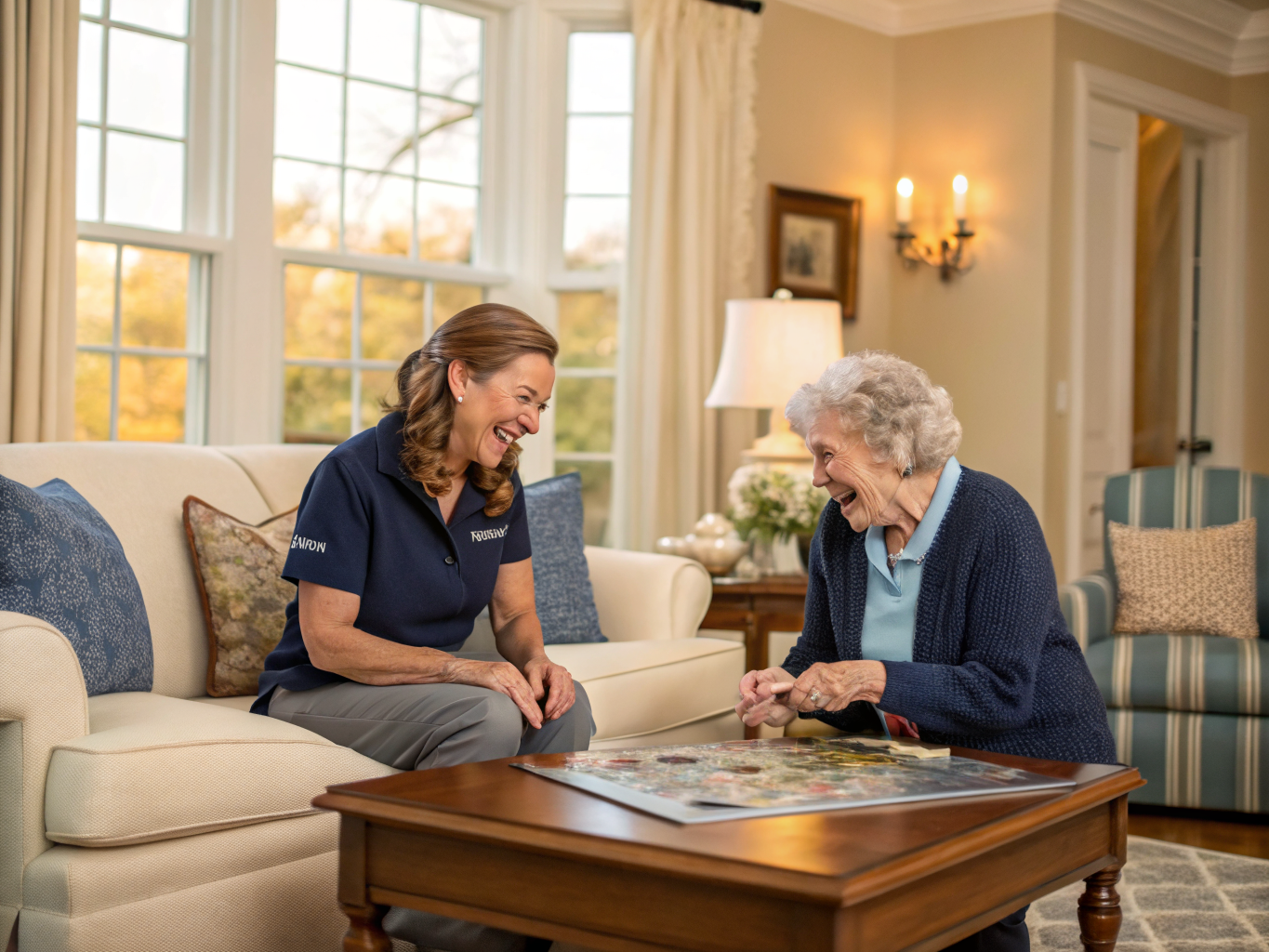
Positive feedback loops in care look like this: A caregiver greets a client with genuine warmth. The client’s nervous system registers safety, producing a slight relaxation of facial muscles and a more receptive posture. The caregiver notices this openness and responds with increased engagement. The client, feeling heard, becomes more communicative. Over days and weeks, this cycle deepens into trust.
Negative feedback loops are equally powerful: A hurried caregiver arrives stressed. The client senses tension through emotional contagion (documented in our article on emotional contagion in caregiving) and becomes guarded or agitated. The caregiver, facing resistance, becomes more task-focused and less warm. The client withdraws further. Over time, care becomes transactional rather than relational.
Research from the National Library of Medicine on interpersonal synchrony confirms that these loops operate at both psychological and physiological levels. Heart rate variability, cortisol production, and even immune function are influenced by the quality of repeated social interactions.
The Neuroscience Behind Relational Caregiving
Mirror Neurons and Empathic Accuracy
The brain’s mirror neuron system fires both when we perform an action and when we observe someone else performing it. In caregiving, this means a caregiver’s calm, deliberate movements literally activate calming neural pathways in the client’s brain. Conversely, rushed or anxious movements trigger the client’s stress response.
Over time, consistent positive mirroring builds what psychologists call empathic accuracy — the caregiver’s ability to correctly identify the client’s emotional state. This is not guesswork; it is a skill that develops through repeated feedback loops. Our article on caregiver empathy and attunement explains how we cultivate this capacity in our team.
Cortisol Regulation Through Consistency
The hypothalamic-pituitary-adrenal (HPA) axis controls the body’s stress response. In older adults, especially those with dementia, the HPA axis becomes dysregulated, producing excessive cortisol that damages the hippocampus and accelerates memory loss. Predictable, warm caregiving interactions help recalibrate this system.
A study cited by the National Institute on Aging found that seniors who received consistent care from familiar providers showed measurably lower cortisol levels than those with rotating, unfamiliar staff. This is a direct, physiological benefit of the feedback loop created by caregiver consistency. Our article on routine and safety in dementia care explores how structured daily patterns reinforce this effect.
Vagal Tone and the Social Engagement System
Stephen Porges’s polyvagal theory explains how the vagus nerve mediates our capacity for social engagement. When an older adult feels safe — when their ventral vagal system is activated by a trusted caregiver’s presence — they are more capable of eye contact, conversation, and emotional expression. When they feel threatened, the dorsal vagal system dominates, producing withdrawal, confusion, and physiological shutdown.
Every interaction between caregiver and client either reinforces ventral vagal activation (safety, connection) or tips toward dorsal vagal withdrawal (fear, disconnection). Positive feedback loops keep the client in the safe zone.
Need 24-Hour Home Care in New Jersey?
Our certified caregivers provide compassionate, around-the-clock support for your loved one — right at home.
Five Practices That Build Positive Feedback Loops
Our caregiver training emphasizes five specific practices that initiate and sustain positive care loops:
1. Observe Before Acting
Before beginning any care task, pause and read the client’s current state. Are they relaxed or tense? Making eye contact or averting their gaze? Leaning forward or pulling away? This two-second observation sets the tone for the entire interaction and prevents the caregiver from imposing an agenda that clashes with the client’s readiness.
2. Use Reflective Language
Instead of correcting a confused statement, reflect the emotion behind it. If a client with Alzheimer’s says, “I need to pick up my children from school,” a trained caregiver responds, “You’re thinking about your children. Tell me about them.” This validates the client’s emotional reality without creating the distress of correction. The Alzheimer’s Association’s communication guidelines support this approach.
3. Offer Choices Within Routines
Autonomy is a fundamental human need that does not disappear with age or cognitive decline. Offering controlled choices — “Would you like the blue shirt or the green one?” “Shall we walk in the garden or sit on the porch?” — activates the prefrontal cortex and maintains the client’s sense of agency. This small act of respect feeds directly into a positive feedback loop.
4. End Each Day With Gratitude
Our caregivers are trained to close each evening with a brief expression of appreciation: “I enjoyed our walk today” or “Thank you for telling me that story about your father.” This final interaction anchors the day in positive emotion, influences sleep quality, and sets the tone for the next morning. Research from the Greater Good Science Center at UC Berkeley confirms that gratitude practices improve both physical and emotional health in caregiving relationships.
5. Monitor Your Own Emotional State
Feedback loops are bidirectional. A caregiver who arrives stressed, tired, or emotionally depleted will transmit that state to the client. We encourage our team to practice brief self-regulation techniques — a deep breath before entering the room, a moment of intentional calm — because their emotional state is the first input in every feedback loop. Our guide on caregiver burnout prevention addresses the systemic supports that make this sustainable.
Feedback Loops Across Different Care Models
| Care Model | Feedback Loop Advantage | Primary Goal |
|---|---|---|
| 24-Hour Care | Consistent team learns patterns; continuous loop without gaps | Safety through rhythm |
| Live-In Care | Deepest individual bond; single caregiver learns every nuance | Emotional anchoring |
| Dementia Care | Repetition-based loops reduce agitation over time | Cognitive preservation |
| Companion Care | Social interaction loops combat isolation | Engagement and joy |
| Overnight Care | Calming presence regulates nighttime nervous system | Sleep protection |
The Family Feedback Loop
Feedback loops do not stop at the caregiver-client relationship. Family members are part of the system. When an adult child sees their parent calm, engaged, and well-cared-for, their own anxiety decreases. This reduced family stress feeds back to the senior, who senses the change. The AARP Caregiving Resource Center documents how family caregiver stress directly impacts the health outcomes of the person receiving care.
We keep families in the loop through regular updates, open communication, and the ability to reach care coordinators at any time. When the family system is healthy, every relationship within it benefits — including the one between caregiver and client. Our article on adjusting to home care guides families through the early stages of building these positive loops.
Start Building Better Care Loops Today
Whether your family needs 24-hour care, live-in support, or companion care, the feedback loops that define the experience begin with the very first interaction. Call (908) 912-6342 or contact us online to schedule a free assessment. We serve families throughout Union, Essex, Middlesex, Somerset, and Morris Counties.
See our reviews from NJ families on Google
Need 24-Hour Home Care in New Jersey?
Our certified caregivers provide compassionate, around-the-clock support for your loved one — right at home.
Frequently Asked Questions
Related reading: 24 Hour Home Care — The Science of Continuous Care.