
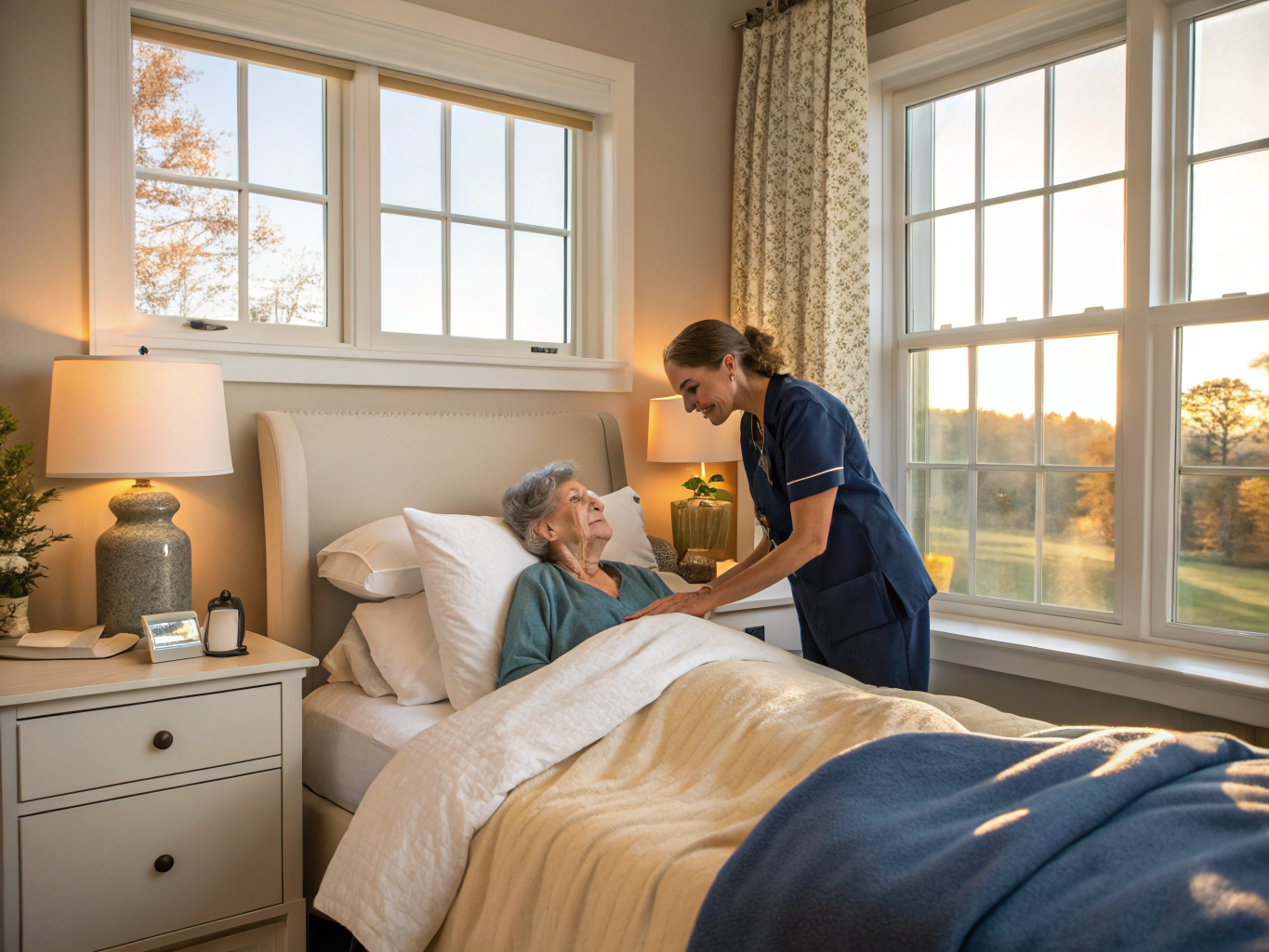

Dementia changes how a person processes time, place, language, and stress. For families, the hardest part often isn’t “forgetting” — it’s the ripple effects: sleep disruption, agitation, confusion, wandering risk, and communication breakdown.
The good news is that day-to-day care can be made calmer and safer with environment design, routine, and communication strategies that are strongly supported in dementia care guidance and evidence reviews.
At 24 HOUR Home Care NJ, we provide dementia home care and Alzheimer’s home care across New Jersey — including 24-hour home care, live-in caregiver support, and overnight care— with an emphasis on stability, respectful communication, and home safety.
What “Research-Informed” Dementia Home Care Actually Means
Quality dementia home care isn’t about “winning an argument with memory.” It’s about reducing stress load and keeping the person emotionally safe.
Across guidelines and evidence-based practice recommendations, the most consistent themes are:
- Person-centered care (care that adapts to the individual’s preferences and history)
- Communication skills (calm tone, simple language, emotional validation)
- Structured activities (especially music and meaningful engagement)
- Home safety modifications (lighting, fall reduction, hazard control)
- Caregiver support/respite (burnout prevention and continuity)
These approaches are repeatedly highlighted in professional dementia care recommendations and research summaries.
The Practical Dementia Home Care Playbook
1) Build a “Predictable Day” (Routine Reduces Stress)
A steady routine supports orientation and can reduce agitation triggers. National caregiving guidance repeatedly emphasizes keeping daily rhythms predictable (meals, bathing, bedtime).
Caregiver action steps
- Keep wake/sleep times consistent
- Use the same order of tasks each day
- Offer choices in small frames (“blue sweater or white sweater?”)
Internal links to place in this section
2) Use “Validation + Redirection” Instead of Correction
When someone insists on something that isn’t accurate, direct correction can escalate distress. Public guidance from NIA and CDC specifically recommends calm communication, patience, and “meeting them where they are.”
Caregiver action steps
- Acknowledge the emotion first (“That sounds scary.”)
- Reassure (“I’m here with you.”)
- Redirect gently (walk to another room, offer tea, switch to a soothing task)
3) Reduce Agitation Triggers With Environment Design
Agitation often has triggers: noise, clutter, shadows, confusing mirrors, rushed interactions. NIA guidance recommends reducing noise/clutter, maintaining comfort, using natural light, and protecting routine.
Home adjustments that matter
- Bright, even lighting; night lights in hallways
- Clear pathways; remove loose rugs and clutter
- Visual cues (simple labels, contrasting colors)
- Safe storage for hazardous items
NIA provides detailed home-safety strategies families can implement quickly.
4) Activities That Work (Not “Busywork”)
A large evidence base shows that structured activities — including music therapy by protocol and person-centered engagement — can reduce agitation in dementia care settings.
Caregiver action steps
- Use familiar music playlists (same 10–20 songs)
- Short “success loops” (fold towels, sort photos, water plants)
- Movement micro-rituals (5-minute walk, light stretching with supervision)
5) Why Communication Training Is a Big Deal
One of the clearest findings in major reviews is that person-centred care + communication skills training is associated with reduced agitation (including sustained improvements).
That’s why high-quality home care isn’t only about “coverage hours.” It’s about caregiver presence, pacing, and skill.
6) Caregiver Burnout Is a Care Quality Issue
If the family caregiver is depleted, everyone suffers — including the person living with dementia. NIA describes respite care as short-term relief that can happen at home or in other settings, supporting caregiver stability.
Caregiver action steps
- Schedule predictable respite windows
- Rotate responsibilities (even if small)
- Use professional support earlier (not only at crisis point)
Other services
- Respite / Short-Term Home Care
- Overnight Care
- Live-In Caregiver
When Dementia Home Care Becomes Essential
Professional in-home support is often needed when families notice:
- Nighttime restlessness or “sundowning” patterns
- Wandering risk or repeated exit-seeking
- Unsafe cooking/forgetting appliances
- Increased falls risk
- Escalating caregiver exhaustion
CDC caregiving guidance highlights the importance of routine, meeting the person where they are, and discussing behavioral changes with a clinician when needed.
Similar Articles
 |
|
|
 |
|
|
 |
|
|
Frequently Asked Questions
Is dementia home care medical?
No. Dementia home care from 24 HOUR Home Care NJ is non-medical support, focused on daily routines, safety, supervision, companionship, and communication.
Do you provide 24-hour dementia home care?
Yes. We offer 24-hour home care, live-in caregivers, and overnight dementia care across New Jersey.
What if behaviors suddenly change?
Sudden changes can sometimes be related to discomfort, environment, or other factors. Public health guidance recommends discussing significant behavior changes with a clinician.
Can care start part-time and expand later?
Absolutely. Many families start with a few shifts per week and evolve into long-term care or 24-hour supervision as needs change.
External Authority Links You Can Keep in Every Dementia Article
These are high-trust, research-based resources (good for Google credibility and reader trust):
- National Institute on Aging: Agitation, aggression, sundowning strategies
- National Institute on Aging: Home safety tips for dementia caregiving
- CDC: Helping dementia caregivers (routine, communication, “meet them where they are”)
- Alzheimer’s Association: Dementia Care Practice Recommendations
Contact 24 HOUR Home Care NJ
If you need dementia home care, Alzheimer’s home care, 24-hour home care, a live-in caregiver, or overnight care in New Jersey, we’re here to help you build a calmer, safer plan.
📞 Call or Text 24 HOUR Home Care NJ: +1 (908) 912-6342
Call Now | Text Us
📍 Find us on Google
Frequently Asked Questions
Get Started Today
If your family needs compassionate, professional home care in New Jersey, 24 HOUR Home Care NJ is here to help. Call (908) 912-6342 for a free consultation, or request a callback online.
Leave a Reply