
A Day in the Life of a Home Health Aide in New Jersey

What does it actually look like to be a home health aide in New Jersey? Beyond the job description and the salary numbers, there is a rich, deeply human reality to this work — mornings that require both technical skill and emotional intelligence, afternoons that test your creativity and patience, and evenings that leave you with a profound sense of purpose. This article follows a composite day in the life of a 24 HOUR Home Care NJ home health aide across three different client scenarios: a client with dementia, a post-surgery recovery client, and a companion care client. Whether you are considering a career in home care or you are a family trying to understand what your loved one’s aide experiences each day, this is for you. Ready to join our team? Visit our careers page or call (908) 912-6342.
6:30 AM — Arrival and Morning Routine
Maria arrives at her first client’s home in Union County at 6:30 AM. She is a Certified Home Health Aide with four years of experience and three clients today — a morning shift, an afternoon shift, and an evening companion visit. Before she touches a doorknob, she is already in professional mode: reviewing the care notes on her phone from the previous aide’s shift, noting that her morning client, a 78-year-old woman with moderate Alzheimer’s, had a restless night.
She rings the bell — never walks in unannounced — and greets her client with a warm smile and a familiar phrase she has learned brings comfort: “Good morning, Mrs. R., the roses in your garden are beautiful today.” The cognitive science is behind this: consistent, familiar greetings create predictable anchors for clients with dementia, reducing morning confusion and the anxiety that comes with it. According to the National Institute on Aging, establishing morning routines is one of the most effective strategies for managing dementia-related agitation.
The morning routine for a dementia client takes 45–75 minutes and includes:
- Safe ambulation to the bathroom: Walking beside the client, one hand lightly on her elbow, watching for unsteady steps
- Morning hygiene: Assisting with washing, brushing teeth, and hair — following the exact same sequence every morning to preserve the client’s sense of familiarity
- Dressing: Laying out two outfit options — never more, as too many choices overwhelm — and allowing the client to choose, preserving her dignity and autonomy
- Medication administration: Reviewing the MAR (medication administration record), preparing the morning medications, and observing the client take each one
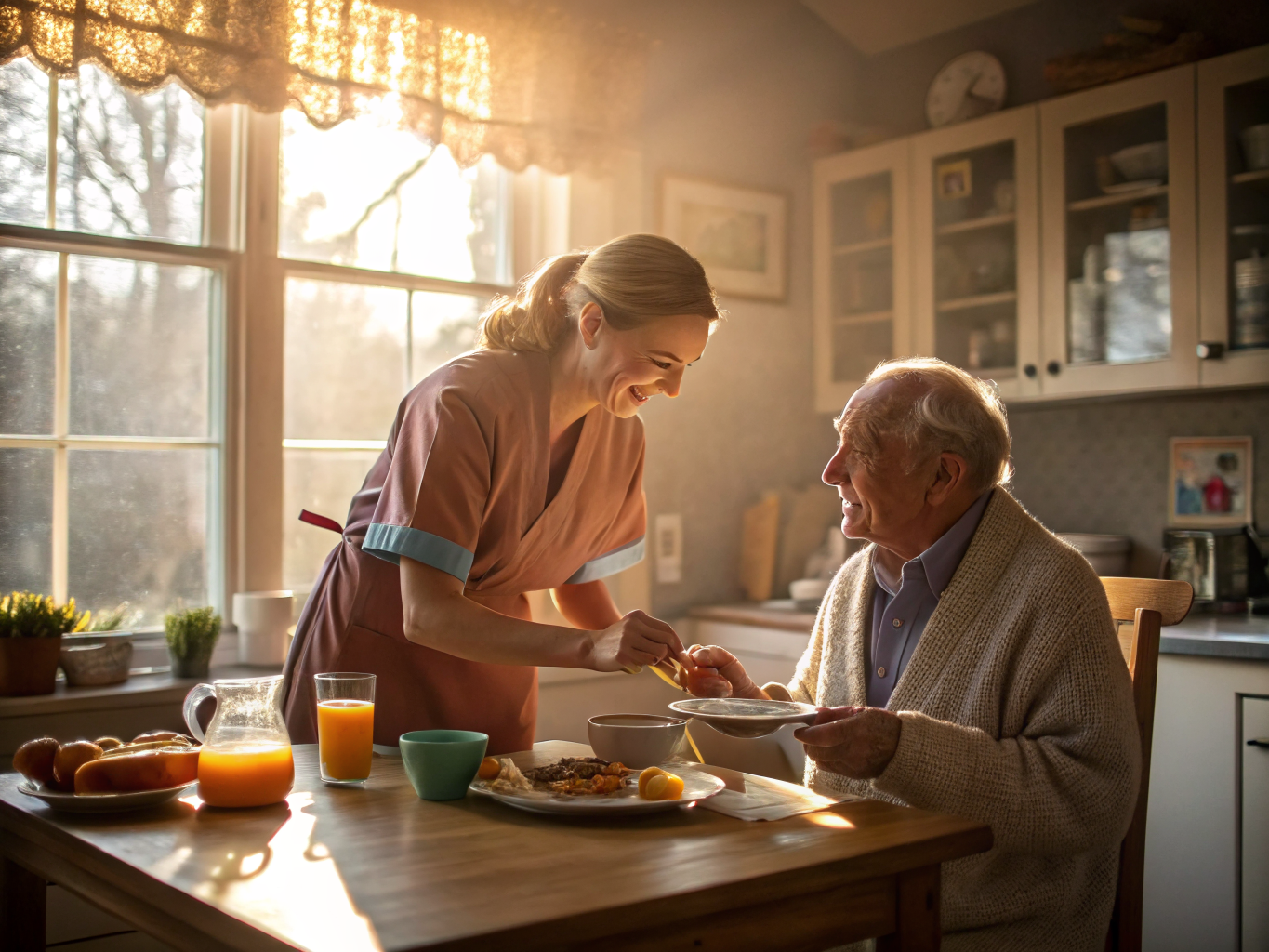
- Breakfast: Scrambled eggs, toast cut into four pieces (easier to manage), orange juice, and decaf coffee — the same breakfast every day
9:00 AM — Cognitive Engagement and Household Tasks
After breakfast, Maria and her client work through a 30-minute memory activity — a scrapbook filled with family photos that Maria helped assemble in her first week with this client. This is not just entertainment: structured cognitive engagement is one of the most evidence-based interventions available for slowing cognitive decline. The NIA and the AARP both highlight cognitive stimulation as a key component of quality dementia care at home.
While her client rests in her recliner, Maria completes the household tasks that keep the home safe and comfortable: dishes, light tidying, wiping counters, checking the bathroom floor for slip hazards, restocking medications, and noting low supplies to report to the family. Every observation is documented in the care log — not because Maria is required to, but because she understands that the notes she leaves today will help tomorrow’s aide provide seamless, informed care.
1:00 PM — Post-Surgery Client: Recovery and Rehabilitation Support
Maria’s afternoon client, a 71-year-old retired teacher named James, is six days post-knee replacement surgery. He was discharged from the hospital two days ago and is in the critical early recovery window — mobile enough to want to push himself, but at real risk of falls, infections, and setbacks if he pushes too hard.
Maria’s role with James is different from her morning dementia work. He is cognitively sharp, motivated, and occasionally impatient with limitations. Her job is to support his recovery without enabling overexertion:
- Wound site monitoring: Observing the surgical site for signs of infection (redness, swelling, warmth, discharge) and reporting any concerns to the supervising RN immediately
- Assisted ambulation: Accompanying James with his walker for prescribed walking intervals — he is supposed to walk 10 minutes every 2 hours; Maria makes sure he does exactly that, no more, no less
- Ice and elevation protocols: Applying ice packs to the knee per the physician’s post-op instructions, ensuring proper elevation during rest periods
- Medication management: Pain medication on schedule — not when pain spikes — because proper pain management is critical for rehabilitation compliance
- Nutrition and hydration: Preparing a high-protein lunch (essential for surgical recovery), monitoring fluid intake, and noting any appetite concerns
- Morale: James gets frustrated. Maria listens. She shares that one of her previous post-surgery clients was back on the golf course in 8 weeks. It is true. And it helps.

5:00 PM — Companion Care: The Power of Presence
Maria’s final visit of the day is to Eleanor, an 84-year-old widow in Essex County who lives independently in the same house she shared with her husband for 52 years. Eleanor has no major medical needs — her blood pressure is well-managed, she is mobile and sharp, and her adult daughter in Florida checks in by phone every evening. What Eleanor has is loneliness.
Research from the AARP consistently shows that social isolation is one of the most serious health threats facing older Americans — linked to a 50% increased risk of dementia and a 29% increased risk of heart disease. Eleanor’s evening companion visit is not a luxury. It is healthcare.
The visit includes:
- Preparing and sharing dinner together — Eleanor loves to talk through recipes, and Maria has learned to ask her about them
- A walk around the block, weather permitting — Eleanor uses a cane but walks confidently with Maria beside her
- An evening game of cards and a crossword puzzle — Eleanor is competitive and gleeful about winning
- Setting out tomorrow’s medications
- A final check that doors are locked, stove is off, and phone is charged before Maria says good night
Eleanor waves from the window. Maria waves back. This is the part of the job that no job description fully captures.
The Emotional Rewards — and the Challenges
Home health aides in New Jersey consistently report the deepest professional satisfaction of any healthcare role — because the work is intensely personal, directly impactful, and conducted in the most human of settings: someone’s home. But the rewards come alongside real challenges:
- Emotional attachment: The bonds you form with clients are real. When a client declines, or passes away, the grief is real too. At 24 HOUR Home Care NJ, our RN supervisors provide ongoing emotional support and team check-ins to help aides process these experiences.
- Physical demands: Transfers, ambulation assistance, and standing for extended periods require physical stamina and proper body mechanics. Training covers safe techniques and injury prevention.
- Dementia-specific challenges: Caring for a client with dementia requires a different cognitive toolkit — patience, creativity, and the ability to remain calm during moments of confusion or agitation. We offer specialty dementia care training for interested aides.
What Families Should Know About Your Loved One’s HHA
If a home health aide is caring for someone you love, here is what we want you to know:
- Your aide has completed 76 hours of approved NJ training, passed a state competency exam, and undergone a thorough background check. They are a licensed professional.
- Your aide is supervised by a Registered Nurse who reviews care plans, visits periodically, and is available for consultation.
- The notes your aide documents each visit are a professional medical record — a communication tool that ensures continuity of care across shifts and providers.
- Your aide cares deeply about your loved one. The professional distance is always maintained — but the human connection is real.
To learn more about what a home health aide does — or to join our team — visit our careers page, HHA jobs, or call (908) 912-6342 today.
Frequently Asked Questions: Home Health Aide Daily Life in NJ
What does a home health aide do every day?
A home health aide’s daily routine depends on the client’s needs and care plan. A typical day may include: arriving and reviewing any changes in the care plan; assisting with morning hygiene (bathing, dressing, grooming); preparing and serving breakfast; administering medication reminders; engaging the client in cognitive activities or conversation; accompanying the client to appointments or running errands; preparing lunch and dinner; light housekeeping; monitoring the client’s condition; and documenting observations for the supervising RN. See our HHA careers page for current openings.
What is the hardest part of being a home health aide?
Many home health aides identify emotional attachment as one of the most challenging aspects of the role — forming deep bonds with clients and then experiencing the grief of decline or loss. Physical demands (transferring, lifting, standing for long periods) can also be taxing. Administrative demands — documentation, care plan adherence — require attention to detail. At 24 HOUR Home Care NJ, our RN supervisors provide ongoing support, regular check-ins, and a team environment that helps aides navigate these challenges. Call (908) 912-6342 to learn about our supportive work culture.
What is the most rewarding thing about being a home health aide?
Home health aides consistently cite the deep personal connections they form with clients and families as the most rewarding aspect of the role. Helping a senior with dementia have a calm, dignified day; supporting a post-surgery patient’s recovery; or simply being the consistent human presence that prevents loneliness — these are experiences that few other careers can provide. According to the AARP, caregivers also report high levels of personal meaning and life satisfaction.
What do home health aides need to know about working with dementia patients?
Caring for clients with dementia requires patience, flexibility, and specialized knowledge. Key skills include: maintaining a calm, predictable routine; using simple, clear language; redirecting rather than correcting confused behavior; managing sundowning (increased confusion and agitation in the afternoon/evening); preventing wandering; and supporting family communication. 24 HOUR Home Care NJ offers specialty dementia care training and positions. See dementia care jobs for current openings.
Is being a home health aide a physically demanding job?
Yes, to a moderate degree. Home health aides regularly assist with patient transfers (helping clients move from bed to chair, chair to bathroom), ambulation, bathing, and repositioning — all of which require physical strength and proper body mechanics. Training covers safe lifting and transfer techniques to minimize injury risk. Aides working with post-surgery or mobility-impaired clients may find the physical demands higher. At 24 HOUR Home Care NJ, we match aides with clients based on physical compatibility and provide ongoing guidance from our RN supervisors.
What should families know about their home health aide?
Families should know that a home health aide is a trained, licensed professional — not just a babysitter or companion. Your aide has completed 76 hours of approved NJ training, passed a state competency exam, undergone a thorough background check, and is supervised by a Registered Nurse. At 24 HOUR Home Care NJ, we encourage families to communicate openly with their assigned aide and with our RN supervisor. We welcome questions, feedback, and requests for schedule adjustments. Call (908) 912-6342 to discuss your family’s needs.